Maximo, St. Petersburg
Updated · 1,039 residents
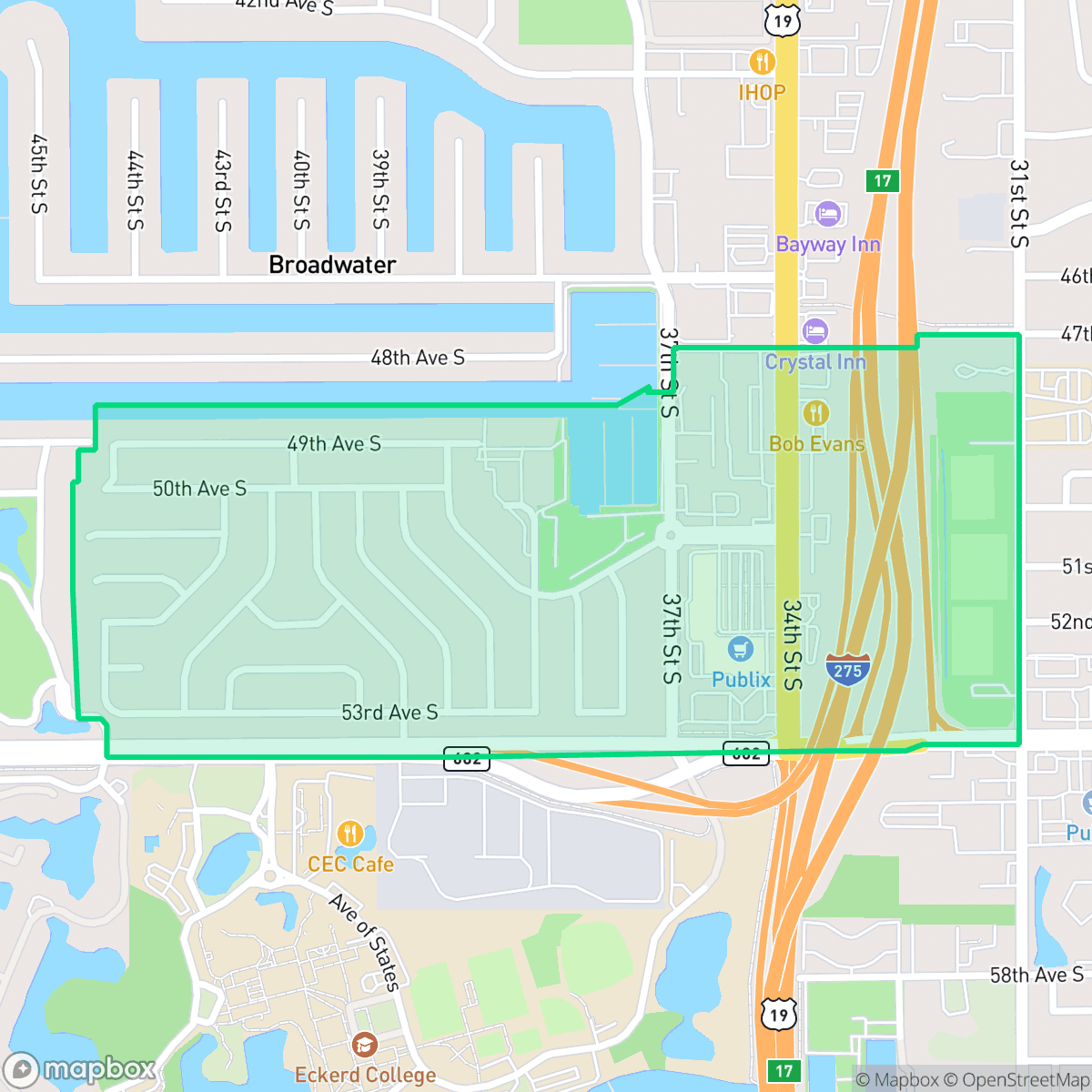
Maximo is a coastal community defined by its maritime heritage and direct access to Boca Ciega Bay. The area offers a generally walkable environment with a distinct, upscale aesthetic characterized by spacious waterfront properties and mid-century charm.
Key Highlights
About Maximo
The Maximo neighborhood in South St. Petersburg takes its name from Antonio Maximo Hernandez, a 19th-century fisherman and the first recorded settler on the Pinellas peninsula. The area is rich in archaeological significance, featuring protected shell middens and Indian mounds that date back thousands of years, particularly within the 40-acre Maximo Park. The modern residential neighborhood and the iconic Maximo Marina were developed in the late 1950s by Babe Wolosoff. To create the land for this development, extensive dredging was performed, which also established what was once dubbed the world's largest covered marina. Today, the neighborhood remains defined by its maritime heritage, its strategic location near the mouth of Boca Ciega Bay, and its proximity to the Sunshine Skyway Bridge, blending historical archaeological sites with mid-century residential growth.
The neighborhood features a semi-rural atmosphere with scattered woodland and open spaces that contrast with the denser suburban pockets found elsewhere in St. Petersburg. The visual landscape is notably polished, showcasing large homes with private docks and expansive driveways that contribute to a more spacious residential feel. Residents benefit from a balanced demographic mix and high levels of health insurance coverage, creating a stable environment for a variety of households.
Living in this area involves certain trade-offs, particularly regarding environmental factors. The region is situated within a designated floodplain, which results in an elevated risk of inundation compared to the city average. Additionally, the neighborhood experiences a consistent level of ambient noise from local traffic, and the presence of light industrial and utility facilities creates a mixed-use environment. According to iHuus data, residents should also be aware of localized air quality challenges, though the area remains a desirable choice for those who prioritize waterfront access and a more open, walkable residential setting.
Neighborhood Scores Across 15 Qualities
Residential spacing provides a moderate level of privacy, offering more buffer between neighbors than the St. Petersburg average. Some areas feature closely packed homes situated on narrow canal lots.
Sidewalks and safe crossings are available throughout much of the area, making it more walkable than the St. Petersburg average. While residential cul-de-sacs offer safe routes for pedestrians, a lack of visible sidewalks near certain canals can limit overall connectivity.
Large homes, private pools, and waterfront amenities contribute to a visual landscape that is more polished than the St. Petersburg average. According to iHuus data, the area features notable property depth with expansive driveways and frequent dock installations.
Accessible paths and connected green spaces offer better walking opportunities for pets than the St. Petersburg average; however, dense lot coverage and man-made canals can limit access to open public parks in certain parts of the neighborhood.
Open land and scattered woodland are common throughout the area, providing a slightly more rural character than the St. Petersburg average. Some sections feature dense suburban development characterized by uniform housing tracts and canal infrastructure.
Activity levels are higher than the St. Petersburg average, driven by a diverse mix of dining hubs and transit-oriented pockets alongside quieter residential streets. According to iHuus data, residents can find varying degrees of vibrancy ranging from bustling commercial nodes near local colleges to subdued coastal stretches.
Local traffic from nearby busy streets creates a consistent level of ambient noise. This acoustic profile is slightly more active than the average for St. Petersburg.
Frequent periods of unhealthy air quality pose significant risks to sensitive groups in this area. According to iHuus data, these conditions are slightly worse than the city average.
Light commercial and utility facilities exist alongside residential areas, resulting in a higher presence of industrial-style zoning than is typically seen across St. Petersburg. While heavy industry is largely absent from key pockets, some sectors contain active commercial traffic or utility sites.
Health insurance accessibility among residents is notably higher than the St. Petersburg average, according to iHuus data.
Political leanings in Maximo skew more liberal than the St. Petersburg average, with a clear majority of residents identifying with liberal values.
Residents experience a balanced mix of young adults, families, and older populations. According to iHuus data, this demographic spread is slightly more varied than the average found across St. Petersburg.
Frequent flooding concerns exist because this area sits within a designated floodplain. According to iHuus data, the risk of inundation in Maximo is higher than the average for St. Petersburg.
Address-Level Insights for Maximo


iHuus Neighborhood Intelligence Insights
Get address-level neighborhood insights for Maximo
- Street-level scores — see how individual blocks compare, not just neighborhood averages
- Micro-zone boundaries — identify quiet pockets, flood boundaries, and walkable clusters before you visit
- 15 dimensions in full — walkability, noise, air quality, school quality, insurance coverage, population age profile, urban/rural index, and more
- Boundary risk alerts — know if your address sits near a block boundary where scores drop, the kind of detail no listing will ever mention
- School insights — individual school ratings and insights, not just district-level data
- Compare before you commit — side-by-side data across neighborhoods, down to block precision
No credit card required
Compare with Any Neighborhood
| Dimension | Maximo | Albert Whitted Airport |
|---|---|---|
| 🚶 Walkabilityavg 6.61 | ||
| 🔊 Acoustic Comfortavg 3.78 | ||
| 🤫 Privacy Indexavg 5.45 | ||
| 🎨 Visual Appealavg 6.33 | ||
| 🐕 Dog Friendlinessavg 5.45 | ||
| 🗺️ Urban-Rural Indexavg 6.19 | ||
| ✨ Neighborhood Vibeavg 3.5 | ||
| 🏥 Health Insurance Coverageavg 6.88 | ||
| 🌿 Air Qualityavg 1.87 | ||
| 🏭 Industrial Proximityavg 7.55 | ||
| 🌊 Flood Safetyavg 4.61 | ||
| 🗳️ Ideological Leanavg 6.01 | ||
| 👥 Population Age Profileavg 5.11 | ||
| 🔥 Fire Safety | ||
| 🏫 School Quality |
Maximo Rankings
School Districts Serving Maximo
School Insights for Maximo
Below average outcomes; significant attendance and academic challenges.
School Insights
See what's really behind every school rating near Maximo
- Individual school ratings — each school's own score with outcome context, not just a district average
- Enrollment & class size data — student-to-teacher ratio and how it compares to the state average
- Full demographics breakdown — ethnicity and gender composition for every school in the enrollment zone
- Every school in the district — all schools within the enrollment boundary ranked by rating, not just the closest one
- Grade levels & benchmarks — elementary through high school, with below/above state-average flags
No credit card required