Magnolia Heights, St. Petersburg
Updated · 1,350 residents
Magnolia Heights is a historic, residential enclave defined by its 1920s bungalow architecture and tree-lined streets. Residents enjoy a highly walkable environment with a quiet, semi-rural feel that remains free from industrial activity.
Key Highlights
About Magnolia Heights
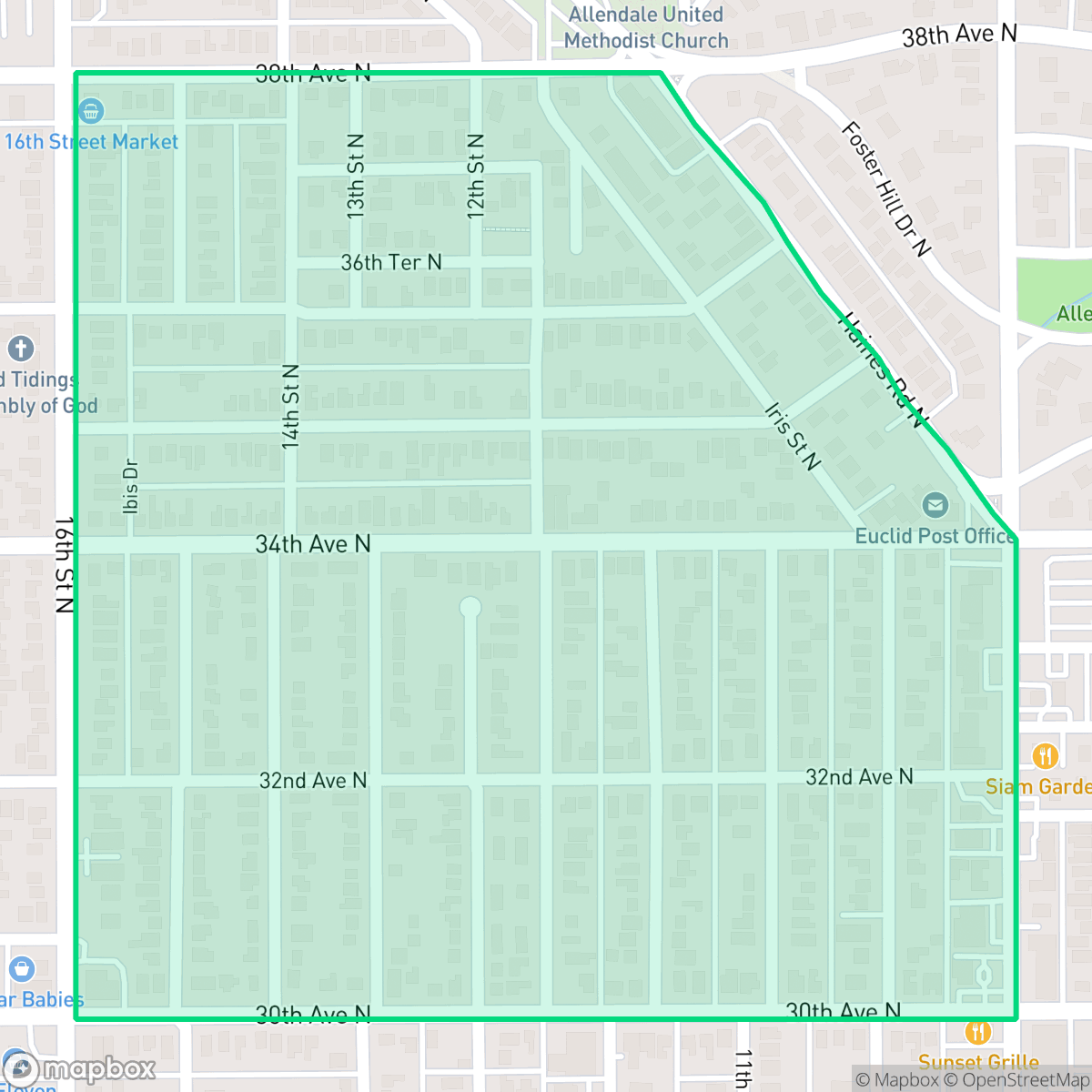
Magnolia Heights is a residential neighborhood in St. Petersburg, Florida, primarily developed during the 1920s land boom. It is characterized by its distinct collection of 1920s-style bungalow homes, which contribute to the area's enduring architectural identity. Situated between 30th and 38th Avenues North and bounded by 16th Street North and Martin Luther King Jr. Street North, the neighborhood is recognized for its quiet, tree-lined streets and preserved residential scale. The community maintains its character through the active Magnolia Heights Neighborhood Association, which fosters local engagement and preserves the area's historic residential atmosphere. Unlike more commercialized sections of the city, Magnolia Heights remains a focused enclave that retains much of the original aesthetic and layout from its founding era.
The area offers a polished visual environment, characterized by well-maintained properties and a sense of privacy that exceeds much of the city. While the neighborhood maintains a steady, mixed-use rhythm, its layout provides a distinct separation from the busier urban core. Residents benefit from being part of the Pinellas County School District, which is known for its academic stability and strong local financial support, even as the district navigates shifts in student enrollment and campus consolidation. According to iHuus data, the neighborhood maintains a consistent, navigable grid that supports a pedestrian-friendly lifestyle.
Prospective residents should note that while the area offers a peaceful atmosphere, it occasionally experiences challenges with air quality and limited public green space for pets. The demographic mix is diverse, attracting a variety of age groups to its quiet, grid-based streets. It is an ideal location for those prioritizing architectural charm and walkability while seeking a residential enclave that avoids the noise and congestion of heavy industrial zones.
Neighborhood Scores Across 15 Qualities
Homes feature a varied layout with some properties sitting close together and others benefiting from large, wooded buffers. This level of density provides slightly more separation between neighbors than the St. Petersburg average.
Pedestrians benefit from a consistent sidewalk network and a navigable grid system that is notably more walkable than the St. Petersburg average. Most residential streets offer safe crossings, although some high-traffic arterial roads may be less comfortable for walking.
Well-maintained properties and large homes with private pools provide a visual environment that is slightly more polished than the St. Petersburg average. According to iHuus data, the presence of upscale amenities contributes to an overall pleasing streetscape.
Private yards and shaded sidewalk paths provide some walking options, but public green space for exercise is below the St. Petersburg average. According to iHuus data, narrow verges and dense residential lots offer few accessible areas for off-leash activity.
Spacious plots and mature tree cover create a more open, suburban atmosphere than the typical St. Petersburg urban core. This area features a mix of single-family homes and low-density greenery that is slightly more dispersed than the city average.
A blend of residential streets and commercial pockets provides a more active environment than the typical St. Petersburg area. While some sections are subdued, others feature a walkable mix of dining, nightlife, and local parks.
A steady hum of local traffic originates from nearby busy streets, though the acoustic environment remains notably quieter than much of St. Petersburg.
Frequent unhealthy air quality levels pose a significant risk to sensitive groups. According to iHuus data, these conditions are slightly worse than the St. Petersburg average.
Industrial activity and hazardous facilities are absent from this area, offering a cleaner environment than the St. Petersburg average. According to iHuus data, land use is limited to residential and light commercial zones with no detected heavy industry.
Health insurance enrollment among residents is slightly above the St. Petersburg average, according to iHuus data.
Political leanings in this area trend more liberal than the St. Petersburg average, according to iHuus data.
Residents live alongside a balanced variety of young adults, families, and seniors. This demographic spread is slightly more varied than the average seen across St. Petersburg.
Flood risk in this area is significantly lower than the St. Petersburg average, though some residual risk remains as portions of the neighborhood sit within a 500-year floodplain according to iHuus data.
Address-Level Insights for Magnolia Heights


iHuus Neighborhood Intelligence Insights
Get address-level neighborhood insights for Magnolia Heights
- Street-level scores — see how individual blocks compare, not just neighborhood averages
- Micro-zone boundaries — identify quiet pockets, flood boundaries, and walkable clusters before you visit
- 15 dimensions in full — walkability, noise, air quality, school quality, insurance coverage, population age profile, urban/rural index, and more
- Boundary risk alerts — know if your address sits near a block boundary where scores drop, the kind of detail no listing will ever mention
- School insights — individual school ratings and insights, not just district-level data
- Compare before you commit — side-by-side data across neighborhoods, down to block precision
No credit card required
Compare with Any Neighborhood
| Dimension | Magnolia Heights | Albert Whitted Airport |
|---|---|---|
| 🚶 Walkabilityavg 6.61 | ||
| 🔊 Acoustic Comfortavg 3.78 | ||
| 🤫 Privacy Indexavg 5.45 | ||
| 🎨 Visual Appealavg 6.33 | ||
| 🐕 Dog Friendlinessavg 5.45 | ||
| 🗺️ Urban-Rural Indexavg 6.19 | ||
| ✨ Neighborhood Vibeavg 3.5 | ||
| 🏥 Health Insurance Coverageavg 6.88 | ||
| 🌿 Air Qualityavg 1.87 | ||
| 🏭 Industrial Proximityavg 7.55 | ||
| 🌊 Flood Safetyavg 4.61 | ||
| 🗳️ Ideological Leanavg 6.01 | ||
| 👥 Population Age Profileavg 5.11 | ||
| 🔥 Fire Safety | ||
| 🏫 School Quality |
Magnolia Heights Rankings
School Districts Serving Magnolia Heights
School Insights for Magnolia Heights
Below average outcomes; significant attendance and academic challenges.
School Insights
See what's really behind every school rating near Magnolia Heights
- Individual school ratings — each school's own score with outcome context, not just a district average
- Enrollment & class size data — student-to-teacher ratio and how it compares to the state average
- Full demographics breakdown — ethnicity and gender composition for every school in the enrollment zone
- Every school in the district — all schools within the enrollment boundary ranked by rating, not just the closest one
- Grade levels & benchmarks — elementary through high school, with below/above state-average flags
No credit card required