Lakewood, St. Petersburg
Updated · 4,121 residents
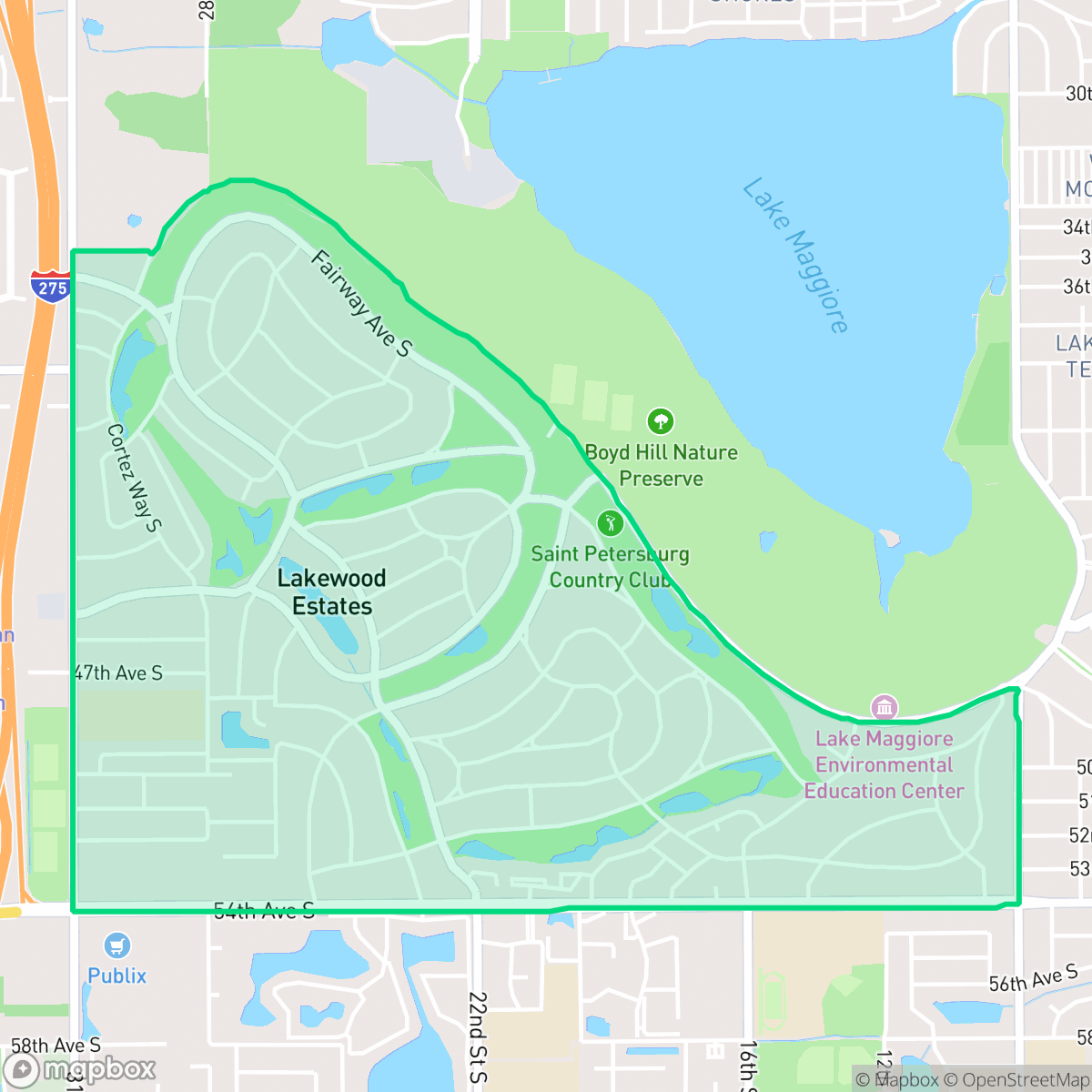
Lakewood is characterized by its historic architecture and winding streets centered around the St. Petersburg Country Club. The area maintains a semi-rural aesthetic with reliable pedestrian access and abundant green space for residents and their pets.
Key Highlights
About Lakewood
Lakewood, specifically the Lakewood Estates area, was developed during the 1920s Florida land boom. Originally owned by Gross and Kreamer and later developed by Charles R. Hall, the neighborhood was designed around the Lakewood Country Club—now the St. Petersburg Country Club—which has hosted the longest-running amateur golf tournament in the United States since 1927. The area features winding streets named after Spanish explorers and cities, with a housing stock reflecting 1920s styles including Mediterranean Revival, cottages, and later ranch-style homes. Originally heavily wooded with streams and ponds, the land was cleared and drained to accommodate residential growth. Since the mid-1960s, Lakewood has been recognized for its successful history of racial integration, serving as a notable example of a community bridging social divides.
The neighborhood functions as a quiet residential enclave that balances suburban convenience with a semi-rural feel. Residents enjoy well-maintained properties and significant greenery, which contributes to an upscale visual appeal. The streets are generally peaceful, though the area remains functional rather than lively, with limited commercial activity within its immediate borders.
Prospective residents should consider that the area experiences moderate traffic noise and occasional air quality concerns common to the broader region. While the neighborhood offers excellent opportunities for walking and pet exercise, it also carries a moderate risk for flooding. The community maintains a diverse age demographic and a strongly liberal political orientation. Families are served by the Pinellas County School District, which is recognized for academic stability despite ongoing efforts to manage enrollment shifts through facility consolidation.
Neighborhood Scores Across 15 Qualities
Housing arrangements vary between detached homes with private yards and denser apartment clusters. According to iHuus data, this level of privacy and spacing is slightly higher than the St. Petersburg average.
Interconnected sidewalk networks and low-traffic residential streets offer safer walking conditions than the St. Petersburg average. Most interior areas provide easy movement for pedestrians, although some perimeter roads experience higher traffic volumes.
Large homes and well-maintained golf course frontage contribute to a visual landscape that is more upscale than the St. Petersburg average. According to iHuus data, the area features a mix of private pools and manicured greenery alongside standard suburban housing.
Extensive green corridors, golf course peripheries, and connected lakefront paths provide ample walking space for pets. According to iHuus data, these continuous sidewalks and grassy fields offer significantly more room for dog walking than the St. Petersburg average.
Open land and wooded patches are more prevalent here than in the rest of St. Petersburg. Residents will find a landscape characterized by scattered homes and natural greenery compared to the denser urban core.
Activity levels are slightly below the St. Petersburg average, as much of the area consists of calm, residential streets with sparse commercial activity. While certain pockets near transit hubs offer dining options, most parts of the neighborhood remain subdued and focused on suburban living.
Steady traffic sounds from nearby busy streets are present, though the acoustic levels remain slightly higher than the St. Petersburg average according to iHuus data.
Frequent unhealthy air quality levels pose a significant risk to sensitive groups. This area experiences similar degradation in air quality compared to the rest of St. Petersburg.
Primarily residential with very little heavy industry, this area offers a peaceful environment similar to the broader St. Petersburg average. While most streets are quiet, some localized areas near storage facilities experience increased freight traffic and loading activity.
Health insurance access among residents in Lakewood is lower than the St. Petersburg average, according to iHuus data.
Voting patterns and census indicators show a significantly more liberal leaning than the St. Petersburg average, according to iHuus data.
Residents experience a diverse age range comprising young adults, families, and seniors. According to iHuus data, this distribution represents a more varied demographic spread than the St. Petersburg average.
Flood risk levels in Lakewood are higher than the St. Petersburg average, though official FEMA studies for this specific area remain incomplete.
Address-Level Insights for Lakewood


iHuus Neighborhood Intelligence Insights
Get address-level neighborhood insights for Lakewood
- Street-level scores — see how individual blocks compare, not just neighborhood averages
- Micro-zone boundaries — identify quiet pockets, flood boundaries, and walkable clusters before you visit
- 15 dimensions in full — walkability, noise, air quality, school quality, insurance coverage, population age profile, urban/rural index, and more
- Boundary risk alerts — know if your address sits near a block boundary where scores drop, the kind of detail no listing will ever mention
- School insights — individual school ratings and insights, not just district-level data
- Compare before you commit — side-by-side data across neighborhoods, down to block precision
No credit card required
Compare with Any Neighborhood
| Dimension | Lakewood | Albert Whitted Airport |
|---|---|---|
| 🚶 Walkabilityavg 6.61 | ||
| 🔊 Acoustic Comfortavg 3.78 | ||
| 🤫 Privacy Indexavg 5.45 | ||
| 🎨 Visual Appealavg 6.33 | ||
| 🐕 Dog Friendlinessavg 5.45 | ||
| 🗺️ Urban-Rural Indexavg 6.19 | ||
| ✨ Neighborhood Vibeavg 3.5 | ||
| 🏥 Health Insurance Coverageavg 6.88 | ||
| 🌿 Air Qualityavg 1.87 | ||
| 🏭 Industrial Proximityavg 7.55 | ||
| 🌊 Flood Safetyavg 4.61 | ||
| 🗳️ Ideological Leanavg 6.01 | ||
| 👥 Population Age Profileavg 5.11 | ||
| 🔥 Fire Safety | ||
| 🏫 School Quality |
Lakewood Rankings
School Districts Serving Lakewood
School Insights for Lakewood
Below average outcomes; significant attendance and academic challenges.
School Insights
See what's really behind every school rating near Lakewood
- Individual school ratings — each school's own score with outcome context, not just a district average
- Enrollment & class size data — student-to-teacher ratio and how it compares to the state average
- Full demographics breakdown — ethnicity and gender composition for every school in the enrollment zone
- Every school in the district — all schools within the enrollment boundary ranked by rating, not just the closest one
- Grade levels & benchmarks — elementary through high school, with below/above state-average flags
No credit card required