Jungle Prada, St. Petersburg
Updated · 1,010 residents
Jungle Prada is a quiet, historically significant community characterized by its lush, tropical landscape and expansive waterfront estates. The neighborhood offers a pedestrian-friendly environment with low traffic and easy access to local parks, making it an ideal setting for those seeking a peaceful, semi-rural atmosphere within the city.
Key Highlights
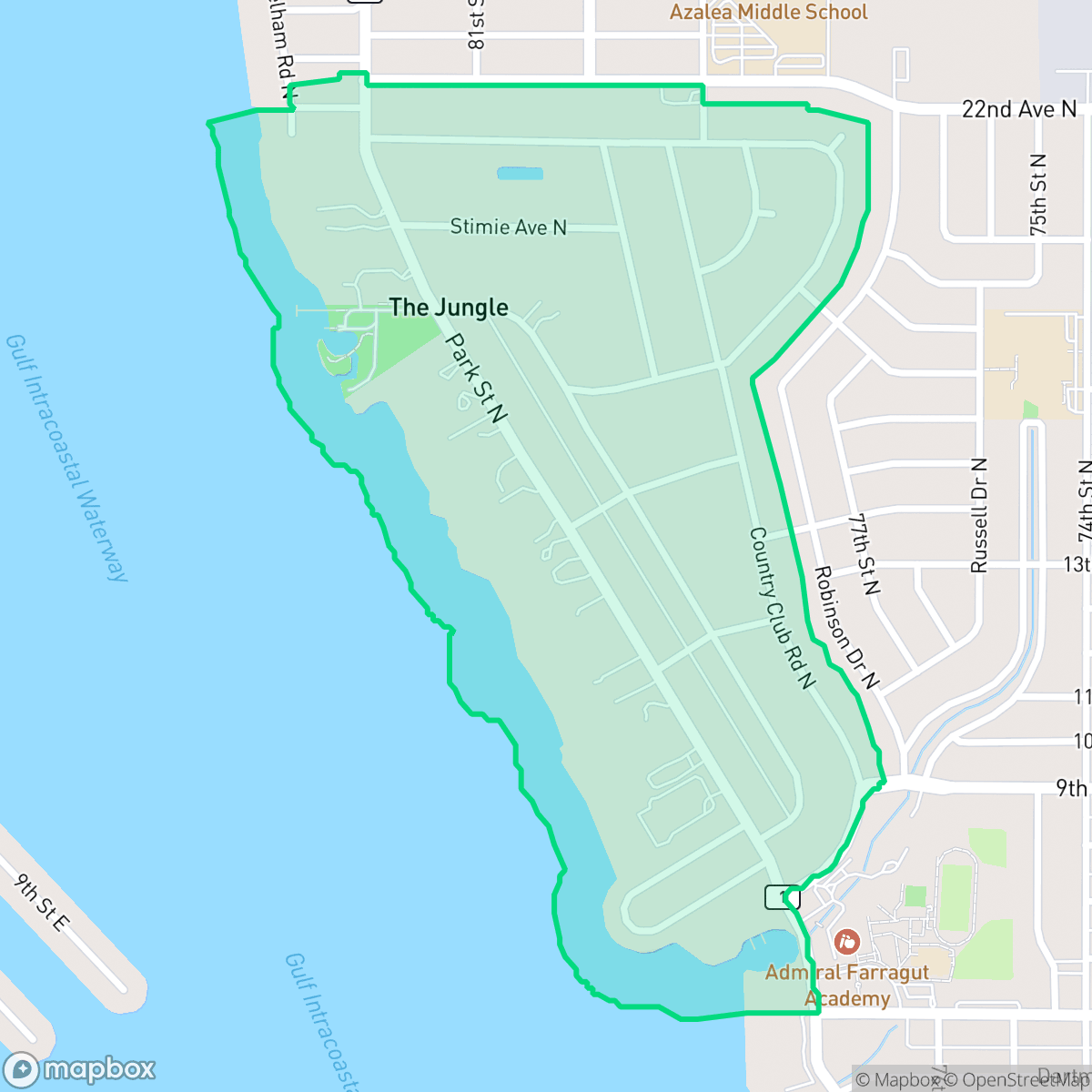
About Jungle Prada
Jungle Prada, a historically rich neighborhood in St. Petersburg, is defined by its deep ties to the Tocobaga tribe, who inhabited the area for over 600 years. The neighborhood is home to the Jungle Prada Site, an archaeological landmark listed on the National Register of Historic Places and the reputed 1528 landing site of Spanish explorer Pánfilo de Narváez. Developed in the 1920s by Walter P. Fuller, the area’s character was shaped by the Jungle Country Club Hotel and the Jungle Prada shopping complex, which housed 'The Gangplank,' a notable speakeasy frequented by figures like Al Capone. Today, the neighborhood is recognized for its lush, tropical landscape, brick-paved streets, and a diverse collection of architectural styles ranging from Spanish Mediterranean to mid-century designs, blending its profound indigenous and colonial history with the legacy of the Florida land boom.
The area maintains a distinct, semi-rural feel thanks to its abundant tree cover and open land, which contrasts with the density found elsewhere in St. Petersburg. Residents benefit from a quiet, acoustic environment with minimal industrial presence, fostering a sense of privacy and seclusion. The architectural landscape, featuring a mix of mid-century and Mediterranean styles, is complemented by well-maintained, walkable streets that encourage outdoor activity and exercise.
While the neighborhood offers high-value aesthetic appeal and stable access to healthcare, prospective residents should note the moderate flood risk and occasional air quality fluctuations. The area is well-suited for families and individuals who prioritize a tranquil, nature-oriented lifestyle over high-density urban convenience. With strong support for local schools and a balanced demographic profile, it remains a stable choice for those looking for a long-term residential home.
Neighborhood Scores Across 15 Qualities
Homes are situated with moderate separation and consistent backyard buffers. This layout provides slightly more privacy than the typical St. Petersburg density, according to iHuus data.
Low traffic residential streets and consistent sidewalks make walking easy through the neighborhood. This area offers better walkability than most of St. Petersburg due to its accessible grid layout and proximity to local parks.
Manicured lawns, private pools, and high-value waterfront estates create a highly aesthetic environment that sits well above the St. Petersburg average. According to iHuus data, the area is characterized by large homes and significant coastal amenities.
Abundant green spaces, including a large central park with tracks and sports fields, provide ample room for exercise. This neighborhood offers significantly more accessible parkland and safe walking areas than the St. Petersburg average.
Frequent open land and significant tree cover provide a more open, semi-rural atmosphere compared to the typical urban density of St. Petersburg. Residents will find a landscape characterized by scattered homes nestled among woodlands and large institutional complexes.
Residential streets offer a subdued, suburban atmosphere with limited commercial activity, falling slightly below the St. Petersburg average for local vibrancy. While some areas near the Jungle Prada Site provide walkable access to wellness services and parks, much of the neighborhood remains focused on quiet residential living.
Acoustic levels remain low with only infrequent sounds from distant traffic or trains. This area offers a significantly quieter environment than most of St. Petersburg, according to iHuus data.
Frequent unhealthy AQI levels pose significant risks to sensitive groups. According to iHuus data, air quality in this area is slightly worse than the St. Petersburg average.
Industrial activity and heavy warehouse facilities are virtually nonexistent here, providing a much cleaner residential environment than the St. Petersburg average. According to iHuus data, the area is characterized by residential and recreational zoning with no detectable industrial hazards.
Health insurance coverage among residents is high and remains slightly above the St. Petersburg average, according to iHuus data.
Political leanings in Jungle Prada are relatively even between conservative and liberal residents. This area represents a more moderate ideological split than the broader St. Petersburg area, according to iHuus data.
Residents live alongside a varied demographic of young adults, families, and seniors. According to iHuus data, the population age distribution is more widely spread than the typical St. Petersburg profile.
Flood risk in this area is higher than the St. Petersburg average, though a lack of detailed FEMA studies means specific vulnerability remains undetermined. Residents should remain cautious as official flood maps for this part of Jungle Prada are not yet fully updated.
Address-Level Insights for Jungle Prada


iHuus Neighborhood Intelligence Insights
Get address-level neighborhood insights for Jungle Prada
- Street-level scores — see how individual blocks compare, not just neighborhood averages
- Micro-zone boundaries — identify quiet pockets, flood boundaries, and walkable clusters before you visit
- 15 dimensions in full — walkability, noise, air quality, school quality, insurance coverage, population age profile, urban/rural index, and more
- Boundary risk alerts — know if your address sits near a block boundary where scores drop, the kind of detail no listing will ever mention
- School insights — individual school ratings and insights, not just district-level data
- Compare before you commit — side-by-side data across neighborhoods, down to block precision
No credit card required
Compare with Any Neighborhood
| Dimension | Jungle Prada | Albert Whitted Airport |
|---|---|---|
| 🚶 Walkabilityavg 6.61 | ||
| 🔊 Acoustic Comfortavg 3.78 | ||
| 🤫 Privacy Indexavg 5.45 | ||
| 🎨 Visual Appealavg 6.33 | ||
| 🐕 Dog Friendlinessavg 5.45 | ||
| 🗺️ Urban-Rural Indexavg 6.19 | ||
| ✨ Neighborhood Vibeavg 3.5 | ||
| 🏥 Health Insurance Coverageavg 6.88 | ||
| 🌿 Air Qualityavg 1.87 | ||
| 🏭 Industrial Proximityavg 7.55 | ||
| 🌊 Flood Safetyavg 4.61 | ||
| 🗳️ Ideological Leanavg 6.01 | ||
| 👥 Population Age Profileavg 5.11 | ||
| 🔥 Fire Safety | ||
| 🏫 School Quality |
Jungle Prada Rankings
School Districts Serving Jungle Prada
School Insights for Jungle Prada
Below average outcomes; significant attendance and academic challenges.
School Insights
See what's really behind every school rating near Jungle Prada
- Individual school ratings — each school's own score with outcome context, not just a district average
- Enrollment & class size data — student-to-teacher ratio and how it compares to the state average
- Full demographics breakdown — ethnicity and gender composition for every school in the enrollment zone
- Every school in the district — all schools within the enrollment boundary ranked by rating, not just the closest one
- Grade levels & benchmarks — elementary through high school, with below/above state-average flags
No credit card required