Jordan Park, St. Petersburg
Updated · 1,241 residents
Jordan Park is a historically significant community in St. Petersburg that blends modern, mixed-income housing with a legacy of cultural preservation. Residents benefit from high levels of health insurance coverage and a spacious, semi-rural atmosphere, though the area experiences notable noise from nearby transit corridors.
Key Highlights
About Jordan Park
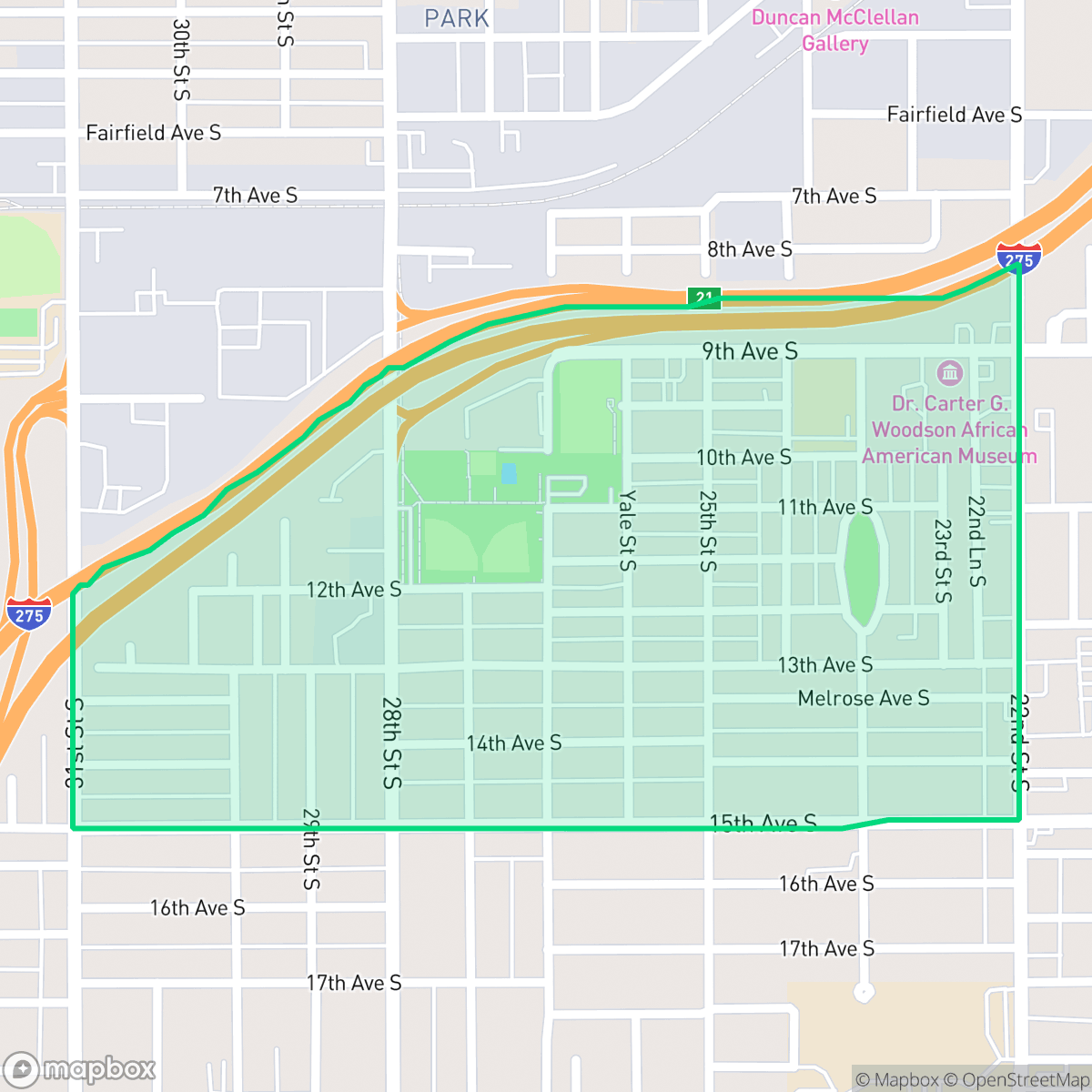
Established between 1939 and 1941, Jordan Park holds historical significance as St. Petersburg’s first public housing project designed for African American residents. Named after Elder Jordan Sr., a prominent local businessman who donated a portion of the land, the neighborhood served as a vital center for the Black community during the era of segregation. The site’s former administration building was transformed in 2006 into the Dr. Carter G. Woodson African American Museum, preserving the area's cultural legacy. Over the decades, Jordan Park has undergone multiple phases of redevelopment, transitioning from its original barrack-style architecture to a modern, mixed-income community. Today, it remains a landmark of African American history in South St. Petersburg, representing both the challenges of the past and ongoing efforts in urban revitalization and community preservation.
The neighborhood features a uniform residential layout with standard tract housing and a spacious feel that distinguishes it from denser urban pockets in the city. It serves as a hub for community identity, anchored by its proximity to cultural landmarks and a stable, family-oriented environment. The area maintains a strong liberal political character and high rates of health insurance coverage among its residents, according to iHuus data.
Potential residents should note that the area is subject to persistent noise from nearby transit routes and experiences air quality challenges that may affect sensitive individuals. While the grid-based street layout offers manageable walking paths, the lack of extensive public park space and narrow sidewalk verges means pet owners may find limited amenities for outdoor recreation. It is best suited for those who value historical community ties and a quieter, more open residential environment over central urban density.
Neighborhood Scores Across 15 Qualities
Residential structures feature mixed spacing with some buffer between neighbors, providing slightly more privacy than the St. Petersburg average. Most homes are situated on standard rectangular lots within an urban grid pattern.
Residential walking is manageable via a grid layout with some sidewalks; however, the area falls slightly below the St. Petersburg average due to heavy tree canopy obscuring paths and proximity to highway noise.
Standard tract housing with modest lot sizes and uniform roof geometries defines the area. This residential landscape presents less visual variety than the St. Petersburg average, according to iHuus data.
Walking dogs is somewhat constrained by a lack of major public parks and narrow sidewalk verges in many areas. While some sections offer green space between the street and sidewalk, overall accessibility for pet owners is below the St. Petersburg average.
Scattered homes and open land provide a more spacious atmosphere than the typical St. Petersburg urban density. According to iHuus data, the area maintains a slightly higher presence of woodland and fields compared to the city average.
Local amenities and dining options provide a level of energy that is noticeably higher than the St. Petersburg average. Residents can access various bars, breweries, and restaurants within a moderately walkable environment.
Persistent noise from nearby transit corridors and infrastructure makes this area louder than the St. Petersburg average. Residents may experience frequent disruptions from heavy traffic or proximity to major travel routes.
Frequent unhealthy air quality levels pose a significant risk to sensitive groups. According to iHuus data, conditions in Jordan Park are slightly worse than the St. Petersburg average.
Primarily residential in character, this area lacks heavy industry and significant hazards. Some pockets feature light commercial uses like breweries or gas stations, which may result in occasional utility odors or increased transit traffic compared to the city average.
Health insurance access among residents is notably higher than the St. Petersburg average, according to iHuus data.
Voting patterns and census indicators reflect a significantly more liberal political leaning than the St. Petersburg average, according to iHuus data.
Residents will encounter a diverse age range including young adults, families, and seniors. This demographic spread is slightly lower than the average seen across St. Petersburg, according to iHuus data.
Residual flood risks exist within this area due to its location in a 500-year floodplain; however, the safety level remains significantly higher than the St. Petersburg average according to iHuus data.
Address-Level Insights for Jordan Park


iHuus Neighborhood Intelligence Insights
Get address-level neighborhood insights for Jordan Park
- Street-level scores — see how individual blocks compare, not just neighborhood averages
- Micro-zone boundaries — identify quiet pockets, flood boundaries, and walkable clusters before you visit
- 15 dimensions in full — walkability, noise, air quality, school quality, insurance coverage, population age profile, urban/rural index, and more
- Boundary risk alerts — know if your address sits near a block boundary where scores drop, the kind of detail no listing will ever mention
- School insights — individual school ratings and insights, not just district-level data
- Compare before you commit — side-by-side data across neighborhoods, down to block precision
No credit card required
Compare with Any Neighborhood
| Dimension | Jordan Park | Albert Whitted Airport |
|---|---|---|
| 🚶 Walkabilityavg 6.61 | ||
| 🔊 Acoustic Comfortavg 3.78 | ||
| 🤫 Privacy Indexavg 5.45 | ||
| 🎨 Visual Appealavg 6.33 | ||
| 🐕 Dog Friendlinessavg 5.45 | ||
| 🗺️ Urban-Rural Indexavg 6.19 | ||
| ✨ Neighborhood Vibeavg 3.5 | ||
| 🏥 Health Insurance Coverageavg 6.88 | ||
| 🌿 Air Qualityavg 1.87 | ||
| 🏭 Industrial Proximityavg 7.55 | ||
| 🌊 Flood Safetyavg 4.61 | ||
| 🗳️ Ideological Leanavg 6.01 | ||
| 👥 Population Age Profileavg 5.11 | ||
| 🔥 Fire Safety | ||
| 🏫 School Quality |
Jordan Park Rankings
School Districts Serving Jordan Park
School Insights for Jordan Park
Below average outcomes; significant attendance and academic challenges.
School Insights
See what's really behind every school rating near Jordan Park
- Individual school ratings — each school's own score with outcome context, not just a district average
- Enrollment & class size data — student-to-teacher ratio and how it compares to the state average
- Full demographics breakdown — ethnicity and gender composition for every school in the enrollment zone
- Every school in the district — all schools within the enrollment boundary ranked by rating, not just the closest one
- Grade levels & benchmarks — elementary through high school, with below/above state-average flags
No credit card required