Isla Del Sol, St. Petersburg
Updated · 1,352 residents
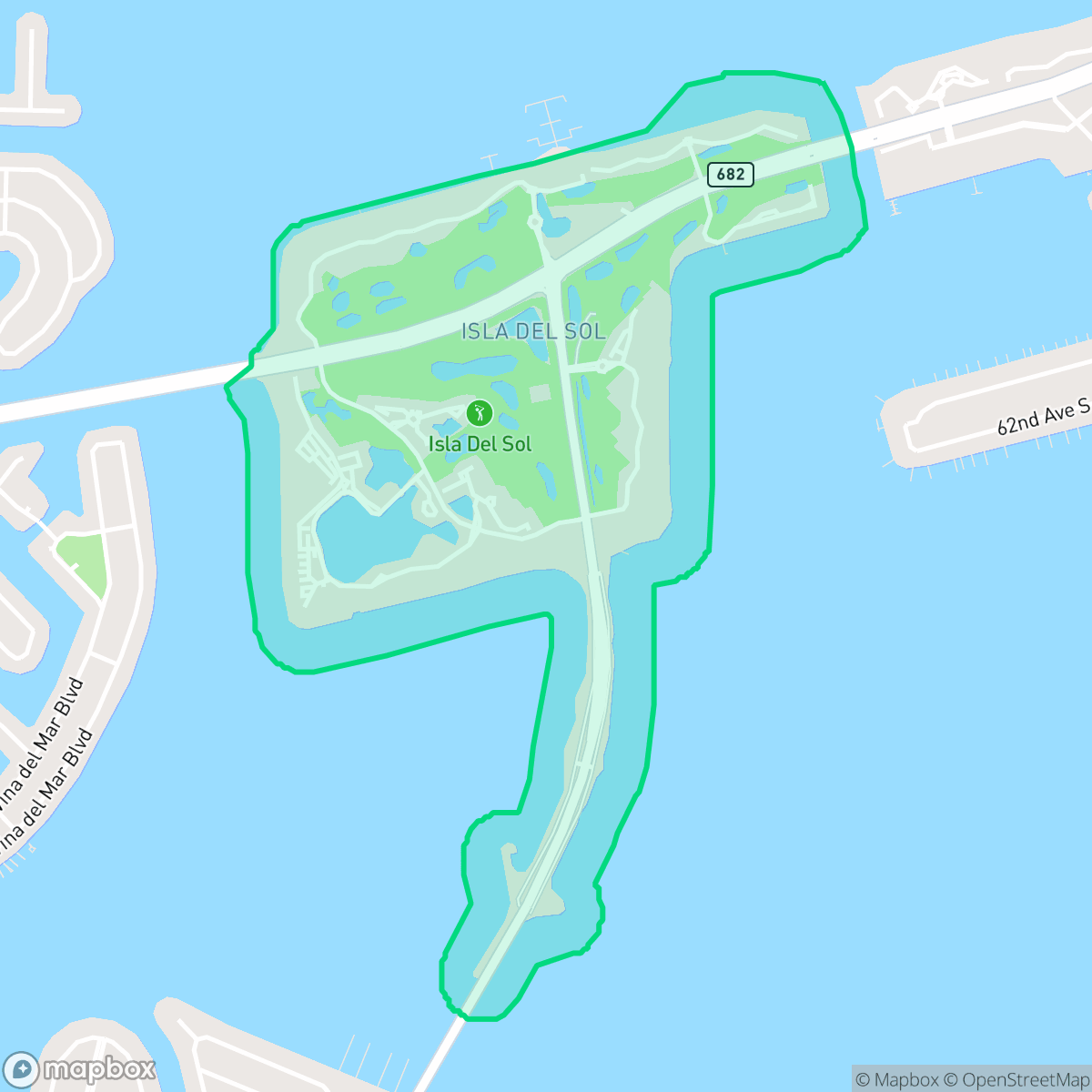
Isla Del Sol is a tranquil, master-planned community located on reclaimed land between mainland St. Petersburg and the Gulf beaches. The area features an upscale aesthetic with resort-style architecture, offering a quiet, suburban atmosphere that appeals primarily to mature residents.
Key Highlights
About Isla Del Sol
Isla Del Sol, a master-planned community in St. Petersburg, Florida, was developed starting in the 1970s on approximately 320 acres of land reclaimed from Boca Ciega Bay. The neighborhood’s name, meaning "Island of the Sun," was coined by developer Ramon Cacicedo. Its creation was facilitated by the earlier construction of the Pinellas Bayway in the 1960s, which provided essential access to the barrier islands. The community is defined by its resort-style architecture, comprising numerous condominium associations, townhomes, and villas centered around the Isla Del Sol Yacht and Country Club. Notably, in 1990, residents collectively raised $5.5 million to purchase the club and its championship golf course, solidifying the neighborhood’s identity as an amenity-rich, resident-governed enclave that serves as a gateway between mainland St. Petersburg and the Gulf beaches.
The neighborhood is defined by its coastal setting and focus on leisure, centered around the yacht and country club. Residents enjoy a relatively quiet environment with moderate pedestrian accessibility, characterized by well-maintained sidewalks and safe street crossings. The visual appeal is consistently high, reflecting the upscale nature of the villas, townhomes, and condominiums that populate the island. According to iHuus data, the area maintains a suburban character that balances residential space with accessible green areas.
Prospective residents should note the trade-offs associated with this coastal location, including a higher risk of flooding that may require insurance coverage. Air quality can occasionally reach levels that impact sensitive groups, and the area is primarily residential with limited commercial activity. While the neighborhood provides a serene retreat for older adults, the surrounding Pinellas County School District remains a stable institution for families, despite ongoing efforts to consolidate campuses due to changing enrollment patterns.
Neighborhood Scores Across 15 Qualities
Residential spacing offers a balanced level of separation between neighbors, though this falls slightly below the St. Petersburg average. According to iHuus data, properties feature mixed density with some visible buffers between homes.
Sidewalks are available on one side of the streets along with safe crossings. This level of pedestrian accessibility is slightly higher than the St. Petersburg average according to iHuus data.
Large residences and frequent upscale amenities contribute to a visual landscape that is more polished than the St. Petersburg average, according to iHuus data.
Frequent access to public parks and wide green verges make this area more dog friendly than the St. Petersburg average, according to iHuus data.
Residential streets and green spaces are distributed in roughly equal proportions. This area presents a more suburban character than the denser urban average for St. Petersburg.
Primarily residential in nature, this coastal area offers a calm atmosphere with significantly less commercial activity than the St. Petersburg average. While some pockets near local landmarks provide walkable access to small eateries, much of the neighborhood is characterized by sparse points of interest and low-intensity street life.
Steady sounds from nearby busy streets are noticeable, though levels remain quieter than the average for St. Petersburg.
Frequent unhealthy air quality levels pose a significant risk to sensitive groups. This area experiences lower air quality than the St. Petersburg average, according to iHuus data.
Residential streets and open green spaces predominate here, with only scattered local services like coffee shops and restaurants present. This lack of heavy industry makes the area comparable to the broader St. Petersburg average for industrial proximity.
Health insurance access among residents is slightly above the St. Petersburg average, according to iHuus data.
Political leanings in this area trend more conservative than the St. Petersburg average, featuring a significant conservative majority with a smaller opposing presence.
Older adults represent the majority of the population, with a notably higher proportion of seniors compared to the St. Petersburg average. This demographic profile suggests a quieter residential atmosphere according to iHuus data.
Located within a designated floodplain, this area carries a significantly higher risk of flooding than the St. Petersburg average. Residents should anticipate the potential requirement for flood insurance according to iHuus data.
Address-Level Insights for Isla Del Sol


iHuus Neighborhood Intelligence Insights
Get address-level neighborhood insights for Isla Del Sol
- Street-level scores — see how individual blocks compare, not just neighborhood averages
- Micro-zone boundaries — identify quiet pockets, flood boundaries, and walkable clusters before you visit
- 15 dimensions in full — walkability, noise, air quality, school quality, insurance coverage, population age profile, urban/rural index, and more
- Boundary risk alerts — know if your address sits near a block boundary where scores drop, the kind of detail no listing will ever mention
- School insights — individual school ratings and insights, not just district-level data
- Compare before you commit — side-by-side data across neighborhoods, down to block precision
No credit card required
Compare with Any Neighborhood
| Dimension | Isla Del Sol | Albert Whitted Airport |
|---|---|---|
| 🚶 Walkabilityavg 6.61 | ||
| 🔊 Acoustic Comfortavg 3.78 | ||
| 🤫 Privacy Indexavg 5.45 | ||
| 🎨 Visual Appealavg 6.33 | ||
| 🐕 Dog Friendlinessavg 5.45 | ||
| 🗺️ Urban-Rural Indexavg 6.19 | ||
| ✨ Neighborhood Vibeavg 3.5 | ||
| 🏥 Health Insurance Coverageavg 6.88 | ||
| 🌿 Air Qualityavg 1.87 | ||
| 🏭 Industrial Proximityavg 7.55 | ||
| 🌊 Flood Safetyavg 4.61 | ||
| 🗳️ Ideological Leanavg 6.01 | ||
| 👥 Population Age Profileavg 5.11 | ||
| 🔥 Fire Safety | ||
| 🏫 School Quality |
Isla Del Sol Rankings
School Districts Serving Isla Del Sol
School Insights for Isla Del Sol
Below average outcomes; significant attendance and academic challenges.
School Insights
See what's really behind every school rating near Isla Del Sol
- Individual school ratings — each school's own score with outcome context, not just a district average
- Enrollment & class size data — student-to-teacher ratio and how it compares to the state average
- Full demographics breakdown — ethnicity and gender composition for every school in the enrollment zone
- Every school in the district — all schools within the enrollment boundary ranked by rating, not just the closest one
- Grade levels & benchmarks — elementary through high school, with below/above state-average flags
No credit card required