Holiday Park, St. Petersburg
Updated · 1,694 residents
Holiday Park offers a quiet, semi-rural atmosphere in north St. Petersburg, defined by its mid-century masonry ranch homes and mature landscaping. Residents enjoy a balanced demographic mix and a stable community rhythm, though the area features limited public green space and requires attention to local air quality conditions.
Key Highlights
About Holiday Park
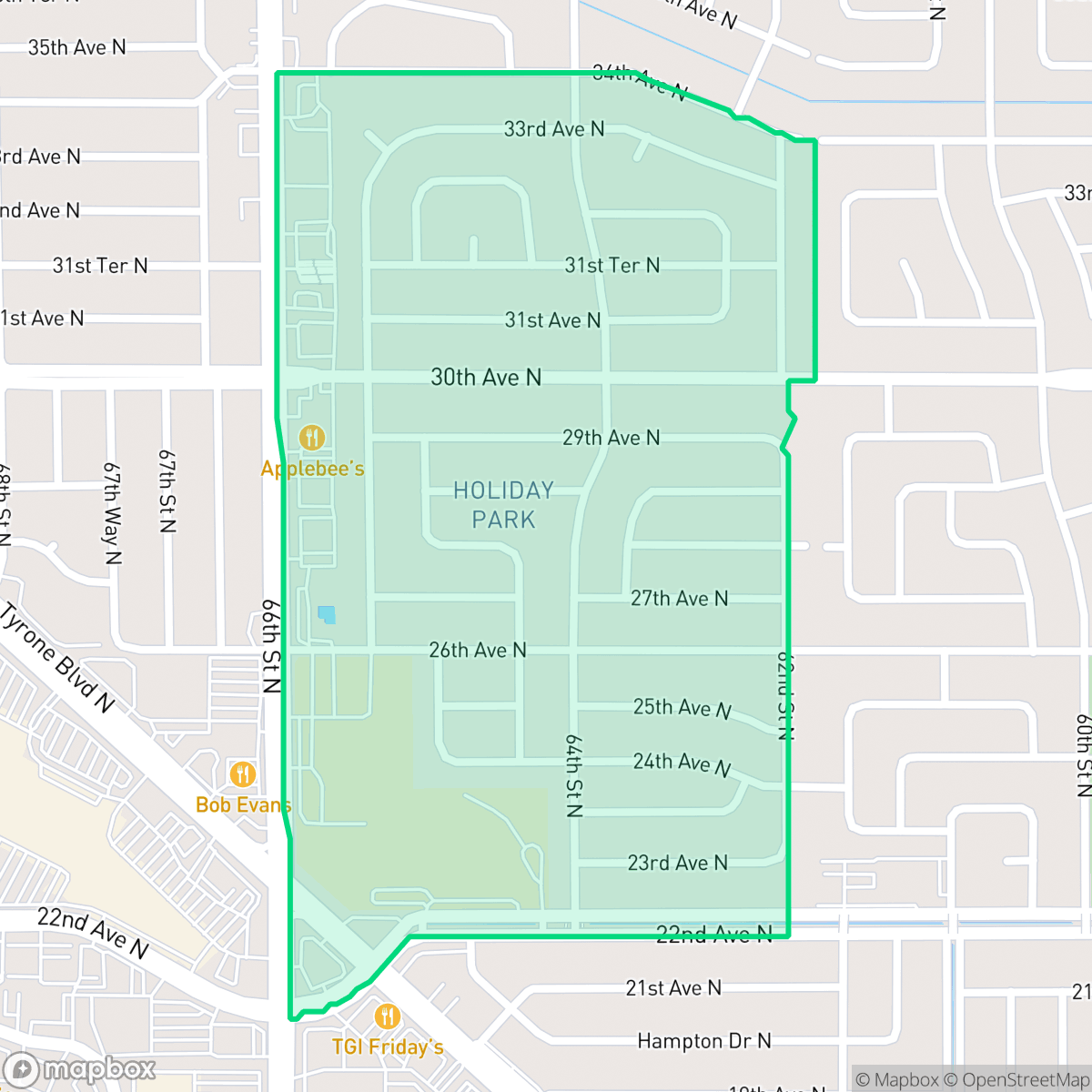
Holiday Park, located in north St. Petersburg between 62nd and 66th Streets and 22nd and 34th Avenues North, was primarily developed beginning in 1958 by Frank Stumm. Stumm, who envisioned a neighborhood where 'every day would be a holiday,' built the initial homes and established a country club for the development, which later became the Elks Club on 66th Street. The neighborhood is characterized by its post-war residential growth, featuring masonry ranch-style homes with white tile roofs and mature landscaping. Following Stumm's death in 1970, development continued through the 1980s under builders like Charles Rutenberg. Today, the area is noted for its stable, quiet residential character, consistent elevation in Flood Zone X, and its mid-century architectural stock, maintaining much of its original mid-century charm.
This neighborhood maintains a distinct suburban feel with a consistent architectural aesthetic that emphasizes privacy. The layout provides more personal space between homes than many other parts of the city, contributing to a sense of separation and calm. While the area is primarily residential, its proximity to local retail hubs ensures that daily necessities remain within reach, creating a steady and predictable pace of life that appeals to a diverse range of residents. According to iHuus data, the political landscape is notably balanced, reflecting a variety of perspectives among neighbors.
For those considering a move to the area, it is well-suited for individuals who value a quiet, established environment. Prospective residents should note that the sidewalk network is not fully continuous, which can impact pedestrian connectivity near busier streets. While the community benefits from high levels of health insurance coverage and access to a stable, well-regarded school district, those with pets should be prepared to rely on private, fenced backyards due to the limited availability of public parks. Overall, the neighborhood provides a consistent suburban lifestyle for those seeking a balance of privacy and local convenience.
Neighborhood Scores Across 15 Qualities
Homes are generally spaced with a moderate amount of distance between neighbors. According to iHuus data, this layout offers slightly more separation than the typical density found across St. Petersburg.
Low traffic volumes and tree-lined residential streets make for pleasant walks, though the neighborhood lacks a continuous sidewalk network in certain areas. According to iHuus data, pedestrian connectivity is slightly lower than the St. Petersburg average due to high-traffic arterials that can segment the community.
Residential views consist primarily of consistent tract housing with moderate lot sizes. According to iHuus data, the visual landscape is roughly in line with the city average, featuring scattered private pools and typical suburban layouts.
Limited sidewalk verges and restricted access to public parks make much of the neighborhood's greenery dependent on private fenced backyards. This level of accessibility for pets is below the St. Petersburg average, according to iHuus data.
Open land and scattered homes provide a slightly more rural atmosphere than the typical St. Petersburg urban density. According to iHuus data, the area maintains a balance of wooded or open spaces alongside suburban residential pockets.
Commercial density and dining options provide a more active atmosphere than the city average. While certain pockets serve as quiet residential zones near parks, other areas function as local hubs with concentrated retail and service activity.
Steady hums from local traffic on nearby busy streets are common here; however, acoustic comfort levels remain slightly higher than the St. Petersburg average.
Frequent unhealthy air quality levels pose a significant risk to sensitive groups. According to iHuus data, conditions in this area are slightly worse than the St. Petersburg average.
Primarily residential with only minimal light commercial activity, this area sits slightly better than the St. Petersburg average for industrial proximity. Residents may notice occasional utility hum or retail traffic near major arterials, but there are no significant industrial or hazardous facilities present.
Health insurance accessibility for residents in this area is notably higher than the St. Petersburg average, according to iHuus data.
Political leanings in this area are split fairly evenly between conservative and liberal perspectives. This reflects a more balanced ideological landscape than the more heavily liberal leaning average seen across St. Petersburg, according to iHuus data.
Residents experience a balanced demographic spread of young adults, families, and older individuals. According to iHuus data, this age distribution is slightly more varied than the average seen across St. Petersburg.
Flood risk in this area remains difficult to determine because official federal studies for the neighborhood are not yet complete. According to iHuus data, the level of potential vulnerability is slightly higher than the average found throughout St. Petersburg.
Address-Level Insights for Holiday Park


iHuus Neighborhood Intelligence Insights
Get address-level neighborhood insights for Holiday Park
- Street-level scores — see how individual blocks compare, not just neighborhood averages
- Micro-zone boundaries — identify quiet pockets, flood boundaries, and walkable clusters before you visit
- 15 dimensions in full — walkability, noise, air quality, school quality, insurance coverage, population age profile, urban/rural index, and more
- Boundary risk alerts — know if your address sits near a block boundary where scores drop, the kind of detail no listing will ever mention
- School insights — individual school ratings and insights, not just district-level data
- Compare before you commit — side-by-side data across neighborhoods, down to block precision
No credit card required
Compare with Any Neighborhood
| Dimension | Holiday Park | Albert Whitted Airport |
|---|---|---|
| 🚶 Walkabilityavg 6.61 | ||
| 🔊 Acoustic Comfortavg 3.78 | ||
| 🤫 Privacy Indexavg 5.45 | ||
| 🎨 Visual Appealavg 6.33 | ||
| 🐕 Dog Friendlinessavg 5.45 | ||
| 🗺️ Urban-Rural Indexavg 6.19 | ||
| ✨ Neighborhood Vibeavg 3.5 | ||
| 🏥 Health Insurance Coverageavg 6.88 | ||
| 🌿 Air Qualityavg 1.87 | ||
| 🏭 Industrial Proximityavg 7.55 | ||
| 🌊 Flood Safetyavg 4.61 | ||
| 🗳️ Ideological Leanavg 6.01 | ||
| 👥 Population Age Profileavg 5.11 | ||
| 🔥 Fire Safety | ||
| 🏫 School Quality |
Holiday Park Rankings
School Districts Serving Holiday Park
School Insights for Holiday Park
Below average outcomes; significant attendance and academic challenges.
School Insights
See what's really behind every school rating near Holiday Park
- Individual school ratings — each school's own score with outcome context, not just a district average
- Enrollment & class size data — student-to-teacher ratio and how it compares to the state average
- Full demographics breakdown — ethnicity and gender composition for every school in the enrollment zone
- Every school in the district — all schools within the enrollment boundary ranked by rating, not just the closest one
- Grade levels & benchmarks — elementary through high school, with below/above state-average flags
No credit card required