Historic Roser Park, St. Petersburg
Updated · 359 residents
Historic Roser Park is a highly walkable neighborhood defined by its unique hilly terrain and diverse early 20th-century architecture. Residents benefit from a vibrant social scene filled with local cafes and entertainment, though the area experiences steady ambient noise from nearby traffic and periodic air quality challenges.
Key Highlights
About Historic Roser Park
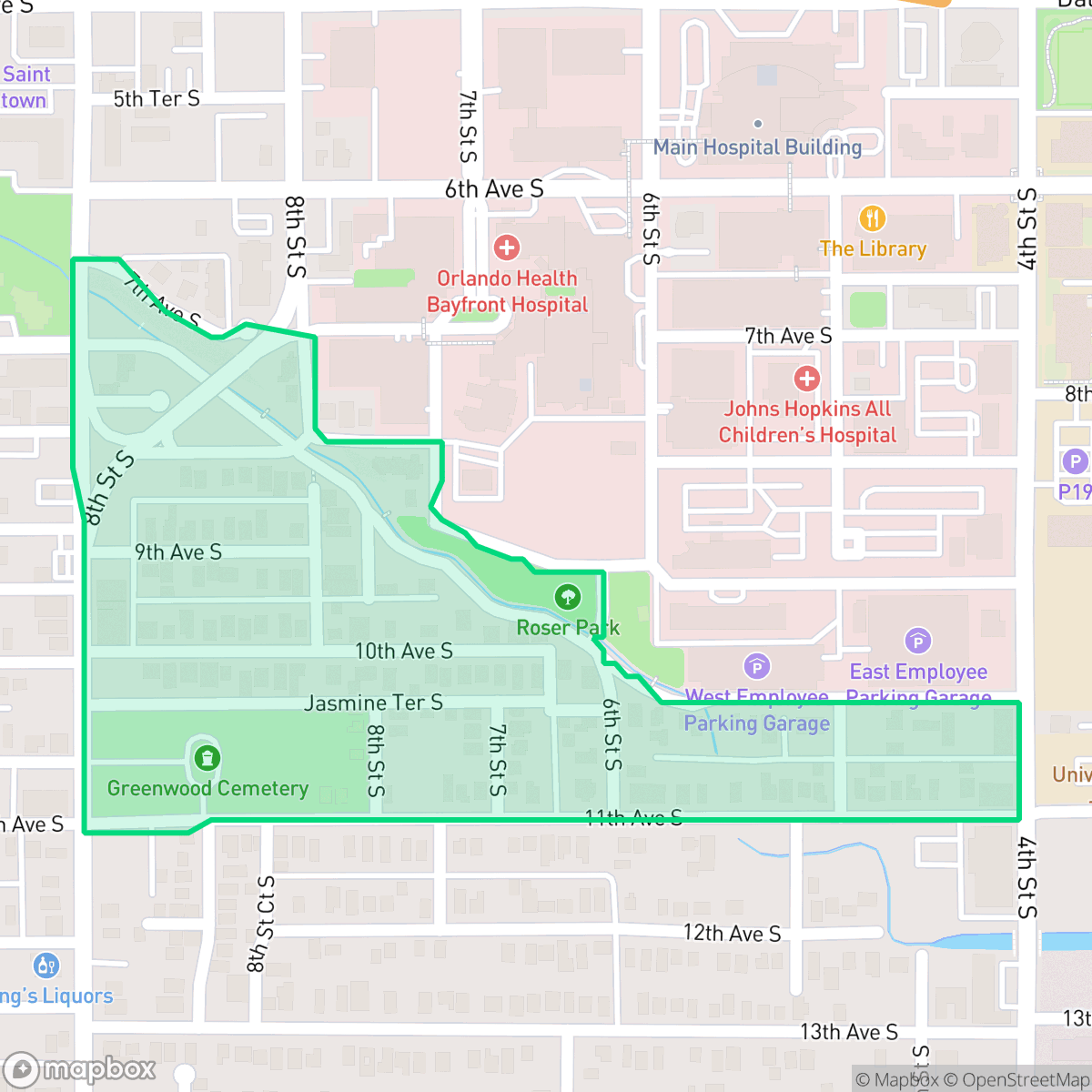
Established in 1911 by developer Charles M. Roser, Historic Roser Park is St. Petersburg’s first designated historic district. Unlike the city’s typical flat grid, the neighborhood follows the natural contours of Booker Creek, creating a unique landscape of winding brick streets, hilly terrain, and scenic ravines. It serves as a diverse architectural catalog of the early 20th century, featuring a mix of Craftsman bungalows, Prairie, Mediterranean Revival, and Colonial Revival homes. The area retains many original design elements, including granite curbstones, hexagon sidewalk pavers, and rusticated block retaining walls. Listed on the National Register of Historic Places, the neighborhood is celebrated for its intentional integration of landscape and residential design, which distinguished it as a premier streetcar suburb during the Florida land boom.
The neighborhood functions as a highly accessible urban enclave where most daily errands can be completed on foot. Its dense, established grid supports a lively atmosphere, characterized by a concentration of dining and social venues that exceed typical city averages. While the area maintains a strong sense of community and a distinct liberal ideological leaning, it remains primarily residential with minimal industrial interference, providing a stable environment for its diverse mix of young professionals, families, and long-term residents. Prospective residents should consider certain environmental trade-offs, including persistent ambient noise from surrounding thoroughfares and air quality concerns. While the area offers moderate privacy due to its closely spaced housing, it provides a balanced suburban feel within the broader city. Families are served by the Pinellas County School District, which offers academic stability and strong community support, though the district is currently navigating enrollment shifts and campus consolidations.
Neighborhood Scores Across 15 Qualities
Residential spacing provides a moderate level of separation between neighbors, though privacy levels are slightly lower than the St. Petersburg average. According to iHuus data, some areas feature closely spaced houses and multi-unit structures with shared walls.
A comprehensive sidewalk network and pedestrian bridges provide high connectivity within the urban core. Most local trips can be completed on foot, which is significantly more accessible than the St. Petersburg average.
Standard residential architecture and small yards characterize the area, resulting in a visual landscape that is slightly below the St. Petersburg average. The neighborhood features a mix of single-family homes with simple rooflines alongside various apartment complexes and commercial blocks.
Public green space and wide grass verges are scarce in this dense grid, though many properties feature private fenced backyards. According to iHuus data, the availability of shared outdoor space for pets is consistent with the St. Petersburg average.
A mix of residential streets and green spaces creates a suburban character that is less dense than the St. Petersburg average. According to iHuus data, the area features a structured grid with some institutional clusters alongside more developed urban pockets.
Local hubs and dining options provide a level of activity that is significantly higher than the St. Petersburg average. According to iHuus data, the area features a dense concentration of cafes, restaurants, and entertainment venues that create a high-energy atmosphere.
Local traffic from nearby thoroughfares creates a consistent level of ambient noise. According to iHuus data, acoustic levels in this area are slightly higher than the St. Petersburg average.
Frequent unhealthy air quality levels pose a significant risk to sensitive groups. According to iHuus data, conditions in this area are slightly worse than the St. Petersburg average.
Primarily residential in character, this area lacks heavy manufacturing and maintains a higher level of industrial separation than the St. Petersburg average. While some light commercial activity and large-scale hospital infrastructure exist, there is no significant industrial presence.
Health insurance accessibility in this area is slightly below the St. Petersburg average, according to iHuus data.
Voting patterns and census indicators reflect a much more liberal political leaning than the St. Petersburg average, according to iHuus data.
Residents live alongside a varied mix of young adults, families, and older populations. This demographic spread is slightly less diverse in age than the average found across St. Petersburg.
Residual flood risks exist due to the area being located within a 500-year floodplain, though safety levels remain notably higher than the St. Petersburg average according to iHuus data.
Address-Level Insights for Historic Roser Park


iHuus Neighborhood Intelligence Insights
Get address-level neighborhood insights for Historic Roser Park
- Street-level scores — see how individual blocks compare, not just neighborhood averages
- Micro-zone boundaries — identify quiet pockets, flood boundaries, and walkable clusters before you visit
- 15 dimensions in full — walkability, noise, air quality, school quality, insurance coverage, population age profile, urban/rural index, and more
- Boundary risk alerts — know if your address sits near a block boundary where scores drop, the kind of detail no listing will ever mention
- School insights — individual school ratings and insights, not just district-level data
- Compare before you commit — side-by-side data across neighborhoods, down to block precision
No credit card required
Compare with Any Neighborhood
| Dimension | Historic Roser Park | Albert Whitted Airport |
|---|---|---|
| 🚶 Walkabilityavg 6.61 | ||
| 🔊 Acoustic Comfortavg 3.78 | ||
| 🤫 Privacy Indexavg 5.45 | ||
| 🎨 Visual Appealavg 6.33 | ||
| 🐕 Dog Friendlinessavg 5.45 | ||
| 🗺️ Urban-Rural Indexavg 6.19 | ||
| ✨ Neighborhood Vibeavg 3.5 | ||
| 🏥 Health Insurance Coverageavg 6.88 | ||
| 🌿 Air Qualityavg 1.87 | ||
| 🏭 Industrial Proximityavg 7.55 | ||
| 🌊 Flood Safetyavg 4.61 | ||
| 🗳️ Ideological Leanavg 6.01 | ||
| 👥 Population Age Profileavg 5.11 | ||
| 🔥 Fire Safety | ||
| 🏫 School Quality |
Historic Roser Park Rankings
School Districts Serving Historic Roser Park
School Insights for Historic Roser Park
Below average outcomes; significant attendance and academic challenges.
School Insights
See what's really behind every school rating near Historic Roser Park
- Individual school ratings — each school's own score with outcome context, not just a district average
- Enrollment & class size data — student-to-teacher ratio and how it compares to the state average
- Full demographics breakdown — ethnicity and gender composition for every school in the enrollment zone
- Every school in the district — all schools within the enrollment boundary ranked by rating, not just the closest one
- Grade levels & benchmarks — elementary through high school, with below/above state-average flags
No credit card required