Historic Park Street, St. Petersburg
Updated · 769 residents
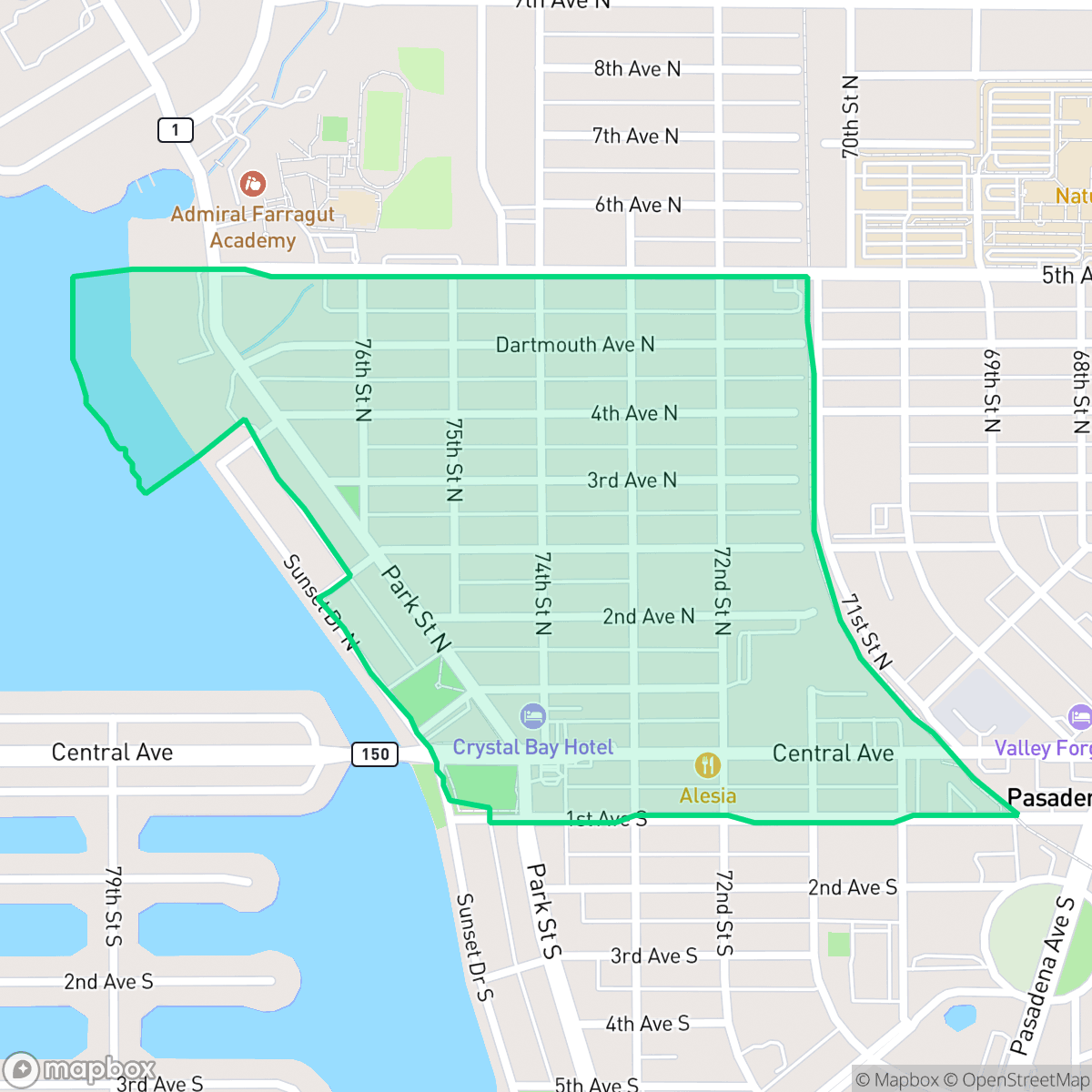
Historic Park Street is a serene, pedestrian-friendly enclave known for its well-preserved Mediterranean architecture and proximity to Boca Ciega Bay. The area offers a highly walkable, quiet residential environment characterized by manicured estates and consistent access to local green spaces.
Key Highlights
About Historic Park Street
Historic Park Street in St. Petersburg, Florida, is a residential area defined by its early 20th-century development, featuring notable Mediterranean-style architecture dating back to the 1920s. Situated near the shores of Boca Ciega Bay, the neighborhood is characterized by its serene atmosphere, mature landscaping, and proximity to significant public spaces such as Sunset Park and Galatea Park. The neighborhood's housing stock includes a mix of single-family homes that reflect the region’s historical growth, often preserving original architectural elements like hardwood floors and masonry details. Its development is closely tied to the waterfront character of the area, maintaining a quiet, established residential identity that distinguishes it from the city’s more commercial districts.
The neighborhood functions as a balanced residential hub, characterized by a diverse age demographic that includes young adults, families, and retirees. Residents benefit from a highly walkable grid layout and a visual landscape marked by well-maintained, upscale homes and private gardens. The absence of heavy industrial activity contributes to a quiet atmosphere, while the proximity to central park complexes provides ample space for outdoor activity and pet owners. According to iHuus data, the area maintains a stable, suburban feel that is notably distinct from the city's more commercial districts.
Prospective residents should consider that the neighborhood experiences occasional air quality concerns and undetermined flood risk, which are factors for long-term planning. While the area is politically balanced and offers high levels of health insurance coverage, it is best suited for those who prioritize a stable, residential lifestyle with easy access to pedestrian-friendly streets. The community is supported by the Pinellas County School District, which remains a stable academic institution despite ongoing demographic shifts and planned campus consolidations.
Neighborhood Scores Across 15 Qualities
Residential spacing offers a balance of proximity and separation, featuring more buffer between neighbors than the St. Petersburg average. Houses generally maintain standard suburban distances with private fenced backyards available for many properties.
Pedestrian movement is facilitated by a grid layout with consistent sidewalks and safe crossings. This area offers significantly better walkability than the St. Petersburg average due to low traffic volumes on residential streets.
Large homes, private pools, and well-maintained waterfront estates characterize the area. According to iHuus data, the visual landscape offers a notably higher level of aesthetic appeal than the St. Petersburg average.
Large central park facilities and grassy street verges provide more opportunities for pet exercise than the city average. According to iHuus data, the neighborhood offers frequent access to green space for dog owners.
Frequent open land and scattered greenery create a semi-rural feel that is slightly more open than the St. Petersburg average. This area features a dense residential grid of single-family homes positioned near central park complexes.
Local energy levels are notably higher than the St. Petersburg average due to a blend of educational institutions, cultural venues, and concentrated dining pockets. While some residential pockets remain quiet, much of the area functions as a balanced hub for services and outdoor activity.
Steady traffic sounds from nearby thoroughfares are present, though acoustic levels remain more favorable than the St. Petersburg average.
Frequent unhealthy air quality levels pose a significant risk to sensitive groups; this condition is slightly worse than the St. Petersburg average according to iHuus data.
Industrial activity is notably absent here, leaving the area predominantly residential with very little heavy commercial traffic. According to iHuus data, this neighborhood lacks warehouses or hazard sites and offers a cleaner environment than much of St. Petersburg.
Health insurance accessibility is notably higher than the St. Petersburg average, according to iHuus data.
Political views in this area are distributed relatively evenly between conservative and liberal leanings. This represents a more moderate ideological landscape than the broader St. Petersburg average, according to iHuus data.
Residents of all ages are represented here, featuring a more balanced spread of young adults, families, and seniors than is typical for the St. Petersburg average.
Flood safety levels in this area are consistent with the St. Petersburg average, though a lack of detailed FEMA studies means specific risk levels remain unverified. Residents should remain cautious as current data does not provide a definitive assessment of vulnerability to rising waters.
Address-Level Insights for Historic Park Street


iHuus Neighborhood Intelligence Insights
Get address-level neighborhood insights for Historic Park Street
- Street-level scores — see how individual blocks compare, not just neighborhood averages
- Micro-zone boundaries — identify quiet pockets, flood boundaries, and walkable clusters before you visit
- 15 dimensions in full — walkability, noise, air quality, school quality, insurance coverage, population age profile, urban/rural index, and more
- Boundary risk alerts — know if your address sits near a block boundary where scores drop, the kind of detail no listing will ever mention
- School insights — individual school ratings and insights, not just district-level data
- Compare before you commit — side-by-side data across neighborhoods, down to block precision
No credit card required
Compare with Any Neighborhood
| Dimension | Historic Park Street | Albert Whitted Airport |
|---|---|---|
| 🚶 Walkabilityavg 6.61 | ||
| 🔊 Acoustic Comfortavg 3.78 | ||
| 🤫 Privacy Indexavg 5.45 | ||
| 🎨 Visual Appealavg 6.33 | ||
| 🐕 Dog Friendlinessavg 5.45 | ||
| 🗺️ Urban-Rural Indexavg 6.19 | ||
| ✨ Neighborhood Vibeavg 3.5 | ||
| 🏥 Health Insurance Coverageavg 6.88 | ||
| 🌿 Air Qualityavg 1.87 | ||
| 🏭 Industrial Proximityavg 7.55 | ||
| 🌊 Flood Safetyavg 4.61 | ||
| 🗳️ Ideological Leanavg 6.01 | ||
| 👥 Population Age Profileavg 5.11 | ||
| 🔥 Fire Safety | ||
| 🏫 School Quality |
Historic Park Street Rankings
School Districts Serving Historic Park Street
School Insights for Historic Park Street
Below average outcomes; significant attendance and academic challenges.
School Insights
See what's really behind every school rating near Historic Park Street
- Individual school ratings — each school's own score with outcome context, not just a district average
- Enrollment & class size data — student-to-teacher ratio and how it compares to the state average
- Full demographics breakdown — ethnicity and gender composition for every school in the enrollment zone
- Every school in the district — all schools within the enrollment boundary ranked by rating, not just the closest one
- Grade levels & benchmarks — elementary through high school, with below/above state-average flags
No credit card required