Historic Old Northeast, St. Petersburg
Updated · 6,681 residents
Historic Old Northeast is a highly walkable community known for its scenic, upscale residential streets and vibrant social atmosphere near the waterfront. Residents enjoy excellent access to local dining and parks, though the area experiences notable traffic noise and periodic air quality challenges.
Key Highlights
About Historic Old Northeast
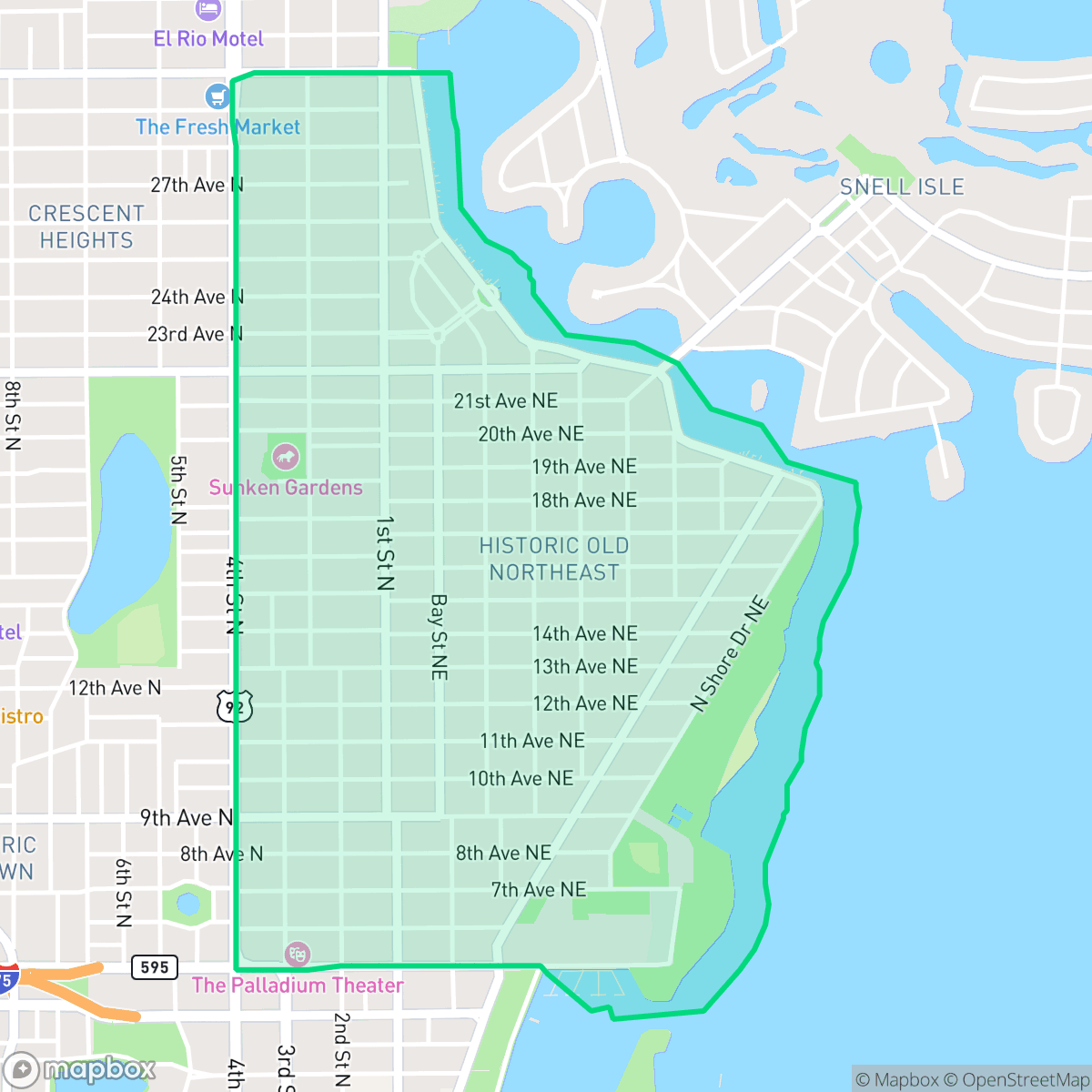
Established in 1911 as St. Petersburg’s first planned subdivision, the Historic Old Northeast—officially the North Shore Historic District—is defined by its early-20th-century development and preserved streetscape. The neighborhood features a dense concentration of architectural styles, including Craftsman bungalows, Mediterranean Revival, Colonial Revival, and Tudor Revival homes, primarily built between the 1910s and 1940s. Its distinct character is anchored by original brick-paved streets, granite curbs, hexagonal block sidewalks, and a mature canopy of oak and magnolia trees. Designed with an intentional grid-and-alley layout, the neighborhood maintains a strong connection to its waterfront origins along Tampa Bay and Coffee Pot Bayou. Added to the National Register of Historic Places in 2003, it remains a landmark of urban preservation, balancing its historic residential fabric with proximity to downtown St. Petersburg.
The area stands out for its high level of walkability and aesthetic appeal, characterized by manicured landscapes and a diverse demographic of young professionals, families, and seniors. It functions as a social hub with a dense concentration of cafes and eateries that foster an energetic, community-oriented lifestyle. The proximity to waterfront parks and green buffers makes it particularly welcoming for pet owners who value outdoor access and well-maintained public spaces. The community maintains a largely liberal political leaning and benefits from high levels of health insurance coverage among its residents.
Prospective residents should consider certain environmental and logistical factors when evaluating the area. While the neighborhood offers a high quality of life, it is subject to frequent traffic noise from nearby transit corridors and occasional air quality concerns. Additionally, the area faces moderate flood risks during extreme weather, and the housing layout provides a mix of privacy levels depending on the specific block. It remains an attractive option for those seeking a blend of urban convenience and established, scenic surroundings supported by a stable and well-funded school district.
Neighborhood Scores Across 15 Qualities
Residential density varies across the area, featuring a mix of closely spaced interior blocks and more spacious waterfront lots. This layout offers slightly more separation between neighbors than the typical St. Petersburg neighborhood.
A complete grid of sidewalks and well-marked pedestrian crossings makes much of the district accessible on foot. This level of connectivity and infrastructure is significantly higher than the St. Petersburg average, according to iHuus data.
Stately homes, manicured landscapes, and waterfront properties with private docks create a visual environment that is significantly more attractive than the St. Petersburg average. Residents can expect well-maintained architecture and frequent premium amenities such as backyard pools and large residential structures.
Extensive waterfront parks, tree-lined verges, and accessible green buffers provide ample space for walking pets. According to iHuus data, the availability of connected green spaces and safe paths is significantly higher than the St. Petersburg average.
A blend of low-rise residential streets and multi-story commercial structures creates a dense suburban feel that is slightly more developed than the St. Petersburg average. This landscape features an established tree canopy alongside accessible waterfront infrastructure and small commercial cores.
Local streets feature a significantly higher concentration of dining, cafes, and social hubs than the St. Petersburg average. While some coastal stretches remain quiet and park-focused, many pockets offer an energetic atmosphere with high walkability near diverse eateries and recreational spaces.
Frequent noise from nearby transit corridors and rail lines creates a louder environment than the St. Petersburg average. According to iHuus data, residents may experience regular auditory disturbances from heavy vehicle or train traffic.
Frequent periods of unhealthy air quality pose significant risks to sensitive groups. This level of pollution is consistent with the broader St. Petersburg area, according to iHuus data.
This area is exclusively residential and light commercial, containing no warehouses or hazardous industrial facilities. According to iHuus data, the lack of heavy industry makes this neighborhood significantly cleaner than the St. Petersburg average.
Health insurance access among residents is notably higher than the St. Petersburg average, according to iHuus data.
Political leaning in this area is notably more liberal than the St. Petersburg average. Residents will find a community with a significant progressive majority and a small presence of opposing viewpoints.
Residents will find a balanced demographic of young professionals, families, and seniors; this age distribution is more varied than the typical profile found across St. Petersburg.
Flood risk levels are somewhat higher than the St. Petersburg average, though official FEMA studies for this specific area remain incomplete. Residents should account for potential vulnerability during extreme weather events.
Address-Level Insights for Historic Old Northeast


iHuus Neighborhood Intelligence Insights
Get address-level neighborhood insights for Historic Old Northeast
- Street-level scores — see how individual blocks compare, not just neighborhood averages
- Micro-zone boundaries — identify quiet pockets, flood boundaries, and walkable clusters before you visit
- 15 dimensions in full — walkability, noise, air quality, school quality, insurance coverage, population age profile, urban/rural index, and more
- Boundary risk alerts — know if your address sits near a block boundary where scores drop, the kind of detail no listing will ever mention
- School insights — individual school ratings and insights, not just district-level data
- Compare before you commit — side-by-side data across neighborhoods, down to block precision
No credit card required
Compare with Any Neighborhood
| Dimension | Historic Old Northeast | Albert Whitted Airport |
|---|---|---|
| 🚶 Walkabilityavg 6.61 | ||
| 🔊 Acoustic Comfortavg 3.78 | ||
| 🤫 Privacy Indexavg 5.45 | ||
| 🎨 Visual Appealavg 6.33 | ||
| 🐕 Dog Friendlinessavg 5.45 | ||
| 🗺️ Urban-Rural Indexavg 6.19 | ||
| ✨ Neighborhood Vibeavg 3.5 | ||
| 🏥 Health Insurance Coverageavg 6.88 | ||
| 🌿 Air Qualityavg 1.87 | ||
| 🏭 Industrial Proximityavg 7.55 | ||
| 🌊 Flood Safetyavg 4.61 | ||
| 🗳️ Ideological Leanavg 6.01 | ||
| 👥 Population Age Profileavg 5.11 | ||
| 🔥 Fire Safety | ||
| 🏫 School Quality |
Historic Old Northeast Rankings
School Districts Serving Historic Old Northeast
School Insights for Historic Old Northeast
Below average outcomes; significant attendance and academic challenges.
School Insights
See what's really behind every school rating near Historic Old Northeast
- Individual school ratings — each school's own score with outcome context, not just a district average
- Enrollment & class size data — student-to-teacher ratio and how it compares to the state average
- Full demographics breakdown — ethnicity and gender composition for every school in the enrollment zone
- Every school in the district — all schools within the enrollment boundary ranked by rating, not just the closest one
- Grade levels & benchmarks — elementary through high school, with below/above state-average flags
No credit card required