Historic Kenwood, St. Petersburg
Updated · 3,008 residents
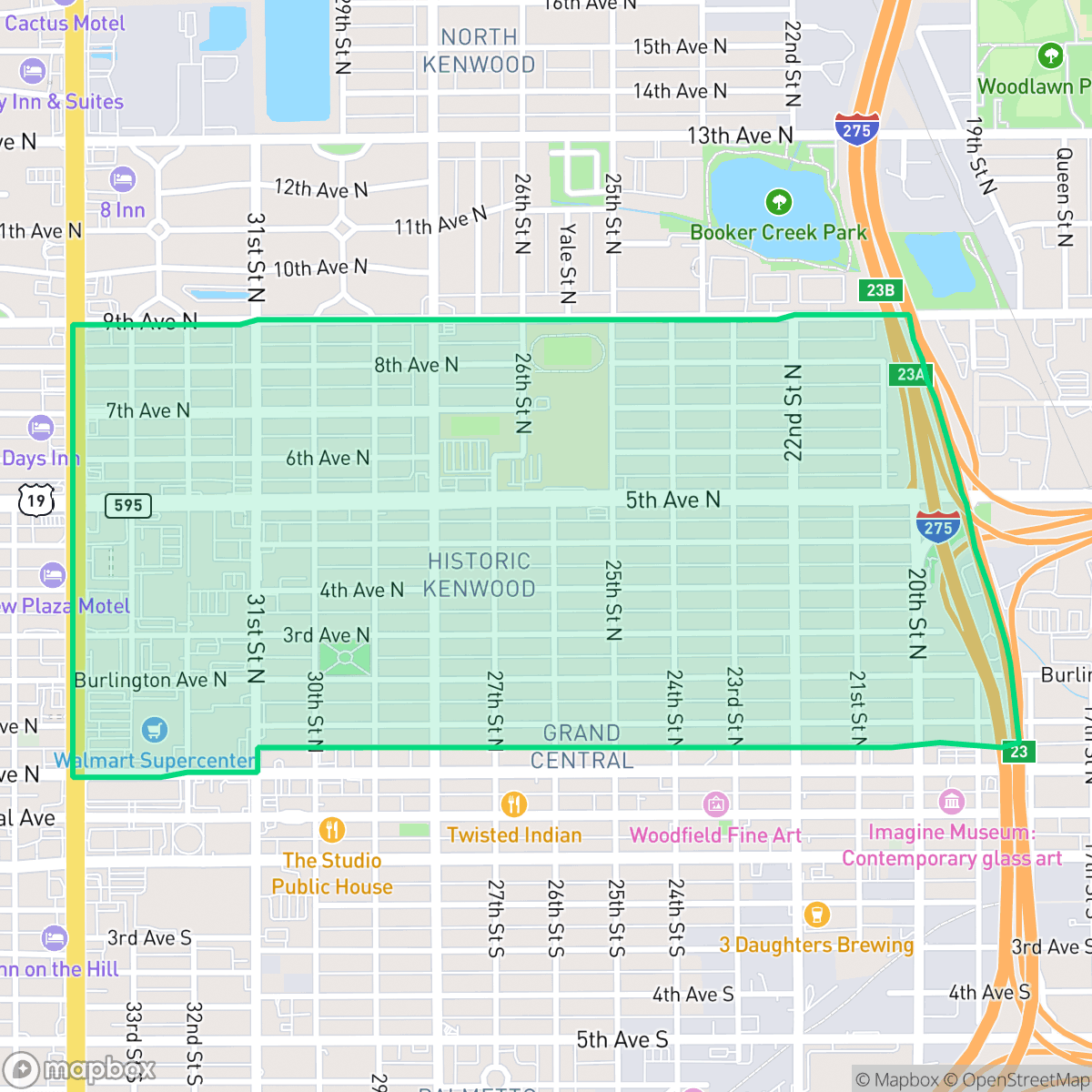
Historic Kenwood is a highly walkable neighborhood defined by its dense grid of craftsman homes and a vibrant, liberal-leaning social atmosphere. Residents enjoy easy access to local cafes and independent shops, though the area features limited public green space and moderate ambient noise from nearby traffic.
Key Highlights
About Historic Kenwood
Established in 1912 on former avocado groves, Historic Kenwood was St. Petersburg’s first suburb designed for year-round residents. Developer Charles Hall subdivided the land, which grew rapidly during the 1920s Florida Land Boom. The neighborhood is renowned for having one of the largest concentrations of American Craftsman bungalows in Florida, featuring over 2,200 historic buildings. After a period of decline from the 1950s to the 1980s, the community underwent a significant revitalization in the 1990s, led by an active neighborhood association and members of the LGBT community. Designated as a National Historic District in 2003, it is also recognized as an Artist Enclave. Key features include the historic Seminole Park, brick-lined avenues, and the 1926 St. Petersburg High School, which serves as a landmark for the area's early 20th-century development.
The neighborhood functions as a central hub for independent commerce, characterized by a high level of walkability that allows residents to easily navigate between local dining and wellness establishments. The community maintains a distinct, strongly liberal identity, supported by a diverse age range of residents. Its urban design creates a balanced suburban feel, providing a consistent grid that facilitates pedestrian movement throughout the residential streets.
Prospective residents should consider the trade-offs associated with this urban environment. According to iHuus data, the area experiences moderate traffic noise and occasional air quality challenges that may affect sensitive individuals. While the residential layout offers a reasonable level of privacy, public green space is limited compared to other parts of the city. Families will find themselves within the Pinellas County School District, which remains a stable institution despite ongoing efforts to consolidate campuses due to shifting enrollment trends.
Neighborhood Scores Across 15 Qualities
Residential spacing varies between tightly packed urban grids and more buffered multi-unit clusters, offering a level of privacy that is slightly higher than the St. Petersburg average.
Pedestrian access is excellent due to a consistent sidewalk network and well-marked crosswalks that significantly outperform the St. Petersburg average. While major highway interchanges can disrupt continuity, most residential streets offer a highly navigable grid for those traveling on foot.
Uniform housing styles and small yards define the area, which offers a typical urban landscape that sits slightly below the St. Petersburg average for visual variety.
Public green space and accessible parkland are below the St. Petersburg average. While some areas feature grass verges near sidewalks, much of the residential sector consists of narrow pavement and private fenced yards with minimal communal greenery.
Residential streets and green spaces exist in equal measure, matching the broader city average. This layout provides a transition between dense low-rise urban grids and more open suburban landscapes.
A dense concentration of local cafes, bars, and dining establishments creates a much more active social atmosphere than the St. Petersburg average. This neighborhood serves as a significant local hub for wellness services, independent shops, and walkable commercial corridors.
Steady traffic sounds from nearby busy streets are present, though levels remain comparable to the St. Petersburg average. Residents may experience a consistent ambient hum during peak commuting hours.
Frequent unhealthy air quality levels pose significant risks to sensitive groups. According to iHuus data, conditions in this area are slightly worse than the St. Petersburg average.
Largely residential in character, this area lacks heavy industry and hazardous facilities. While some light commercial activity and occasional freight traffic from storage facilities exist, the level of industrial proximity is slightly lower than the St. Petersburg average.
Health insurance accessibility in this area is lower than the St. Petersburg average, according to iHuus data.
Voting patterns and census indicators show a much more liberal leaning than the St. Petersburg average, according to iHuus data.
Residents of all life stages are represented here, with a demographic spread that is largely in line with the rest of St. Petersburg.
Residual flood risks exist within the 500-year floodplain, though safety levels remain notably higher than the St. Petersburg city average according to iHuus data.
Address-Level Insights for Historic Kenwood


iHuus Neighborhood Intelligence Insights
Get address-level neighborhood insights for Historic Kenwood
- Street-level scores — see how individual blocks compare, not just neighborhood averages
- Micro-zone boundaries — identify quiet pockets, flood boundaries, and walkable clusters before you visit
- 15 dimensions in full — walkability, noise, air quality, school quality, insurance coverage, population age profile, urban/rural index, and more
- Boundary risk alerts — know if your address sits near a block boundary where scores drop, the kind of detail no listing will ever mention
- School insights — individual school ratings and insights, not just district-level data
- Compare before you commit — side-by-side data across neighborhoods, down to block precision
No credit card required
Compare with Any Neighborhood
| Dimension | Historic Kenwood | Albert Whitted Airport |
|---|---|---|
| 🚶 Walkabilityavg 6.61 | ||
| 🔊 Acoustic Comfortavg 3.78 | ||
| 🤫 Privacy Indexavg 5.45 | ||
| 🎨 Visual Appealavg 6.33 | ||
| 🐕 Dog Friendlinessavg 5.45 | ||
| 🗺️ Urban-Rural Indexavg 6.19 | ||
| ✨ Neighborhood Vibeavg 3.5 | ||
| 🏥 Health Insurance Coverageavg 6.88 | ||
| 🌿 Air Qualityavg 1.87 | ||
| 🏭 Industrial Proximityavg 7.55 | ||
| 🌊 Flood Safetyavg 4.61 | ||
| 🗳️ Ideological Leanavg 6.01 | ||
| 👥 Population Age Profileavg 5.11 | ||
| 🔥 Fire Safety | ||
| 🏫 School Quality |
Historic Kenwood Rankings
School Districts Serving Historic Kenwood
School Insights for Historic Kenwood
Below average outcomes; significant attendance and academic challenges.
School Insights
See what's really behind every school rating near Historic Kenwood
- Individual school ratings — each school's own score with outcome context, not just a district average
- Enrollment & class size data — student-to-teacher ratio and how it compares to the state average
- Full demographics breakdown — ethnicity and gender composition for every school in the enrollment zone
- Every school in the district — all schools within the enrollment boundary ranked by rating, not just the closest one
- Grade levels & benchmarks — elementary through high school, with below/above state-average flags
No credit card required