Harris Park, St. Petersburg
Updated · 1,430 residents
Harris Park is a quiet residential neighborhood defined by its mid-century housing and mature oak canopy. While it offers a semi-rural feel with accessible green spaces like Kelly Lake, residents should be aware of high traffic noise from nearby highway corridors and limited pedestrian infrastructure.
Key Highlights
About Harris Park
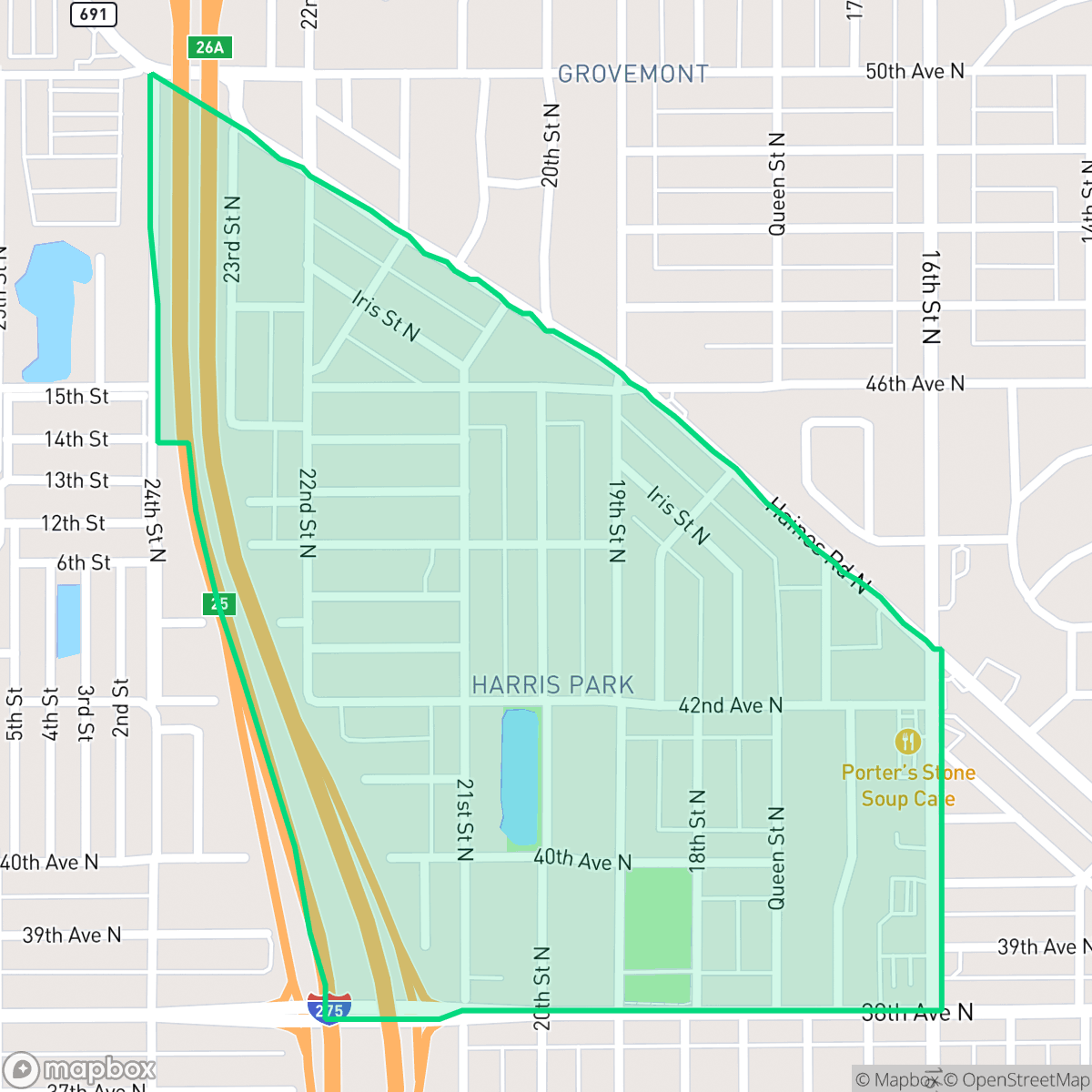
Harris Park, a residential neighborhood in St. Petersburg bounded by 38th Avenue North, Haines Road, 16th Street North, and Interstate 275, derives its name from H.B. Harris, who donated land in the early 20th century to establish a local school. The original Harris School operated on the site from 1912 to 1923, coinciding with the year Pinellas County separated from Hillsborough County. The neighborhood’s development is characterized by mid-century housing, with most homes constructed in the 1940s and 1950s, though some structures date back to 1925. Defined by its canopy of mature oak trees, the area features local landmarks such as Kiwanis Park and the scenic Kelly Lake, which serves as a community focal point. Today, Harris Park remains a quiet, family-oriented suburb known for its diverse residential character and established community associations.
The area maintains a functional, low-key atmosphere with a diverse demographic mix that mirrors the broader city. Its layout features a blend of detached homes and denser residential pockets, creating a moderate level of privacy for inhabitants. While the neighborhood lacks extensive commercial activity, it provides a stable environment for those seeking a suburban lifestyle within reach of major transit routes.
Prospective residents should consider specific livability trade-offs, including higher-than-average traffic noise and air quality concerns related to the proximity of major highways. Pedestrian access is inconsistent due to intermittent sidewalks, and the area faces moderate flood risks during extreme weather events. Despite these challenges, the local community remains well-supported by the Pinellas County School District, which provides consistent educational services and strong public backing.
Neighborhood Scores Across 15 Qualities
Residential spacing varies throughout the area, ranging from detached homes with mature tree buffers to high density sections where structures sit very close together. According to iHuus data, overall privacy levels are slightly below the St. Petersburg average.
Intermittent sidewalks and a central high-speed highway corridor create significant barriers for pedestrians, making the area slightly less walkable than the St. Petersburg average. While some residential streets remain quiet and navigable, heavy traffic from nearby highway interchanges can disrupt walking routes.
Residential views consist of standard tract housing and mobile home parks with small yards. This area offers less visual variety than the St. Petersburg average, featuring primarily functional architecture and few luxury amenities.
Frequent narrow sidewalks and a lack of wide, grassy verges make walking pets more difficult than in other parts of the city. According to iHuus data, many areas rely on private backyards because public green space access is relatively low.
Open land and scattered greenery provide a slightly more rural feel than the typical St. Petersburg landscape. This area features a mix of mature tree canopies and low-density residential pockets situated near major highway corridors.
Residential streets and suburban grids offer a low-key atmosphere, though commercial activity is sparse compared to the city average. Most areas are primarily driven by daily convenience and car-oriented transit near major highway corridors.
Frequent noise from nearby transit corridors and heavy traffic levels characterize the area. This level of acoustic disturbance is higher than the average found throughout St. Petersburg.
Frequent unhealthy air quality levels pose a significant risk to sensitive groups. According to iHuus data, these conditions are slightly worse than the St. Petersburg average.
Heavy manufacturing is absent from the area, though residents near the eastern highway corridors may experience noise and visual impacts from nearby warehouses and commercial strips. According to iHuus data, the presence of industrial activity is slightly lower than the St. Petersburg average.
Health insurance accessibility in Harris Park is notably lower than the St. Petersburg average, according to iHuus data.
Political leanings in Harris Park are relatively evenly split, closely mirroring the political diversity found across St. Petersburg.
A diverse range of age groups resides here, reflecting a demographic mix that is very similar to the broader St. Petersburg area. According to iHuus data, residents include a stable blend of young adults, families, and older community members.
Flood risk in this area is higher than the St. Petersburg average, though a lack of detailed FEMA studies means specific susceptibility remains undetermined. Residents should account for potential vulnerability during extreme weather events according to iHuus data.
Address-Level Insights for Harris Park


iHuus Neighborhood Intelligence Insights
Get address-level neighborhood insights for Harris Park
- Street-level scores — see how individual blocks compare, not just neighborhood averages
- Micro-zone boundaries — identify quiet pockets, flood boundaries, and walkable clusters before you visit
- 15 dimensions in full — walkability, noise, air quality, school quality, insurance coverage, population age profile, urban/rural index, and more
- Boundary risk alerts — know if your address sits near a block boundary where scores drop, the kind of detail no listing will ever mention
- School insights — individual school ratings and insights, not just district-level data
- Compare before you commit — side-by-side data across neighborhoods, down to block precision
No credit card required
Compare with Any Neighborhood
| Dimension | Harris Park | Albert Whitted Airport |
|---|---|---|
| 🚶 Walkabilityavg 6.61 | ||
| 🔊 Acoustic Comfortavg 3.78 | ||
| 🤫 Privacy Indexavg 5.45 | ||
| 🎨 Visual Appealavg 6.33 | ||
| 🐕 Dog Friendlinessavg 5.45 | ||
| 🗺️ Urban-Rural Indexavg 6.19 | ||
| ✨ Neighborhood Vibeavg 3.5 | ||
| 🏥 Health Insurance Coverageavg 6.88 | ||
| 🌿 Air Qualityavg 1.87 | ||
| 🏭 Industrial Proximityavg 7.55 | ||
| 🌊 Flood Safetyavg 4.61 | ||
| 🗳️ Ideological Leanavg 6.01 | ||
| 👥 Population Age Profileavg 5.11 | ||
| 🔥 Fire Safety | ||
| 🏫 School Quality |
Harris Park Rankings
School Districts Serving Harris Park
School Insights for Harris Park
Below average outcomes; significant attendance and academic challenges.
School Insights
See what's really behind every school rating near Harris Park
- Individual school ratings — each school's own score with outcome context, not just a district average
- Enrollment & class size data — student-to-teacher ratio and how it compares to the state average
- Full demographics breakdown — ethnicity and gender composition for every school in the enrollment zone
- Every school in the district — all schools within the enrollment boundary ranked by rating, not just the closest one
- Grade levels & benchmarks — elementary through high school, with below/above state-average flags
No credit card required