Harbordale, St. Petersburg
Updated · 1,116 residents
Harbordale is a quiet, historically rich community defined by its proximity to Salt Creek and a blend of early 20th-century architecture. Residents enjoy a peaceful, dog-friendly environment with balanced suburban appeal and a distinct local identity.
Key Highlights
About Harbordale
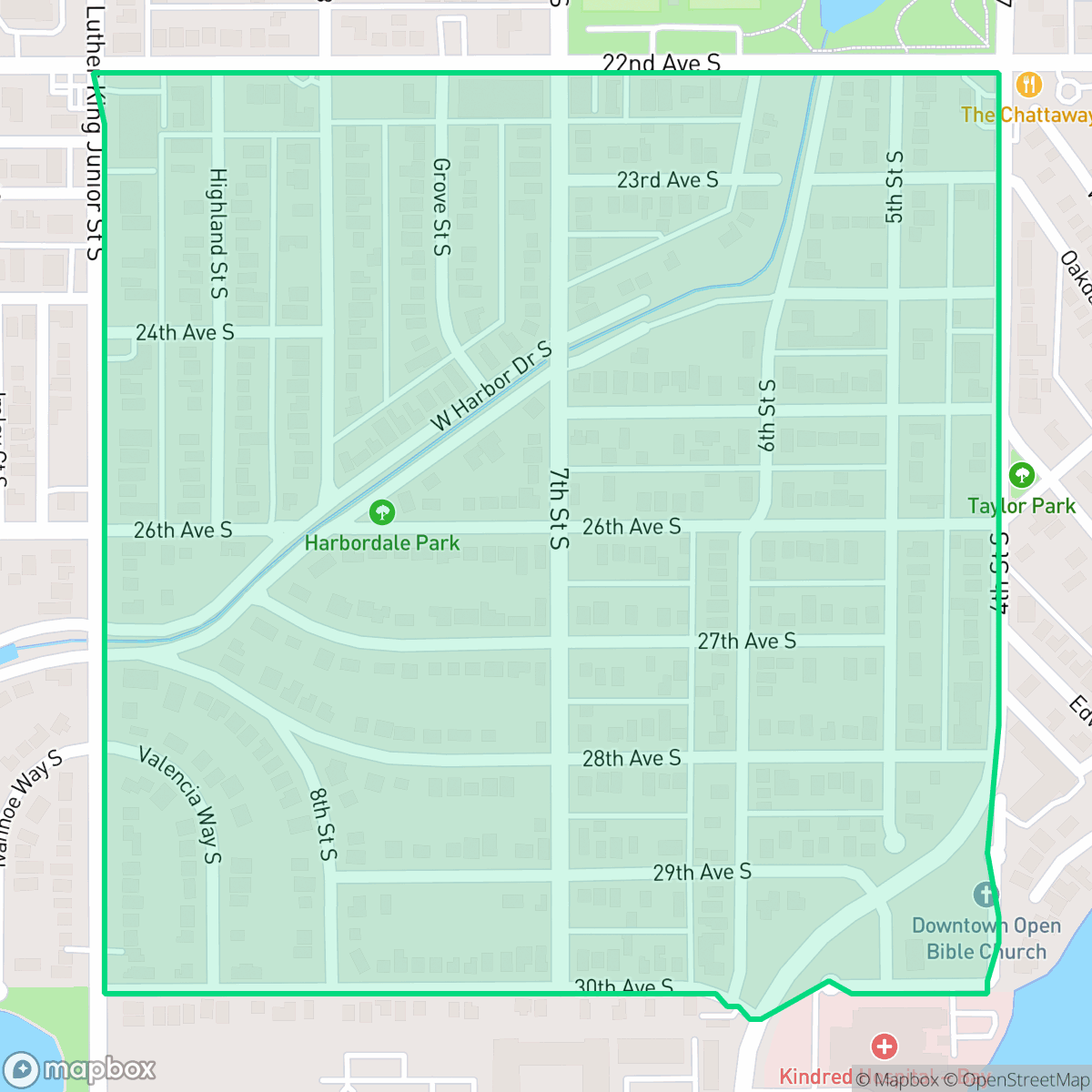
Harbordale, established in the 1920s as part of St. Petersburg’s early expansion, is a historically significant neighborhood defined by its proximity to Salt Creek. Historically, this creek served as a vital waterway for transporting goods between Lake Maggiore and Bayboro Harbor. The neighborhood’s architectural character reflects its development history, with 1920s and 1930s bungalows and period homes concentrated east of 7th Street South, while 1950s-era structures predominate to the west. A notable landmark is the Trinity United Methodist Church, which dates back to 1927. Today, the community is recognized for its active neighborhood association and its unique local identity, often symbolized by the alligator iconography on street signs—a nod to the wildlife found along the banks of Salt Creek.
The neighborhood offers a tranquil residential experience that balances suburban layout with pockets of walkable dining and wellness services. Its visual landscape is varied, featuring a mix of upscale estates, modest single-family homes, and established tree canopies that contribute to a quiet, functional atmosphere. With minimal industrial presence, the area remains largely undisturbed, providing a peaceful retreat that caters to a diverse demographic of families, young adults, and seniors. The community maintains a strong sense of local pride, reflected in its active neighborhood association and consistent grid of streets that are generally easy to navigate on foot.
While the area provides excellent access to green spaces for pet owners, prospective residents should consider specific environmental factors. Air quality levels occasionally reach points that may concern sensitive groups, and flood risk remains an area of uncertainty due to the lack of updated federal mapping. The local school system, part of the Pinellas County School District, is recognized for its academic stability and strong voter support, although the district is currently navigating enrollment shifts. Overall, the neighborhood is well-suited for those who prioritize a quiet, politically engaged community with a unique historical character over a high-energy urban environment.
Neighborhood Scores Across 15 Qualities
Residential spacing provides a moderate level of buffer between neighbors, though density varies throughout the area. Some pockets feature closely spaced homes, resulting in a slightly higher density than the St. Petersburg average.
Residential streets feature a consistent grid with sidewalks and mature tree canopy, making the area slightly more pedestrian friendly than the St. Petersburg average. While low traffic streets are easy to navigate, some arterial roads carry higher vehicle speeds.
Residential views range from upscale estates with private pools to more modest single-family homes and dense mobile home communities. According to iHuus data, the visual quality of the area is slightly above the St. Petersburg average.
Abundant park access and continuous green verges provide much better opportunities for dog walking than the St. Petersburg average. Large central parks with lakes and nearby coastal greenspace offer wide, safe paths away from traffic.
Residential streets and green spaces are distributed in roughly equal measure, offering a suburban layout that is slightly less dense than the St. Petersburg average. According to iHuus data, the area features a mix of single-family homes and tree canopy alongside more concentrated residential pockets.
Activity levels are slightly higher than the St. Petersburg average, characterized by a mix of suburban residential grids and pockets of walkable dining near local parks. While some areas offer moderate walkability near wellness services and outdoor spaces, much of the neighborhood maintains a subdued, car-oriented atmosphere.
Acoustic levels remain low with only infrequent sounds from distant traffic or trains. According to iHuus data, this neighborhood is significantly quieter than the St. Petersburg average.
Frequent unhealthy air quality levels pose significant risks to sensitive groups. This level of pollution is slightly worse than the average found across St. Petersburg, according to iHuus data.
Residential life remains largely undisturbed by heavy industry, as the area consists primarily of homes and light commercial clusters. According to iHuus data, this lack of industrial activity is slightly better than the city average.
Health insurance enrollment among residents is lower than the St. Petersburg average, according to iHuus data.
Voting patterns and census indicators show a much more liberal political leaning than the St. Petersburg average, according to iHuus data.
Residents of all ages are represented here, reflecting a demographic balance that aligns with the city average. This variety of young adults, families, and seniors creates a community with a steady age distribution.
Flood risk in this area remains undetermined because detailed federal studies have not yet been completed for the neighborhood. According to iHuus data, the level of vulnerability is slightly higher than the average seen across St. Petersburg.
Address-Level Insights for Harbordale


iHuus Neighborhood Intelligence Insights
Get address-level neighborhood insights for Harbordale
- Street-level scores — see how individual blocks compare, not just neighborhood averages
- Micro-zone boundaries — identify quiet pockets, flood boundaries, and walkable clusters before you visit
- 15 dimensions in full — walkability, noise, air quality, school quality, insurance coverage, population age profile, urban/rural index, and more
- Boundary risk alerts — know if your address sits near a block boundary where scores drop, the kind of detail no listing will ever mention
- School insights — individual school ratings and insights, not just district-level data
- Compare before you commit — side-by-side data across neighborhoods, down to block precision
No credit card required
Compare with Any Neighborhood
| Dimension | Harbordale | Albert Whitted Airport |
|---|---|---|
| 🚶 Walkabilityavg 6.61 | ||
| 🔊 Acoustic Comfortavg 3.78 | ||
| 🤫 Privacy Indexavg 5.45 | ||
| 🎨 Visual Appealavg 6.33 | ||
| 🐕 Dog Friendlinessavg 5.45 | ||
| 🗺️ Urban-Rural Indexavg 6.19 | ||
| ✨ Neighborhood Vibeavg 3.5 | ||
| 🏥 Health Insurance Coverageavg 6.88 | ||
| 🌿 Air Qualityavg 1.87 | ||
| 🏭 Industrial Proximityavg 7.55 | ||
| 🌊 Flood Safetyavg 4.61 | ||
| 🗳️ Ideological Leanavg 6.01 | ||
| 👥 Population Age Profileavg 5.11 | ||
| 🔥 Fire Safety | ||
| 🏫 School Quality |
Harbordale Rankings
School Districts Serving Harbordale
School Insights for Harbordale
Below average outcomes; significant attendance and academic challenges.
School Insights
See what's really behind every school rating near Harbordale
- Individual school ratings — each school's own score with outcome context, not just a district average
- Enrollment & class size data — student-to-teacher ratio and how it compares to the state average
- Full demographics breakdown — ethnicity and gender composition for every school in the enrollment zone
- Every school in the district — all schools within the enrollment boundary ranked by rating, not just the closest one
- Grade levels & benchmarks — elementary through high school, with below/above state-average flags
No credit card required