Harbor Isle, St. Petersburg
Updated · 477 residents
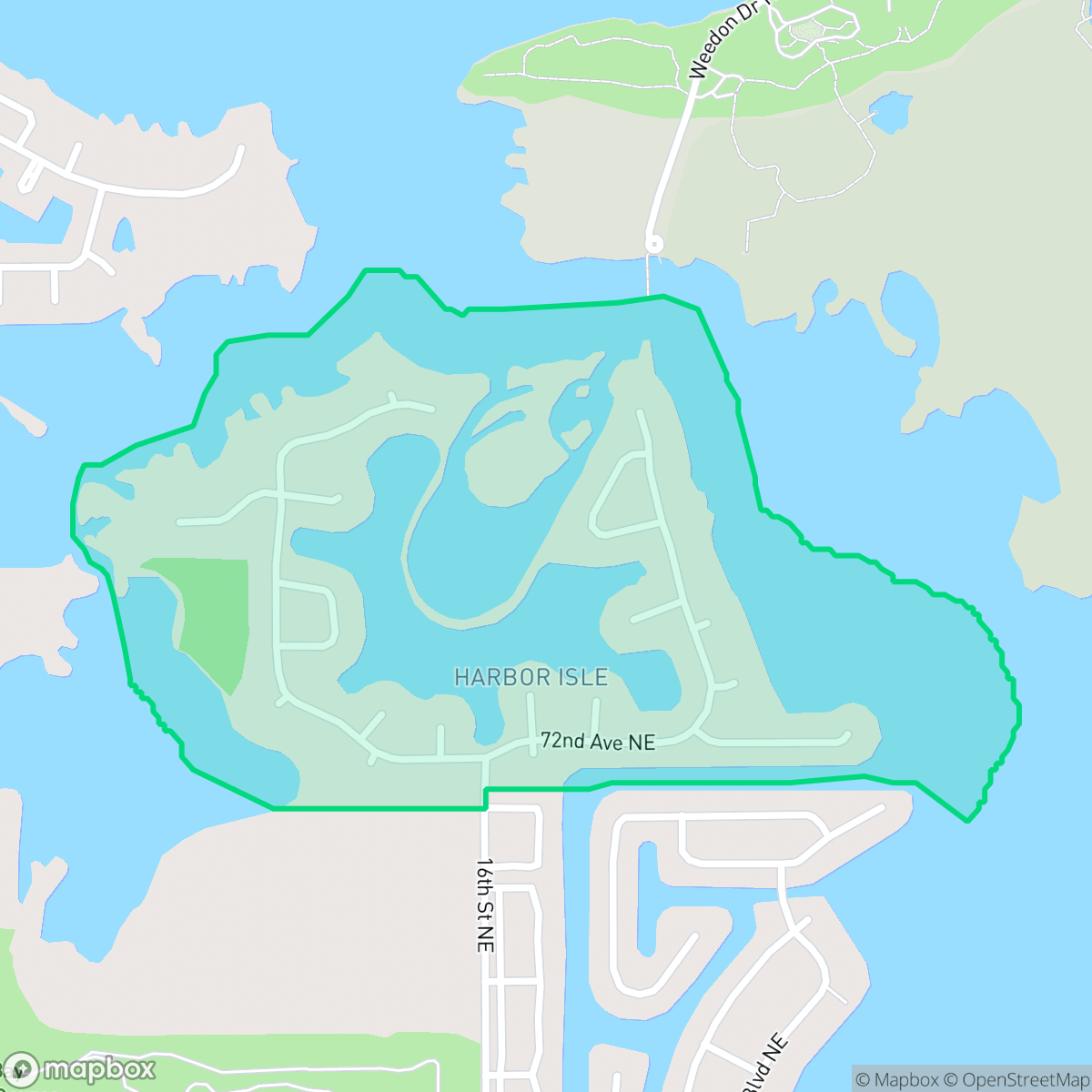
Harbor Isle is a quiet, waterfront community in northeastern St. Petersburg known for its distinctive horseshoe-shaped street layout and deep-water access to Riviera Bay. Residents enjoy a peaceful, secluded atmosphere characterized by upscale scenery and a strong sense of residential privacy.
Key Highlights
About Harbor Isle
Harbor Isle is a residential waterfront neighborhood in northeastern St. Petersburg, platted in the 1970s on land previously characterized by rugged coastal marshlands and estuaries. The community was developed by excavating a large, central man-made lake, with the removed soil used to elevate the surrounding land for residential construction. Historically, the area was connected to the nearby Weedon Island Preserve via a bridge that served as a thoroughfare between St. Petersburg and the Gandy area. The neighborhood consists of approximately 220 single-family homes, many built by notable local developers like Rutenberg and Sibley, and is defined by its horseshoe-shaped street layout and deep-water access to Riviera Bay and Bayou Grande. Today, the central lake functions as a city-managed retention pond, playing a critical role in local stormwater management.
The area offers a secluded, residential environment defined by its lack of industrial activity and calm, low-traffic streets. The aesthetic appeal is high, characterized by spacious properties and well-maintained surroundings that contribute to a serene, upscale atmosphere. Because it is tucked away from commercial hubs, the neighborhood serves as a quiet retreat for those prioritizing privacy and a slower pace of life.
Living here involves certain trade-offs, particularly regarding environmental factors like flood risk and air quality, which are notable concerns for the area. While the lack of sidewalks makes it less traditional for pedestrians, the low traffic volume allows for pleasant walking. The community is well-suited for families and individuals who value a balanced, moderate political environment and access to high-quality health insurance, provided they are comfortable with the inherent challenges of coastal living.
Neighborhood Scores Across 15 Qualities
Residential spacing offers a balance of separation and proximity, providing slightly more buffer between neighbors than the St. Petersburg average.
Low traffic volumes and calm streets make for pleasant strolls, even though the lack of sidewalks puts walkability slightly below the St. Petersburg average.
Large homes and premium amenities create a landscape that is notably more aesthetically pleasing than the St. Petersburg average. This area features spacious properties and well-maintained surroundings according to iHuus data.
Connected green spaces and wide, low-traffic paths make this area more suitable for pet owners than the St. Petersburg average.
Natural landscapes and sparse development define this area, offering a significantly more rural atmosphere than the St. Petersburg average according to iHuus data.
Very little commercial activity or street life exists here, making the area significantly more subdued than the St. Petersburg average. Residents will find a peaceful landscape that lacks local destinations and nearby amenities.
Frequent unhealthy air quality levels pose a significant risk to sensitive groups. According to iHuus data, these conditions are slightly worse than the average found across St. Petersburg.
Industrial activity and warehouses are entirely absent from this area, providing a much more residential environment than the St. Petersburg average. Residents can expect quiet streets consisting of homes and green spaces without proximity to heavy industrial facilities or hazard sites.
Health insurance access among residents is exceptionally high, significantly outpacing the St. Petersburg average according to iHuus data.
Political perspectives within the community are evenly split between conservative and liberal leanings. This demographic profile is notably more moderate than the broader St. Petersburg average, according to iHuus data.
A balanced mix of young adults, families, and older residents characterizes the area. According to iHuus data, this demographic variety is more pronounced than in much of St. Petersburg.
Properties in this area are located within a designated floodplain, making flood insurance typically a necessity. According to iHuus data, the susceptibility to flooding is notably higher than the St. Petersburg average.
Address-Level Insights for Harbor Isle


iHuus Neighborhood Intelligence Insights
Get address-level neighborhood insights for Harbor Isle
- Street-level scores — see how individual blocks compare, not just neighborhood averages
- Micro-zone boundaries — identify quiet pockets, flood boundaries, and walkable clusters before you visit
- 15 dimensions in full — walkability, noise, air quality, school quality, insurance coverage, population age profile, urban/rural index, and more
- Boundary risk alerts — know if your address sits near a block boundary where scores drop, the kind of detail no listing will ever mention
- School insights — individual school ratings and insights, not just district-level data
- Compare before you commit — side-by-side data across neighborhoods, down to block precision
No credit card required
Compare with Any Neighborhood
| Dimension | Harbor Isle | Albert Whitted Airport |
|---|---|---|
| 🚶 Walkabilityavg 6.61 | ||
| 🔊 Acoustic Comfortavg 3.78 | ||
| 🤫 Privacy Indexavg 5.45 | ||
| 🎨 Visual Appealavg 6.33 | ||
| 🐕 Dog Friendlinessavg 5.45 | ||
| 🗺️ Urban-Rural Indexavg 6.19 | ||
| ✨ Neighborhood Vibeavg 3.5 | ||
| 🏥 Health Insurance Coverageavg 6.88 | ||
| 🌿 Air Qualityavg 1.87 | ||
| 🏭 Industrial Proximityavg 7.55 | ||
| 🌊 Flood Safetyavg 4.61 | ||
| 🗳️ Ideological Leanavg 6.01 | ||
| 👥 Population Age Profileavg 5.11 | ||
| 🔥 Fire Safety | ||
| 🏫 School Quality |
Harbor Isle Rankings
School Districts Serving Harbor Isle
School Insights for Harbor Isle
Below average outcomes; significant attendance and academic challenges.
School Insights
See what's really behind every school rating near Harbor Isle
- Individual school ratings — each school's own score with outcome context, not just a district average
- Enrollment & class size data — student-to-teacher ratio and how it compares to the state average
- Full demographics breakdown — ethnicity and gender composition for every school in the enrollment zone
- Every school in the district — all schools within the enrollment boundary ranked by rating, not just the closest one
- Grade levels & benchmarks — elementary through high school, with below/above state-average flags
No credit card required