Graham-Rogall, St. Petersburg
Updated · 28 residents
Graham-Rogall is a highly walkable urban area characterized by its energetic atmosphere and proximity to central St. Petersburg. Residents enjoy easy access to local amenities and expansive green spaces, though the neighborhood experiences consistent traffic noise and air quality challenges.
Key Highlights
About Graham-Rogall
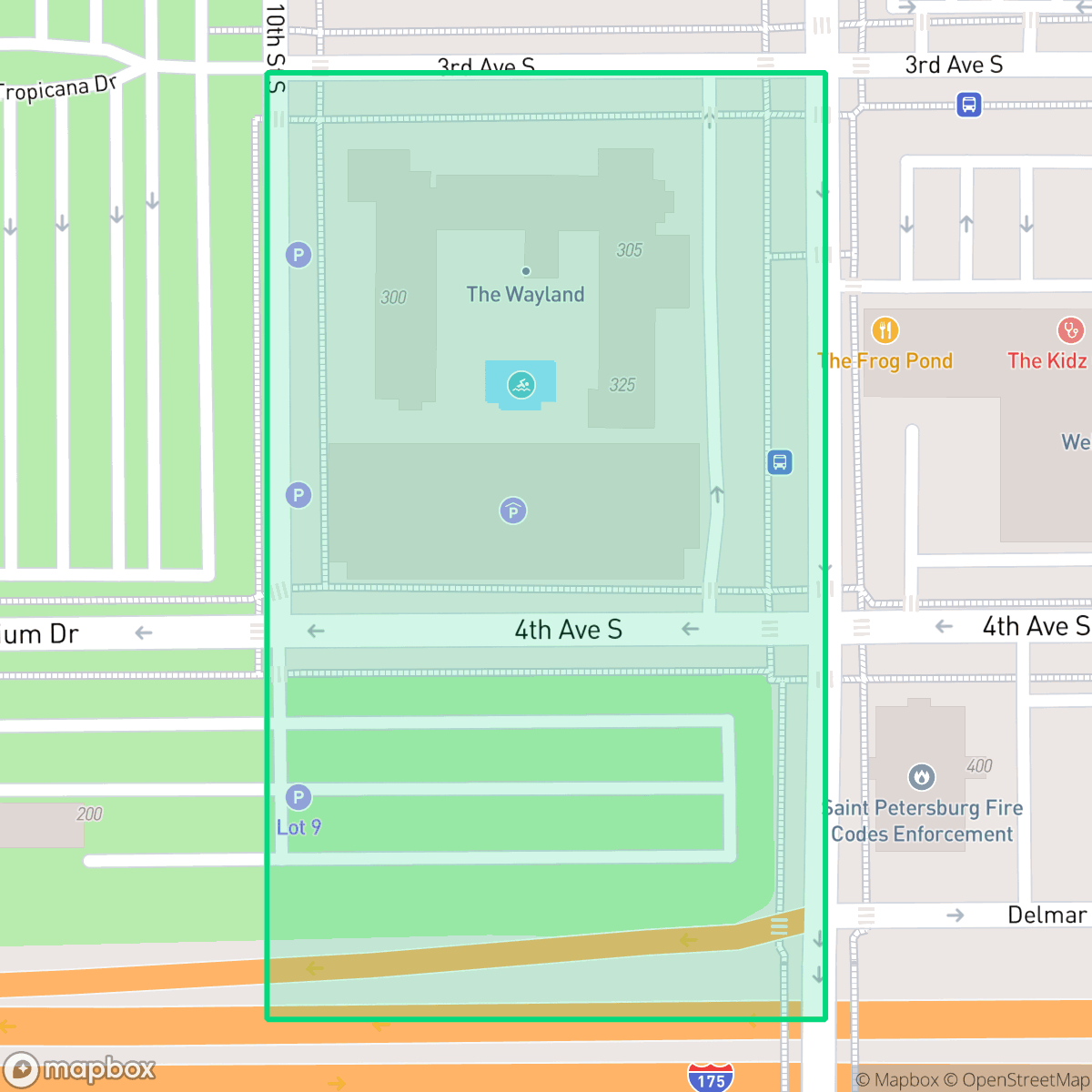
Graham-Rogall was not a traditional neighborhood but rather a prominent public housing complex in St. Petersburg, Florida, located near Tropicana Field. The site consisted of two primary buildings: the 336-unit Graham Park, constructed in 1971, and the 150-unit Rogall Congregate, built in 1978. For decades, the complex served as a significant housing resource for the city's elderly and disabled populations. In the early 2000s, the St. Petersburg Housing Authority sold the property to private developers, leading to the controversial eviction of its long-term residents between 2008 and 2009 to make way for proposed upscale condominium redevelopment. The site remains a notable reference point in local discussions regarding affordable housing, urban renewal, and the displacement of vulnerable residents in St. Petersburg.
The area functions as a vibrant urban hub with a high level of pedestrian connectivity, supported by a dense grid of sidewalks. While it maintains a low-density feel with predominantly low-rise structures, it remains a center of constant activity and commercial engagement. The demographic profile is notably diverse, hosting a mix of young professionals, families, and seniors who lean toward progressive political views. The neighborhood benefits from a stable school system through the Pinellas County School District, which maintains strong academic standing and community support despite ongoing enrollment shifts across the region.
Living here requires balancing the benefits of a walkable, pet-friendly environment against specific environmental trade-offs. The area experiences steady traffic sounds and lower air quality compared to other parts of the city. Additionally, residents should be aware of the limited privacy inherent in its more compact housing arrangements. It is best suited for those who prioritize immediate access to city life and walkability over absolute quiet or seclusion.
Neighborhood Scores Across 15 Qualities
Closer proximity to neighbors and shared building structures are common here, making the area feel more densely populated than the St. Petersburg average.
Pedestrian navigation is easy due to a dense grid of wide sidewalks and frequent crossings. This level of connectivity for residents is significantly higher than the St. Petersburg average.
Standard tract housing and a mix of apartment complexes define the landscape, which is slightly less visually diverse than the St. Petersburg average according to iHuus data.
Wide grassy verges and a public park with a lakeside walking path provide ample space for pets. According to iHuus data, this area offers significantly more accessible green space for animals than the St. Petersburg average.
Spacious layouts and more open ground cover define this area, which feels significantly less dense than the city average. Most of the neighborhood consists of low-rise structures with fewer multi-story buildings compared to St. Petersburg's urban core.
Constant activity and a dense concentration of dining and nightlife options create an atmosphere far more vibrant than the city average. Residents can expect a highly walkable environment characterized by frequent movement and strong commercial presence, according to iHuus data.
A consistent hum of local traffic from nearby busy streets defines the acoustic environment. According to iHuus data, this level of sound is more noticeable here than in many other parts of St. Petersburg.
Frequent unhealthy air quality levels present significant risks for sensitive groups; according to iHuus data, these conditions are slightly worse than the St. Petersburg average.
Primarily residential in character, this area features only light commercial activity and lacks heavy industrial facilities. According to iHuus data, the lack of large-scale manufacturing makes this neighborhood slightly cleaner of industrial influence than much of St. Petersburg.
Health insurance coverage among residents is lower than the St. Petersburg average, according to iHuus data.
Political leanings in this area are notably more liberal than the St. Petersburg average, featuring a significant progressive majority.
Residents live alongside a balanced mix of young professionals, families, and seniors. This demographic spread is largely consistent with the broader St. Petersburg area.
Residual flood risks exist within a 500-year floodplain, though the area remains significantly safer than much of St. Petersburg according to iHuus data.
Address-Level Insights for Graham-Rogall


iHuus Neighborhood Intelligence Insights
Get address-level neighborhood insights for Graham-Rogall
- Street-level scores — see how individual blocks compare, not just neighborhood averages
- Micro-zone boundaries — identify quiet pockets, flood boundaries, and walkable clusters before you visit
- 15 dimensions in full — walkability, noise, air quality, school quality, insurance coverage, population age profile, urban/rural index, and more
- Boundary risk alerts — know if your address sits near a block boundary where scores drop, the kind of detail no listing will ever mention
- School insights — individual school ratings and insights, not just district-level data
- Compare before you commit — side-by-side data across neighborhoods, down to block precision
No credit card required
Compare with Any Neighborhood
| Dimension | Graham-Rogall | Albert Whitted Airport |
|---|---|---|
| 🚶 Walkabilityavg 6.61 | ||
| 🔊 Acoustic Comfortavg 3.78 | ||
| 🤫 Privacy Indexavg 5.45 | ||
| 🎨 Visual Appealavg 6.33 | ||
| 🐕 Dog Friendlinessavg 5.45 | ||
| 🗺️ Urban-Rural Indexavg 6.19 | ||
| ✨ Neighborhood Vibeavg 3.5 | ||
| 🏥 Health Insurance Coverageavg 6.88 | ||
| 🌿 Air Qualityavg 1.87 | ||
| 🏭 Industrial Proximityavg 7.55 | ||
| 🌊 Flood Safetyavg 4.61 | ||
| 🗳️ Ideological Leanavg 6.01 | ||
| 👥 Population Age Profileavg 5.11 | ||
| 🔥 Fire Safety | ||
| 🏫 School Quality |
Graham-Rogall Rankings
School Districts Serving Graham-Rogall
School Insights for Graham-Rogall
Below average outcomes; significant attendance and academic challenges.
School Insights
See what's really behind every school rating near Graham-Rogall
- Individual school ratings — each school's own score with outcome context, not just a district average
- Enrollment & class size data — student-to-teacher ratio and how it compares to the state average
- Full demographics breakdown — ethnicity and gender composition for every school in the enrollment zone
- Every school in the district — all schools within the enrollment boundary ranked by rating, not just the closest one
- Grade levels & benchmarks — elementary through high school, with below/above state-average flags
No credit card required