Gateway, St. Petersburg
Updated · 3,276 residents
Gateway functions as a vibrant suburban hub characterized by a high degree of walkability and diverse residential architecture ranging from waterfront estates to established tract housing. While residents benefit from easy access to local retail and dining, the area faces challenges regarding air quality and a heightened risk of flooding.
Key Highlights
About Gateway
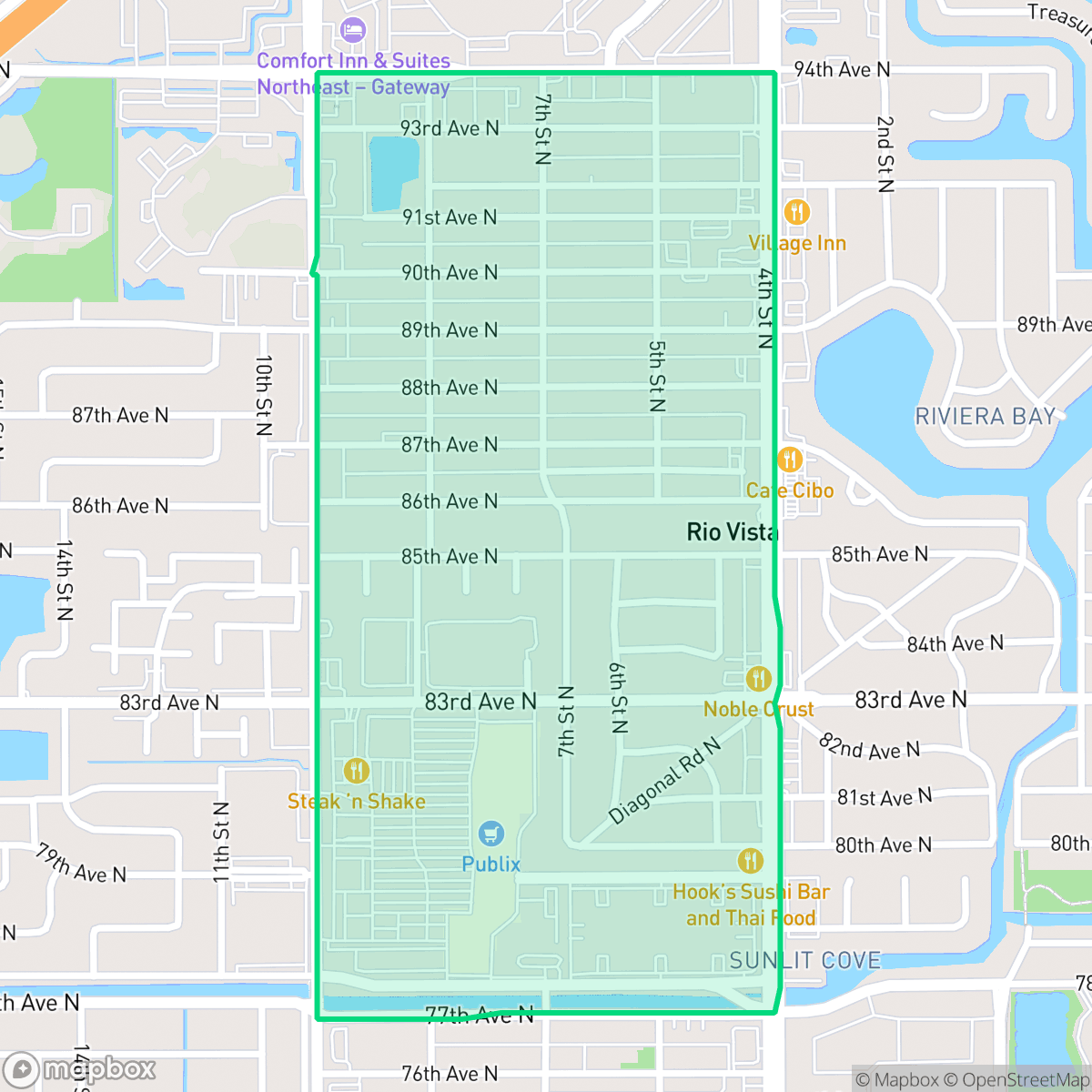
The Gateway area, a 30-square-mile district in north St. Petersburg, evolved from its mid-20th-century origins as dairy and pastureland into a prominent 'edge city.' Following a development boom in the 1950s and 1960s, the region transformed into a major business and industrial hub, notably marked by the 1968 opening of the Gateway Mall. Today, it serves as a critical transportation crossroads for the Tampa Bay region, situated at the western end of the Howard Frankland Bridge. While primarily recognized as a center for corporate headquarters and manufacturing, the district also encompasses residential communities like Riviera Bay and Meadowlawn. The area remains defined by its strategic role as a regional employment core, hosting major firms including Raymond James Financial and Jabil, while continuing to transition toward a modern, mixed-use environment.
The neighborhood offers a unique blend of corporate professional life and suburban living, defined by its connectivity to the broader Tampa Bay region. Residents enjoy a highly walkable environment with an active collection of cafes, shopping centers, and wellness studios that foster an energetic atmosphere. The landscape is visually diverse, featuring a mix of apartment complexes and single-family homes that provide a moderate level of privacy compared to more dense urban pockets of the city.
Potential residents should consider that the area experiences moderate traffic noise and has limited access to dedicated public green spaces for pets. While the community benefits from stable health insurance coverage and strong academic support through the local school district, it is important to note the environmental considerations, specifically the poor air quality and significant flood vulnerability. This area is well-suited for professionals and families who prioritize convenience and regional accessibility over proximity to traditional public parks.
Neighborhood Scores Across 15 Qualities
Residential spacing offers a balance of shared community areas and individual yards. According to iHuus data, this level of separation provides slightly more buffering between neighbors than the St. Petersburg average.
Pedestrians benefit from a consistent sidewalk network and safe crossings on both residential streets and main roads. According to iHuus data, this connectivity is notably higher than the St. Petersburg average.
Residential views range from upscale waterfront estates with private pools to standard middle-class tract housing and apartment complexes. This visual variety is consistent with the city average for St. Petersburg.
Walking paths and green verges are available in certain areas, though the neighborhood lacks dedicated public parks. According to iHuus data, opportunities for dog walking are slightly below the city average.
A mix of single-family homes, apartment clusters, and commercial retail defines the landscape. This area feels slightly more open than the typical St. Petersburg urban environment due to the presence of scattered residential pockets and larger commercial developments.
Active retail corridors and diverse dining options create a much more energetic atmosphere than the St. Petersburg average. Residents can access a high concentration of local cafes, wellness studios, and shopping centers within a walkable suburban landscape.
Steady traffic sounds from nearby busy streets are present, though acoustic levels remain more tranquil than the city average according to iHuus data.
Frequent periods of unhealthy air quality pose significant risks to sensitive groups. According to iHuus data, these conditions are slightly worse than the average found across St. Petersburg.
Primarily residential and light commercial in nature, this area lacks heavy industrial hazards or large logistics hubs. According to iHuus data, the absence of significant industry here is slightly better than the St. Petersburg average.
Health insurance access among residents is slightly above the St. Petersburg average, according to iHuus data. This indicates a relatively high level of coverage within the community.
Political leanings in this area are evenly split between conservative and liberal views, making it less partisan than the St. Petersburg average according to iHuus data.
Residents live alongside a balanced variety of young adults, families, and older individuals. This demographic distribution aligns closely with the average seen throughout St. Petersburg.
Significant flood vulnerability exists here due to the area's location within a designated floodplain; according to iHuus data, this risk level is considerably higher than the St. Petersburg average.
Address-Level Insights for Gateway


iHuus Neighborhood Intelligence Insights
Get address-level neighborhood insights for Gateway
- Street-level scores — see how individual blocks compare, not just neighborhood averages
- Micro-zone boundaries — identify quiet pockets, flood boundaries, and walkable clusters before you visit
- 15 dimensions in full — walkability, noise, air quality, school quality, insurance coverage, population age profile, urban/rural index, and more
- Boundary risk alerts — know if your address sits near a block boundary where scores drop, the kind of detail no listing will ever mention
- School insights — individual school ratings and insights, not just district-level data
- Compare before you commit — side-by-side data across neighborhoods, down to block precision
No credit card required
Compare with Any Neighborhood
| Dimension | Gateway | Albert Whitted Airport |
|---|---|---|
| 🚶 Walkabilityavg 6.61 | ||
| 🔊 Acoustic Comfortavg 3.78 | ||
| 🤫 Privacy Indexavg 5.45 | ||
| 🎨 Visual Appealavg 6.33 | ||
| 🐕 Dog Friendlinessavg 5.45 | ||
| 🗺️ Urban-Rural Indexavg 6.19 | ||
| ✨ Neighborhood Vibeavg 3.5 | ||
| 🏥 Health Insurance Coverageavg 6.88 | ||
| 🌿 Air Qualityavg 1.87 | ||
| 🏭 Industrial Proximityavg 7.55 | ||
| 🌊 Flood Safetyavg 4.61 | ||
| 🗳️ Ideological Leanavg 6.01 | ||
| 👥 Population Age Profileavg 5.11 | ||
| 🔥 Fire Safety | ||
| 🏫 School Quality |
Gateway Rankings
School Districts Serving Gateway
School Insights for Gateway
Below average outcomes; significant attendance and academic challenges.
School Insights
See what's really behind every school rating near Gateway
- Individual school ratings — each school's own score with outcome context, not just a district average
- Enrollment & class size data — student-to-teacher ratio and how it compares to the state average
- Full demographics breakdown — ethnicity and gender composition for every school in the enrollment zone
- Every school in the district — all schools within the enrollment boundary ranked by rating, not just the closest one
- Grade levels & benchmarks — elementary through high school, with below/above state-average flags
No credit card required