Garden Manor Lake, St. Petersburg
Updated · 430 residents
Garden Manor Lake is a quiet, mid-century suburban enclave known for its tree-lined streets and high walkability. Residents enjoy a steady, family-oriented pace of life with easy access to community recreation and local parks.
Key Highlights
About Garden Manor Lake
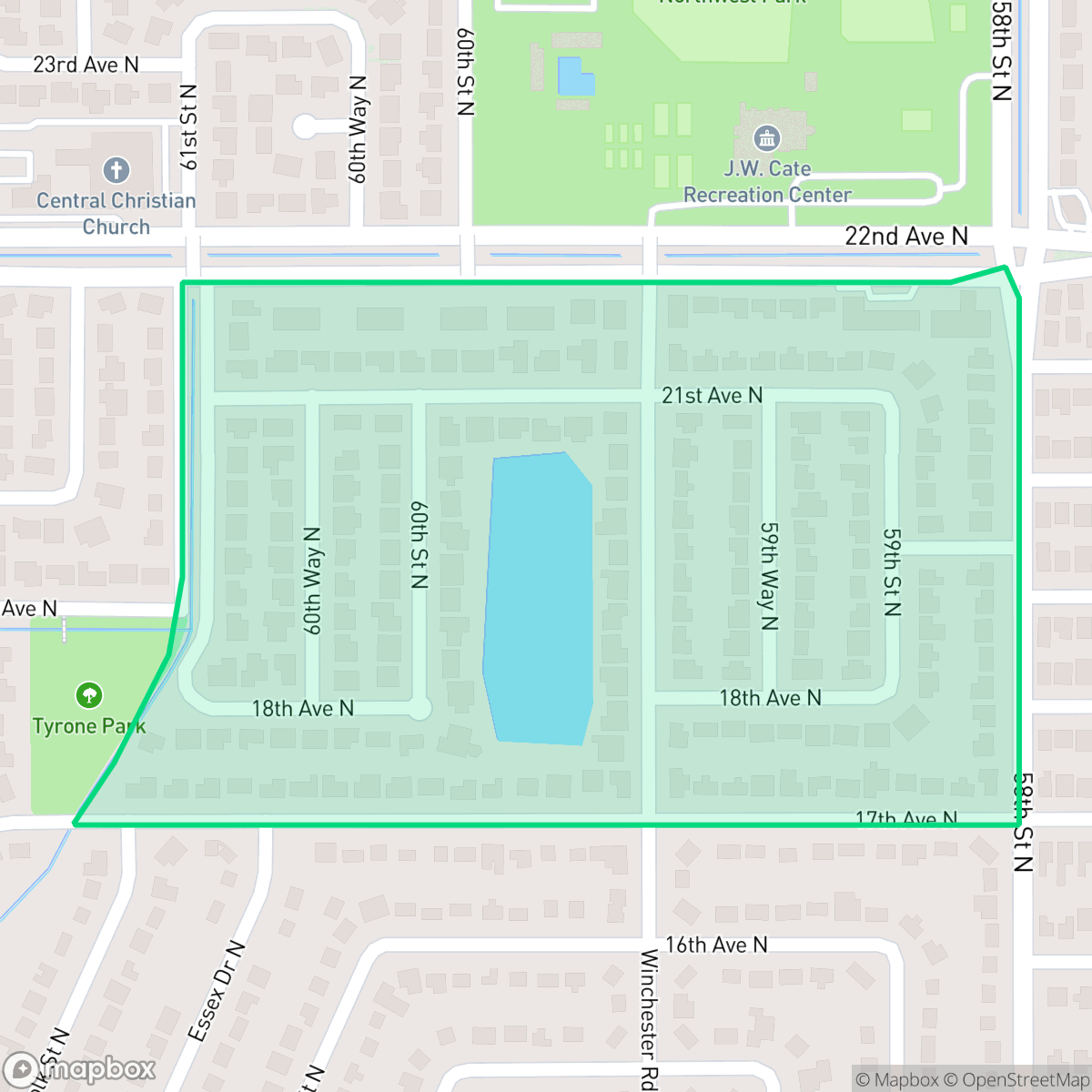
Garden Manor Lake Estates is a residential neighborhood in western St. Petersburg, defined by its mid-20th-century suburban character. Developed primarily during the 1950s, the area features a collection of classic ranch-style homes set along tree-lined streets. The neighborhood is bounded by 17th Avenue North, 22nd Avenue North, Norfolk Street, and 58th Street North. Its identity is closely tied to its quiet, family-oriented atmosphere and the presence of small, scenic lakes that reflect the original mid-century planning vision. Residents are served by the nearby J.W. Cate Recreation Center, which acts as a central hub for community gatherings and local association meetings. The neighborhood maintains a strong sense of community through the Garden Manor Lake Estates Neighborhood Association, which focuses on preserving the area's residential charm and fostering civic engagement.
The area is characterized by a dense suburban layout that maintains a semi-rural feel through its open land and scattered homes. It offers a balanced demographic mix, making it a stable environment for families and individuals alike. With an absence of industrial activity, the neighborhood focuses on residential comfort and community-led wellness initiatives centered around local recreation facilities. According to iHuus data, the community benefits from a lack of heavy industry, allowing for a more tranquil environment than many other urban sectors.
Prospective residents should note that the neighborhood sits within a designated floodplain, which requires careful consideration regarding property maintenance and insurance. While the environment is highly walkable, the area experiences moderate traffic noise and occasionally poor air quality. Despite these trade-offs, the community remains a resilient choice for those who value a pedestrian-friendly lifestyle and a politically balanced atmosphere.
Neighborhood Scores Across 15 Qualities
Residential spacing offers a moderate level of separation between properties, providing slightly more buffer between neighbors than the St. Petersburg average. Homes are situated with limited distance between structures, according to iHuus data.
Extensive sidewalk networks and pedestrian-priority areas make navigating the neighborhood on foot easy. This level of accessibility for walkers is significantly higher than the St. Petersburg average.
Typical tract housing with modest yards and occasional private pools defines the area. The visual landscape is slightly below the St. Petersburg average for aesthetic variety.
A large central park featuring ball fields and courts provides accessible green space for pets. According to iHuus data, this area offers slightly better amenities for dog owners than the St. Petersburg average.
Frequent open land and scattered homes amid woodland create a landscape slightly more rural than the St. Petersburg average. This area features a dense suburban layout characterized by uniform single-family housing and a central community park.
Active community life revolves around local parks and wellness centers, providing a level of liveliness that is higher than the St. Petersburg average. Residents can access various fitness services and outdoor spaces within a walkable, suburban setting.
Steady sounds from nearby busy streets are present, though the acoustic environment remains more tranquil than many other parts of St. Petersburg according to iHuus data.
Frequent unhealthy air quality levels pose significant risks to sensitive groups. According to iHuus data, conditions in this area are slightly worse than the St. Petersburg average.
Residential and recreational zoning dominates the area with an absence of warehouses or heavy industry. This lack of industrial presence is notably higher than the St. Petersburg average, according to iHuus data.
Health insurance access among residents is lower than the St. Petersburg average, according to iHuus data.
Political leanings in this area are split nearly evenly between conservative and liberal perspectives; this represents a more moderate distribution than the broader St. Petersburg average according to iHuus data.
Residents will find a balanced demographic spread of young adults, families, and older individuals. This age distribution is slightly more varied than the average seen across St. Petersburg.
Frequent flooding is a concern in this area because it sits within a designated floodplain. According to iHuus data, the vulnerability to rising waters is notably higher than the St. Petersburg average.
Address-Level Insights for Garden Manor Lake


iHuus Neighborhood Intelligence Insights
Get address-level neighborhood insights for Garden Manor Lake
- Street-level scores — see how individual blocks compare, not just neighborhood averages
- Micro-zone boundaries — identify quiet pockets, flood boundaries, and walkable clusters before you visit
- 15 dimensions in full — walkability, noise, air quality, school quality, insurance coverage, population age profile, urban/rural index, and more
- Boundary risk alerts — know if your address sits near a block boundary where scores drop, the kind of detail no listing will ever mention
- School insights — individual school ratings and insights, not just district-level data
- Compare before you commit — side-by-side data across neighborhoods, down to block precision
No credit card required
Compare with Any Neighborhood
| Dimension | Garden Manor Lake | Albert Whitted Airport |
|---|---|---|
| 🚶 Walkabilityavg 6.61 | ||
| 🔊 Acoustic Comfortavg 3.78 | ||
| 🤫 Privacy Indexavg 5.45 | ||
| 🎨 Visual Appealavg 6.33 | ||
| 🐕 Dog Friendlinessavg 5.45 | ||
| 🗺️ Urban-Rural Indexavg 6.19 | ||
| ✨ Neighborhood Vibeavg 3.5 | ||
| 🏥 Health Insurance Coverageavg 6.88 | ||
| 🌿 Air Qualityavg 1.87 | ||
| 🏭 Industrial Proximityavg 7.55 | ||
| 🌊 Flood Safetyavg 4.61 | ||
| 🗳️ Ideological Leanavg 6.01 | ||
| 👥 Population Age Profileavg 5.11 | ||
| 🔥 Fire Safety | ||
| 🏫 School Quality |
Garden Manor Lake Rankings
School Districts Serving Garden Manor Lake
School Insights for Garden Manor Lake
Below average outcomes; significant attendance and academic challenges.
School Insights
See what's really behind every school rating near Garden Manor Lake
- Individual school ratings — each school's own score with outcome context, not just a district average
- Enrollment & class size data — student-to-teacher ratio and how it compares to the state average
- Full demographics breakdown — ethnicity and gender composition for every school in the enrollment zone
- Every school in the district — all schools within the enrollment boundary ranked by rating, not just the closest one
- Grade levels & benchmarks — elementary through high school, with below/above state-average flags
No credit card required