Fossil Park, St. Petersburg
Updated · 2,741 residents
Fossil Park is a distinctive residential community known for its mid-century character and strong focus on local youth sports. Residents enjoy a highly walkable environment with convenient access to local retail and dining, all while maintaining a semi-rural feel with frequent pockets of greenery.
Key Highlights
About Fossil Park
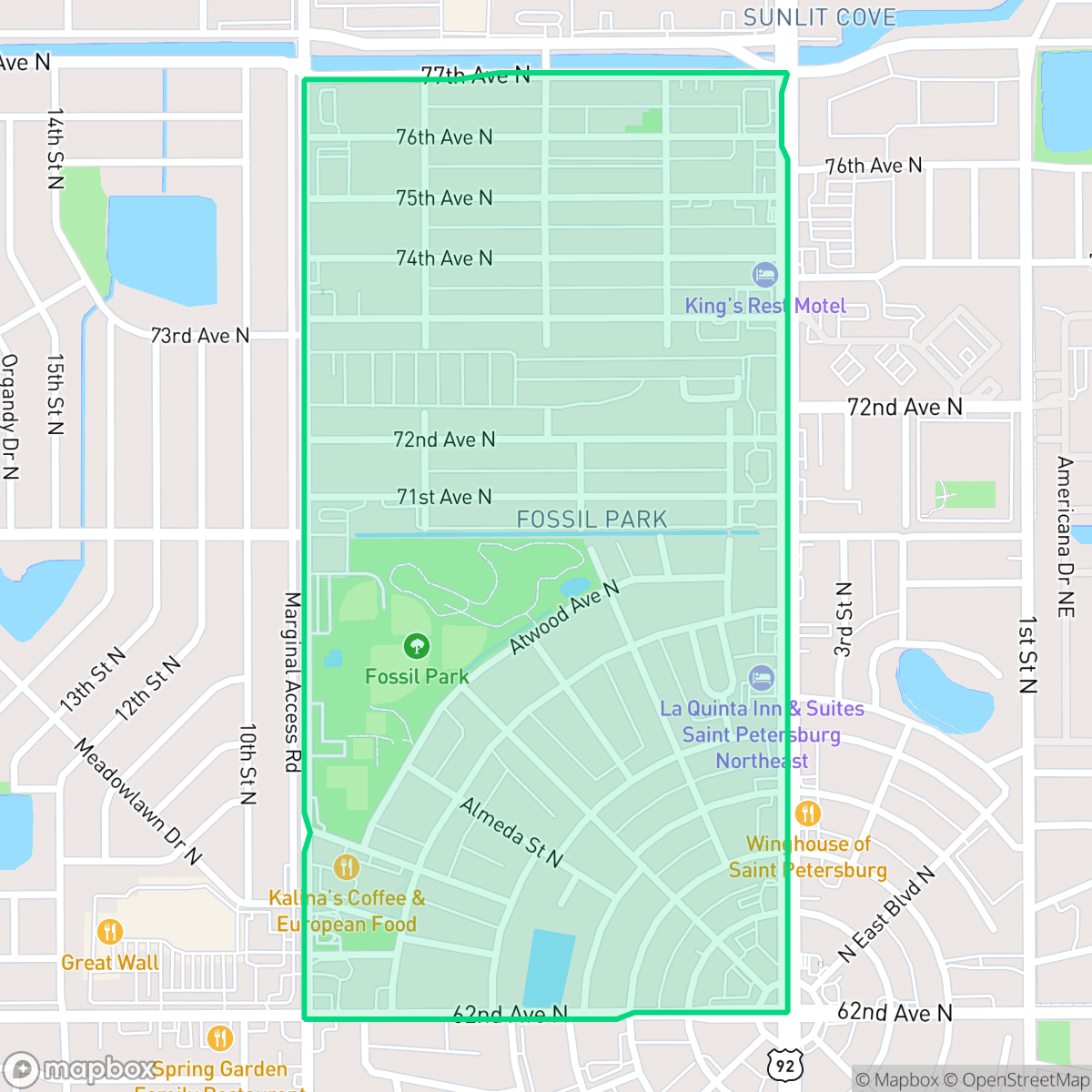
Fossil Park, located between 4th and 9th Streets North and 62nd and 77th Avenues North, traces its roots to the 1920s, though it grew rapidly as a residential community for veterans after World War II. Originally pine flatwoods and wetlands, the area was once a grapefruit grove known as Swannee Gardens. The neighborhood’s name reflects the significant quantity of fossils and prehistoric artifacts discovered on the property, a legacy commemorated by the "Fossil Wall" at the local park. Designed with influences from the City Beautiful Movement, the southern section features unique circular street patterns. The community is defined by its modest, mid-century ranch-style homes and serves as a hub for youth sports, centered around the Willis S. Johns Recreation Center, which opened in 1971. Today, Fossil Park remains a quiet, residential neighborhood known for its historical character and long-standing community traditions.
The neighborhood stands out for its balanced demographic mix and active suburban atmosphere, supported by a variety of local businesses and recreational amenities. Pedestrians benefit from a well-connected grid of streets with consistent sidewalks, making it one of the more accessible areas in the city for those who prefer to travel on foot. The landscape is characterized by a mix of suburban housing and open green spaces, providing a setting that avoids the heavy industrial presence found in other parts of the region. Residents often find the area to be a lively hub where local cafes and shops are within easy reach.
Prospective residents should be aware of specific environmental and lifestyle trade-offs. The community is situated within a designated floodplain, which necessitates careful consideration of flood safety. Additionally, air quality levels can occasionally be poor, and residents may notice steady noise from nearby major traffic arteries. Despite these factors, the area remains a popular choice for those seeking a diverse, politically mixed community with access to the well-regarded Pinellas County school system.
Neighborhood Scores Across 15 Qualities
Residential spacing varies throughout the area, ranging from closely packed multi-family units to suburban homes with private fenced yards. This level of density is slightly higher than the St. Petersburg average, according to iHuus data.
Pedestrian access is well-supported by a grid of residential streets featuring continuous sidewalks and safe crossings. According to iHuus data, this level of walkability is notably higher than the St. Petersburg average.
Uniform tract housing and high-density mobile home parks characterize the area, which presents a slightly lower visual variety than the St. Petersburg average. Many properties feature private or shared pools within a consistent, single-story residential layout.
Grassy verges and nearby park areas provide adequate space for pet exercise. According to iHuus data, the availability of walking paths in this area is above the St. Petersburg average.
Frequent open land and scattered homes among woodlands provide a slightly more rural atmosphere than the St. Petersburg average. Residents can expect a landscape defined by pockets of greenery and less dense development compared to the city center.
A diverse mix of retail centers, dining, and cultural venues provides significantly more activity than the St. Petersburg average. Residents can access various local cafes, bars, and independent shops within a walkable landscape.
Steady traffic sounds from nearby thoroughfares are present; however, acoustic comfort levels remain higher than the St. Petersburg average according to iHuus data.
Frequent unhealthy air quality levels pose a significant risk to sensitive groups. This condition is slightly worse than the St. Petersburg average, according to iHuus data.
Residential tranquility is maintained by an absence of heavy manufacturing, though large retail centers and utility substations provide occasional light commercial activity. This area remains slightly cleaner than the St. Petersburg average regarding industrial proximity, according to iHuus data.
Health insurance enrollment among residents is lower than the St. Petersburg average, according to iHuus data.
Political perspectives in Fossil Park are roughly balanced between conservative and liberal leanings, representing a more moderate distribution than the city average according to iHuus data.
Residents live alongside a balanced mix of young adults, families, and seniors. This demographic spread is slightly more varied than the average found throughout St. Petersburg.
Significant flood risk exists within this area because it sits inside a designated floodplain; according to iHuus data, this level of vulnerability is notably higher than the St. Petersburg average.
Address-Level Insights for Fossil Park


iHuus Neighborhood Intelligence Insights
Get address-level neighborhood insights for Fossil Park
- Street-level scores — see how individual blocks compare, not just neighborhood averages
- Micro-zone boundaries — identify quiet pockets, flood boundaries, and walkable clusters before you visit
- 15 dimensions in full — walkability, noise, air quality, school quality, insurance coverage, population age profile, urban/rural index, and more
- Boundary risk alerts — know if your address sits near a block boundary where scores drop, the kind of detail no listing will ever mention
- School insights — individual school ratings and insights, not just district-level data
- Compare before you commit — side-by-side data across neighborhoods, down to block precision
No credit card required
Compare with Any Neighborhood
| Dimension | Fossil Park | Albert Whitted Airport |
|---|---|---|
| 🚶 Walkabilityavg 6.61 | ||
| 🔊 Acoustic Comfortavg 3.78 | ||
| 🤫 Privacy Indexavg 5.45 | ||
| 🎨 Visual Appealavg 6.33 | ||
| 🐕 Dog Friendlinessavg 5.45 | ||
| 🗺️ Urban-Rural Indexavg 6.19 | ||
| ✨ Neighborhood Vibeavg 3.5 | ||
| 🏥 Health Insurance Coverageavg 6.88 | ||
| 🌿 Air Qualityavg 1.87 | ||
| 🏭 Industrial Proximityavg 7.55 | ||
| 🌊 Flood Safetyavg 4.61 | ||
| 🗳️ Ideological Leanavg 6.01 | ||
| 👥 Population Age Profileavg 5.11 | ||
| 🔥 Fire Safety | ||
| 🏫 School Quality |
Fossil Park Rankings
School Districts Serving Fossil Park
School Insights for Fossil Park
Below average outcomes; significant attendance and academic challenges.
School Insights
See what's really behind every school rating near Fossil Park
- Individual school ratings — each school's own score with outcome context, not just a district average
- Enrollment & class size data — student-to-teacher ratio and how it compares to the state average
- Full demographics breakdown — ethnicity and gender composition for every school in the enrollment zone
- Every school in the district — all schools within the enrollment boundary ranked by rating, not just the closest one
- Grade levels & benchmarks — elementary through high school, with below/above state-average flags
No credit card required