Five Points, St. Petersburg
Updated · 876 residents
Five Points is a highly walkable neighborhood known for its historic architecture and a vibrant local retail scene. Residents benefit from easy access to independent shops and diverse dining options, though the area experiences moderate street noise and periodic air quality fluctuations.
Key Highlights
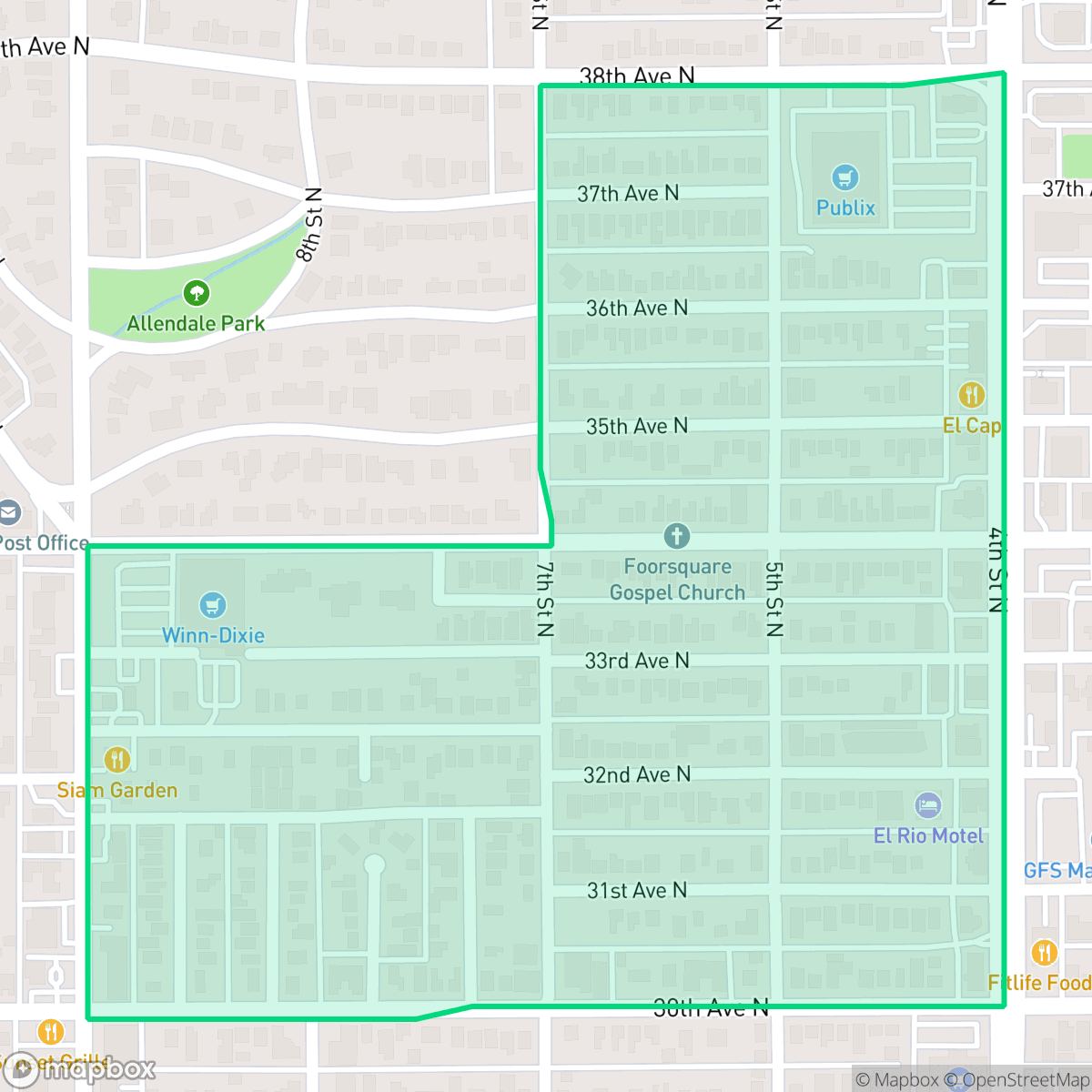
About Five Points
Five Points is an established residential neighborhood in St. Petersburg, Florida, known for its picturesque, brick-lined streets and mature oak canopy. The area’s architectural character is defined by a collection of early-to-mid 20th-century homes, featuring a mix of 1920s Craftsman bungalows, Mediterranean Revival styles, and mid-century estates. Originally developed as a hub for working-class families, the neighborhood has evolved into a quiet, community-focused enclave. Its name is derived from the convergence of five roads that historically served as a focal point for the area. Today, Five Points is recognized for its high elevation relative to the city and its enduring historical integrity, maintaining a balance between preserved heritage and modern residential updates while remaining centrally located near St. Petersburg’s downtown and cultural districts.
The neighborhood functions as a lively social hub where a dense grid of streets and well-maintained sidewalks make daily errands and local dining easily accessible on foot. With a demographic that spans young professionals, families, and seniors, the area maintains a balanced social atmosphere that is more active than many other parts of the city. The visual environment is varied, ranging from middle-class housing to upscale waterfront estates, creating a distinct character that blends historic preservation with modern residential life.
While the area offers high health insurance coverage and a low industrial presence, prospective residents should consider certain trade-offs. The neighborhood has limited public space for pets and faces a moderate risk of flooding, requiring awareness during extreme weather events. Additionally, according to iHuus data, steady traffic sounds from nearby corridors contribute to a moderate level of street noise. This location is best suited for those who prioritize pedestrian-friendly living and proximity to cultural districts over a secluded or quiet suburban environment.
Neighborhood Scores Across 15 Qualities
Residential spacing varies throughout the area, ranging from closely packed interior blocks to larger lots near the waterfront. This level of density provides slightly more separation between neighbors than the St. Petersburg average.
Dense street grids and well-maintained sidewalks make most daily errands accessible on foot. This area offers significantly better pedestrian infrastructure and safer crossings than the St. Petersburg average, according to iHuus data.
Streetscapes feature a mix of middle-class housing and affluent waterfront estates with private docks, making the visual environment slightly more upscale than the St. Petersburg average according to iHuus data.
Public green space and wide sidewalks for walking pets are below the St. Petersburg average. While some areas offer waterfront access, many residential blocks feature narrow verges and dense lots with minimal public park proximity.
Residential streets and commercial corridors provide a dense suburban feel that is slightly more developed than the St. Petersburg average. This area features a blend of single-family homes and multi-story buildings alongside established commercial blocks.
Concentrated clusters of independent shops and diverse dining options create a much more active atmosphere than the typical St. Petersburg neighborhood. According to iHuus data, this mixed-use area provides a noticeable amount of local activity through its walkable grid of restaurants and retail blocks.
Steady traffic sounds from nearby busy streets are common in this area. According to iHuus data, the acoustic environment is notably more active than the St. Petersburg average.
Frequent unhealthy air quality levels pose a significant risk to sensitive groups. This condition is roughly comparable to the city average according to iHuus data.
Residential and light commercial uses dominate the area, with very few industrial facilities or hazardous sites nearby. Residents may encounter occasional utility odors or transit traffic near local service hubs like gas stations, but overall industrial proximity is lower than the St. Petersburg average according to iHuus data.
Health insurance access among residents is notably higher than the St. Petersburg average, according to iHuus data.
Political leanings in this area are more liberal than the St. Petersburg average, characterized by a liberal majority with some opposing presence.
Residents live alongside a balanced mix of young professionals, families, and seniors. This demographic variety is slightly more diverse than the typical age distribution found across St. Petersburg.
Flood risk in this area is slightly higher than the St. Petersburg average, though detailed FEMA studies for this specific zone remain incomplete. Residents should consider potential vulnerabilities during extreme weather events according to iHuus data.
Address-Level Insights for Five Points


iHuus Neighborhood Intelligence Insights
Get address-level neighborhood insights for Five Points
- Street-level scores — see how individual blocks compare, not just neighborhood averages
- Micro-zone boundaries — identify quiet pockets, flood boundaries, and walkable clusters before you visit
- 15 dimensions in full — walkability, noise, air quality, school quality, insurance coverage, population age profile, urban/rural index, and more
- Boundary risk alerts — know if your address sits near a block boundary where scores drop, the kind of detail no listing will ever mention
- School insights — individual school ratings and insights, not just district-level data
- Compare before you commit — side-by-side data across neighborhoods, down to block precision
No credit card required
Compare with Any Neighborhood
| Dimension | Five Points | Albert Whitted Airport |
|---|---|---|
| 🚶 Walkabilityavg 6.61 | ||
| 🔊 Acoustic Comfortavg 3.78 | ||
| 🤫 Privacy Indexavg 5.45 | ||
| 🎨 Visual Appealavg 6.33 | ||
| 🐕 Dog Friendlinessavg 5.45 | ||
| 🗺️ Urban-Rural Indexavg 6.19 | ||
| ✨ Neighborhood Vibeavg 3.5 | ||
| 🏥 Health Insurance Coverageavg 6.88 | ||
| 🌿 Air Qualityavg 1.87 | ||
| 🏭 Industrial Proximityavg 7.55 | ||
| 🌊 Flood Safetyavg 4.61 | ||
| 🗳️ Ideological Leanavg 6.01 | ||
| 👥 Population Age Profileavg 5.11 | ||
| 🔥 Fire Safety | ||
| 🏫 School Quality |
Five Points Rankings
School Districts Serving Five Points
School Insights for Five Points
Below average outcomes; significant attendance and academic challenges.
School Insights
See what's really behind every school rating near Five Points
- Individual school ratings — each school's own score with outcome context, not just a district average
- Enrollment & class size data — student-to-teacher ratio and how it compares to the state average
- Full demographics breakdown — ethnicity and gender composition for every school in the enrollment zone
- Every school in the district — all schools within the enrollment boundary ranked by rating, not just the closest one
- Grade levels & benchmarks — elementary through high school, with below/above state-average flags
No credit card required