Euclid-St Pauls, St. Petersburg
Updated · 2,151 residents
Euclid-St. Pauls is a historic district defined by its 1920s architecture, brick-lined streets, and mature oak canopy. The area offers high walkability and a vibrant local atmosphere, though residents should expect frequent noise from nearby rail lines and major roadways.
Key Highlights
About Euclid-St Pauls
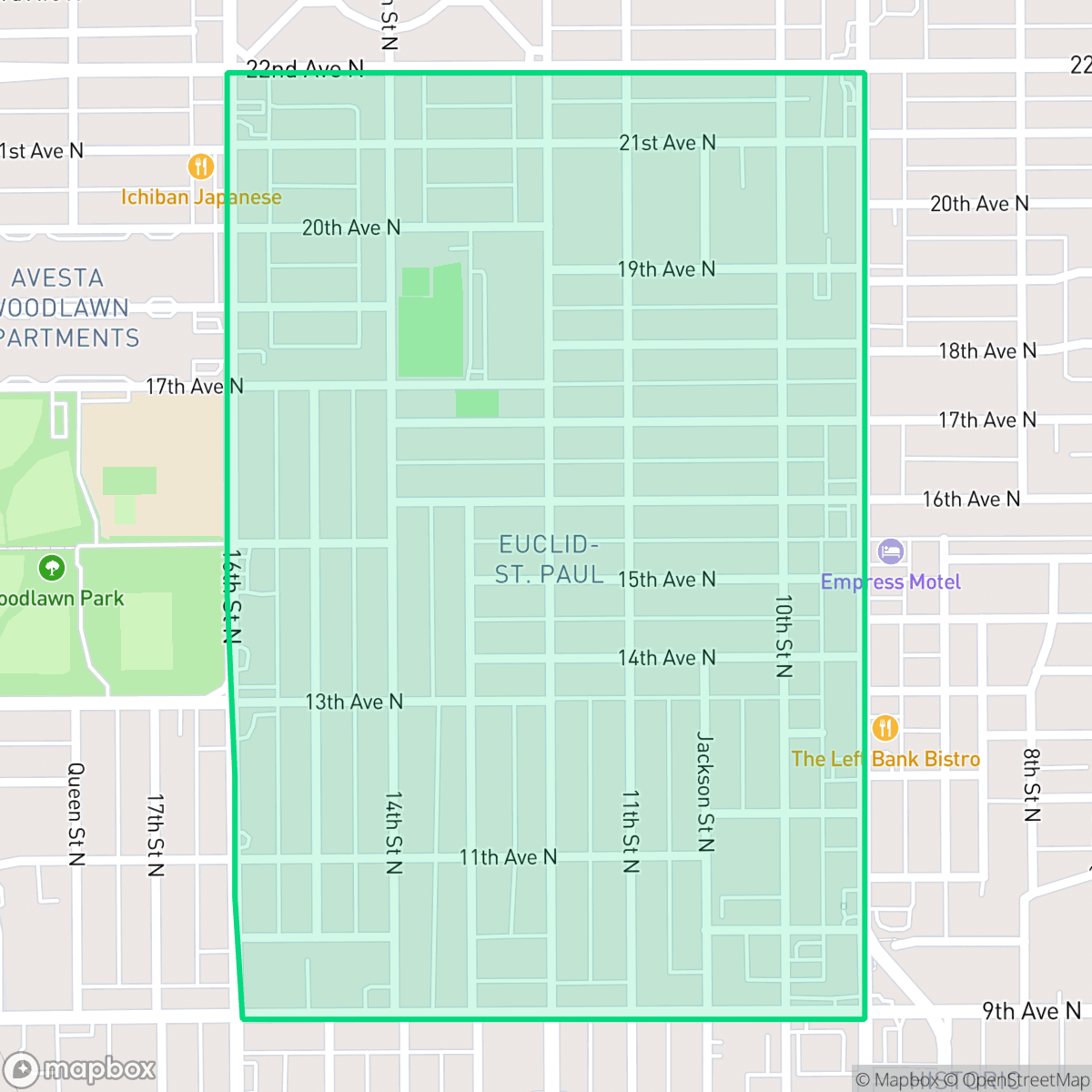
Euclid-St. Pauls is a 240-acre historic neighborhood in St. Petersburg that originated as a citrus grove before undergoing rapid development during the 1920s land boom. Platted by developer John B. Green in 1921, the area was designed with exclusive subdivisions like Edina-Garden of Eden and Old Kentucky, which mandated specific home valuations and sizes. The neighborhood is architecturally defined by its 1920s Florida bungalows, Craftsman homes, and examples of Colonial and Mediterranean Revival styles, many featuring rear-alley garage apartments. Characterized by its original brick-lined streets and mature oak and magnolia canopy, it is home to one of the city's oldest continuously active neighborhood associations, established in 1921. The district is also noted for its unique 'Zone X' flood status, distinguishing it from other near-urban areas in Pinellas County.
The neighborhood maintains a semi-rural feel through its significant tree canopy and open spaces, providing a distinct contrast to the denser urban core of St. Petersburg. Residents benefit from a lively environment filled with cafes, wellness services, and local dining options that reflect the area's strongly liberal demographic. The presence of well-maintained parks and pedestrian-friendly grids encourages an active lifestyle, making the district particularly appealing to those who prioritize walkability and a strong sense of community identity.
Living in this area involves certain trade-offs, particularly regarding acoustic comfort and air quality, which are impacted by local industrial and transit corridors. While the neighborhood boasts a lower flood risk than much of the surrounding city, prospective residents should consider the moderate residential privacy and the current state of local health insurance accessibility. The area is served by the Pinellas County School District, which provides stable academic resources despite ongoing efforts to consolidate facilities due to shifting enrollment trends. It is best suited for individuals or families who value historic charm and proximity to local amenities over absolute silence or pristine air conditions.
Neighborhood Scores Across 15 Qualities
Housing density remains moderate with a mix of apartment blocks and single-family homes that offer slightly more separation than the St. Petersburg average. Backyard fencing and typical suburban lot spacing provide a reasonable buffer between neighboring properties according to iHuus data.
Pedestrian access is well-supported by a dense grid of sidewalks and safe crossings, making it more walkable than the St. Petersburg average. While much of the area offers easy foot traffic near parks and retail, proximity to a major highway can create barriers for southern movement.
Manicured yards and large homes with private pools are interspersed with standard tract housing and apartment complexes. This variety in residential density and property scale aligns with the city average for visual appeal.
Abundant walking trails and large public parks with lakes and ballfields offer more accessible green space for pets than the St. Petersburg average. Tree-lined streets and wide verges throughout many parts of the neighborhood provide safe environments for dog walking.
Frequent open land and significant tree canopy provide a more semi-rural feel compared to the denser city average. Residents can expect a landscape of scattered homes interspersed with pockets of woodland and green spaces.
Vibrant pockets of activity and dining options make this area significantly more lively than the St. Petersburg average. Residents can find a varied mix of wellness services, cafes, and restaurants clustered near local universities and civic institutions.
Frequent sounds from nearby rail lines and major roadways characterize this area. According to iHuus data, acoustic comfort in this neighborhood is slightly lower than the St. Petersburg average.
Frequent unhealthy air quality levels pose significant risks to sensitive groups. According to iHuus data, these conditions are slightly worse than the St. Petersburg average.
Primarily residential in character, this area avoids heavy industrial hazards and lacks the large scale manufacturing found elsewhere. Occasional light commercial activity and a nearby rail corridor provide some intermittent operational hum, but these elements are less prevalent here than in the city average.
Health insurance accessibility in this area is lower than the St. Petersburg average, according to iHuus data.
Voting patterns in this area reflect a significantly more liberal leaning than the St. Petersburg average; according to iHuus data, there is a clear majority favoring liberal ideologies with only a small opposing presence.
A balanced mix of young adults, families, and older residents defines the local demographic. This age distribution mirrors the broader St. Petersburg area.
Flood risk in this area is notably lower than the St. Petersburg average, although some residual risk remains due to its location within a 500-year floodplain. According to iHuus data, property owners should still account for potential seasonal water fluctuations.
Address-Level Insights for Euclid-St Pauls


iHuus Neighborhood Intelligence Insights
Get address-level neighborhood insights for Euclid-St Pauls
- Street-level scores — see how individual blocks compare, not just neighborhood averages
- Micro-zone boundaries — identify quiet pockets, flood boundaries, and walkable clusters before you visit
- 15 dimensions in full — walkability, noise, air quality, school quality, insurance coverage, population age profile, urban/rural index, and more
- Boundary risk alerts — know if your address sits near a block boundary where scores drop, the kind of detail no listing will ever mention
- School insights — individual school ratings and insights, not just district-level data
- Compare before you commit — side-by-side data across neighborhoods, down to block precision
No credit card required
Compare with Any Neighborhood
| Dimension | Euclid-St Pauls | Albert Whitted Airport |
|---|---|---|
| 🚶 Walkabilityavg 6.61 | ||
| 🔊 Acoustic Comfortavg 3.78 | ||
| 🤫 Privacy Indexavg 5.45 | ||
| 🎨 Visual Appealavg 6.33 | ||
| 🐕 Dog Friendlinessavg 5.45 | ||
| 🗺️ Urban-Rural Indexavg 6.19 | ||
| ✨ Neighborhood Vibeavg 3.5 | ||
| 🏥 Health Insurance Coverageavg 6.88 | ||
| 🌿 Air Qualityavg 1.87 | ||
| 🏭 Industrial Proximityavg 7.55 | ||
| 🌊 Flood Safetyavg 4.61 | ||
| 🗳️ Ideological Leanavg 6.01 | ||
| 👥 Population Age Profileavg 5.11 | ||
| 🔥 Fire Safety | ||
| 🏫 School Quality |
Euclid-St Pauls Rankings
School Districts Serving Euclid-St Pauls
School Insights for Euclid-St Pauls
Below average outcomes; significant attendance and academic challenges.
School Insights
See what's really behind every school rating near Euclid-St Pauls
- Individual school ratings — each school's own score with outcome context, not just a district average
- Enrollment & class size data — student-to-teacher ratio and how it compares to the state average
- Full demographics breakdown — ethnicity and gender composition for every school in the enrollment zone
- Every school in the district — all schools within the enrollment boundary ranked by rating, not just the closest one
- Grade levels & benchmarks — elementary through high school, with below/above state-average flags
No credit card required