Edge District, St. Petersburg
Updated · 239 residents
The Edge District is a high-energy urban hub defined by its exceptional walkability and dense concentration of nightlife and dining along the Central Avenue corridor. Residents enjoy a vibrant, pedestrian-oriented lifestyle, though the area is characterized by utilitarian industrial architecture and a consistently active, noisy environment.
Key Highlights
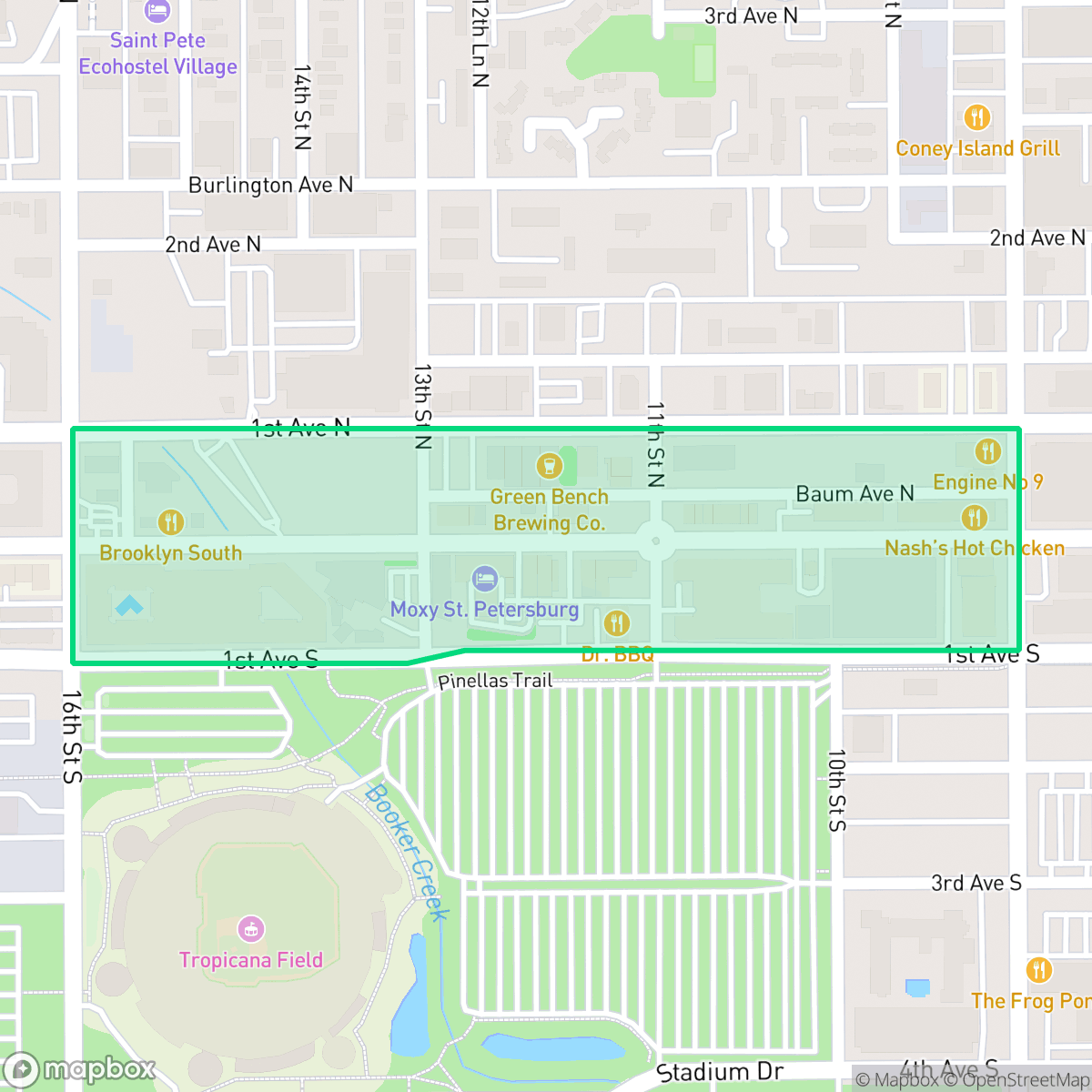
About Edge District
The Edge District in St. Petersburg, Florida, originated as the city’s primary industrial and commercial hub following the arrival of the Orange Belt Railroad in 1888. Unlike the tourist-focused downtown core, the area historically served local needs, housing lumber mills, warehouses, and automotive businesses. Its architectural character is defined by the adaptive reuse of early 20th-century industrial structures, including former loading bays and freight warehouses. Historically adjacent to the Gas Plant and Methodist Town neighborhoods, the district functioned as a utilitarian corridor. Following a period of mid-century decline, the area underwent a significant revitalization beginning around 2012, transforming into a vibrant, pedestrian-oriented destination. Today, it preserves its industrial roots through the restoration of historic buildings, which now anchor a diverse community of local businesses and cultural spaces along the Central Avenue corridor.
This neighborhood functions as a bustling commercial center where the landscape is defined by multi-story buildings and a dense urban grid. It attracts a diverse population of residents who value proximity to city life and a progressive community atmosphere. The area maintains a high level of daily activity, with heavy foot traffic and a steady hum of ambient noise from nearby thoroughfares, making it well-suited for those who prefer an intense, urban experience over quiet, secluded living.
Prospective residents should consider the trade-offs of living in such a dense environment, including limited privacy due to shared property lines and close building configurations. While the neighborhood is highly accessible on foot, pet owners may find limited green space, and those sensitive to air quality should be aware of the industrial-influenced environment. Families living here are served by the Pinellas County School District, which provides stable academic leadership and strong community financial support, even as the district manages long-term enrollment trends and campus consolidations.
Neighborhood Scores Across 15 Qualities
Dense building configurations and narrow gaps between structures result in much less separation than the St. Petersburg average. Residents should expect close proximity to neighbors due to the prevalence of multi-family housing and shared property lines.
Dense street grids and consistent crosswalks make much of the area accessible on foot, significantly outperforming the city average for walkability. While a large multi-lane highway system creates some physical barriers, the neighborhood maintains a comprehensive network of sidewalks and safe crossings according to iHuus data.
Standard apartment complexes and small urban lots define the landscape, offering a visual profile that is slightly below the St. Petersburg average. The area lacks large luxury estates or private greenery, featuring instead a utilitarian mix of commercial blocks and surface parking.
Minimal green space and heavy pavement characterize much of the area, although some residents benefit from a public park with a lake walking path. This availability of accessible pet areas is slightly below the St. Petersburg average.
Highly developed infrastructure with multi-story buildings and significant lot coverage characterizes this area. This level of density is notably lower than the typical urban profile seen across much of St. Petersburg.
Constant movement and a dense concentration of dining, bars, and nightlife create an intense urban atmosphere that is significantly more active than the St. Petersburg average. According to iHuus data, this area functions as a bustling commercial center characterized by heavy foot traffic and continuous activity.
Ongoing street noise from nearby thoroughfares creates a more active acoustic environment than the St. Petersburg average. According to iHuus data, this area maintains a consistent level of ambient sound throughout the day.
Frequent unhealthy air quality levels pose a significant risk to sensitive groups. According to iHuus data, these conditions are slightly worse than the average seen across St. Petersburg.
Light industrial and utility infrastructure, such as parking garages and storage facilities, are present alongside residential areas. Residents may encounter more freight traffic and loading dock activity than is typically found in other parts of St. Petersburg.
Health insurance access among residents in this area is notably lower than the St. Petersburg average, according to iHuus data.
Political demographics in this area lean significantly more liberal than the broader St. Petersburg average, according to iHuus data.
Residents of all ages live here, reflecting a demographic spread that is very similar to the broader St. Petersburg area. According to iHuus data, the population features a balanced blend of young professionals, families, and older adults.
Residual flood risks exist within the area, though safety levels are notably higher than the St. Petersburg average according to iHuus data.
Address-Level Insights for Edge District


iHuus Neighborhood Intelligence Insights
Get address-level neighborhood insights for Edge District
- Street-level scores — see how individual blocks compare, not just neighborhood averages
- Micro-zone boundaries — identify quiet pockets, flood boundaries, and walkable clusters before you visit
- 15 dimensions in full — walkability, noise, air quality, school quality, insurance coverage, population age profile, urban/rural index, and more
- Boundary risk alerts — know if your address sits near a block boundary where scores drop, the kind of detail no listing will ever mention
- School insights — individual school ratings and insights, not just district-level data
- Compare before you commit — side-by-side data across neighborhoods, down to block precision
No credit card required
Compare with Any Neighborhood
| Dimension | Edge District | Albert Whitted Airport |
|---|---|---|
| 🚶 Walkabilityavg 6.61 | ||
| 🔊 Acoustic Comfortavg 3.78 | ||
| 🤫 Privacy Indexavg 5.45 | ||
| 🎨 Visual Appealavg 6.33 | ||
| 🐕 Dog Friendlinessavg 5.45 | ||
| 🗺️ Urban-Rural Indexavg 6.19 | ||
| ✨ Neighborhood Vibeavg 3.5 | ||
| 🏥 Health Insurance Coverageavg 6.88 | ||
| 🌿 Air Qualityavg 1.87 | ||
| 🏭 Industrial Proximityavg 7.55 | ||
| 🌊 Flood Safetyavg 4.61 | ||
| 🗳️ Ideological Leanavg 6.01 | ||
| 👥 Population Age Profileavg 5.11 | ||
| 🔥 Fire Safety | ||
| 🏫 School Quality |
Edge District Rankings
School Districts Serving Edge District
School Insights for Edge District
Below average outcomes; significant attendance and academic challenges.
School Insights
See what's really behind every school rating near Edge District
- Individual school ratings — each school's own score with outcome context, not just a district average
- Enrollment & class size data — student-to-teacher ratio and how it compares to the state average
- Full demographics breakdown — ethnicity and gender composition for every school in the enrollment zone
- Every school in the district — all schools within the enrollment boundary ranked by rating, not just the closest one
- Grade levels & benchmarks — elementary through high school, with below/above state-average flags
No credit card required