Eckerd College, St. Petersburg
Updated · 1,337 residents
Centered around its iconic mid-century campus along Boca Ciega Bay, this neighborhood offers an upscale, coastal atmosphere with manicured residential pockets. While the area provides moderate walkability and pet-friendly paths, residents should be prepared for a quiet suburban environment that faces notable noise from transit corridors and air quality concerns.
Key Highlights
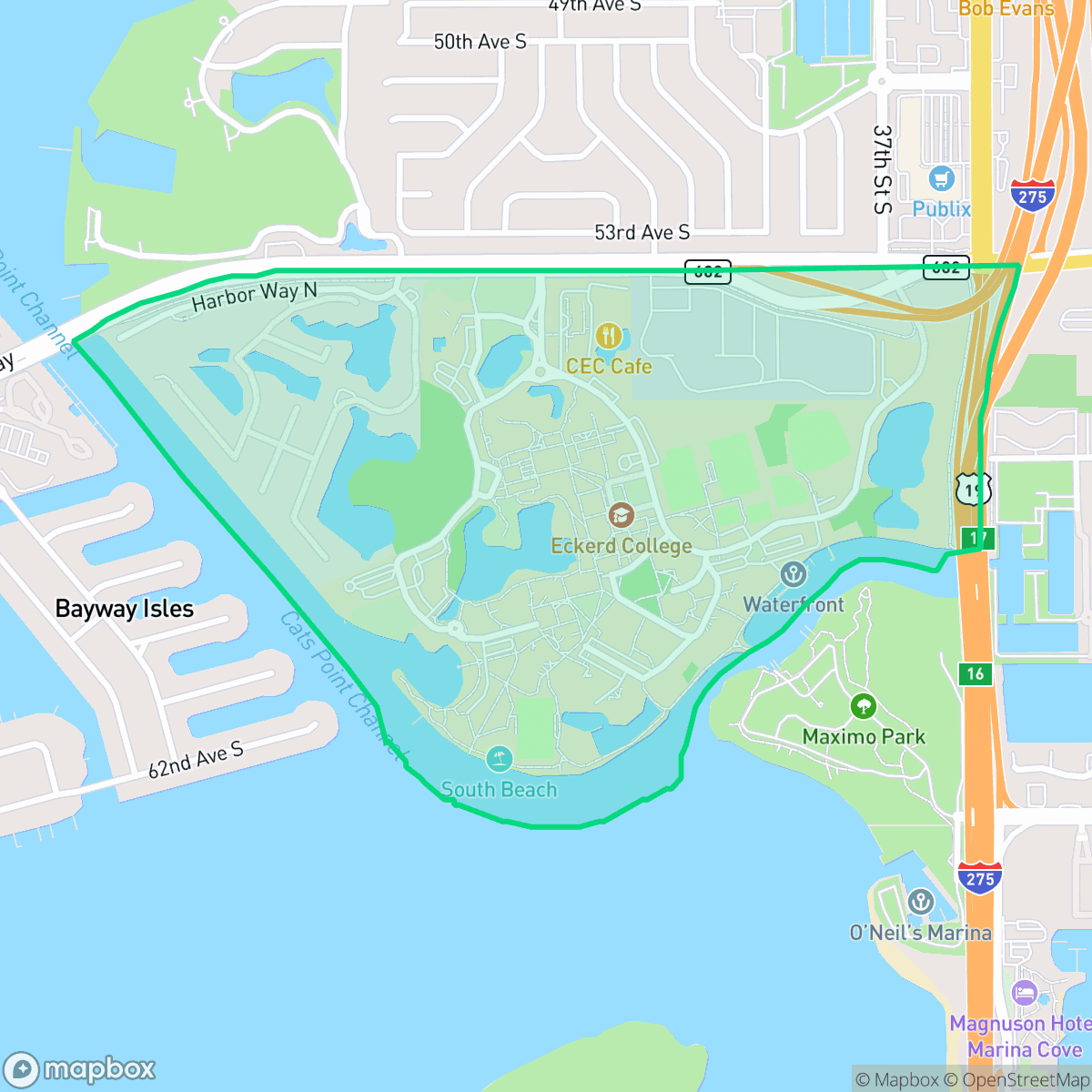
About Eckerd College
Eckerd College, originally founded as Florida Presbyterian College in 1958, is situated on a 188-acre campus along Boca Ciega Bay in St. Petersburg. Designed by architect William Harvard, the campus is noted for its mid-century modern aesthetic, which reflects the architectural trends of the late 1950s and 1960s. The institution was renamed in 1972 following a significant endowment from Jack Eckerd, the founder of the Eckerd drugstore chain. The area is defined by its waterfront location and its role as a hub for environmental and marine science research, which has significantly shaped the cultural identity of the surrounding southern tip of the Pinellas Peninsula.
The area is defined by its unique blend of high-density residential clusters and open coastal land, creating a polished, upscale environment that benefits from significant waterfront views. Residents enjoy a moderately walkable layout with accessible paths for pets, though the neighborhood maintains a subdued, quiet character that is typical of its suburban coastal setting. The demographic is diverse, catering to a mix of young professionals, families, and long-term residents who value the proximity to the bay and the well-maintained aesthetic of the local landscape.
Prospective residents should consider several trade-offs when evaluating the neighborhood. The area is located within a designated floodplain, necessitating specialized insurance, and it experiences higher noise levels due to its proximity to major transit arteries. Additionally, air quality metrics indicate that sensitive groups may face challenges, and the reliance on car-centric infrastructure persists despite the available pedestrian paths. It is best suited for those who prioritize scenic, upscale surroundings and access to regional school districts over a completely tranquil or noise-free living experience.
Neighborhood Scores Across 15 Qualities
Residential spacing provides a moderate level of seclusion, with some buffer between neighbors that sits slightly above the St. Petersburg average. According to iHuus data, density varies from closely packed condo buildings to tight waterfront lots for single-family homes.
Pedestrian access is supported by sidewalks and safe crossings, though the presence of a high speed arterial road makes much of the area feel car centric. According to iHuus data, walkability in this neighborhood is slightly higher than the St. Petersburg average.
Manicured residential complexes and affluent waterfront properties with private docks characterize the area. According to iHuus data, the visual environment is notably more polished than the St. Petersburg average.
Connected green spaces and wide, traffic-safe paths make this area significantly more dog friendly than the St. Petersburg average. While dedicated large public parks are limited, moderate greenery around waterfronts and residential complexes provides sufficient space for walking.
Open land and wooded areas are interspersed with dense, multi-story residential clusters along the coast. This balance of greenery and high-density development sits slightly above the St. Petersburg average for semi-rural characteristics.
Activity levels in this area are slightly higher than the city average, though much of the neighborhood remains a subdued coastal environment with sparse commercial activity. While some pockets near transit hubs offer concentrated dining options, many residential stretches are primarily calm and low-key.
Frequent disturbances from nearby transit corridors, such as major roadways and rail lines, result in an acoustic environment that is notably more disruptive than the St. Petersburg average.
Frequent unhealthy air quality levels pose a significant risk to sensitive groups. According to iHuus data, conditions in this area are slightly worse than the St. Petersburg average.
Light commercial activity and local services are interspersed with residential areas, though there is less industrial density than the St. Petersburg average. According to iHuus data, the neighborhood lacks heavy industry but maintains a mix of small businesses and recreational spaces.
Health insurance access among residents is significantly higher than the St. Petersburg average, according to iHuus data.
Political leanings in this area are closely aligned with the broader St. Petersburg average, reflecting a mix of diverse perspectives. According to iHuus data, there is no significant leaning toward either conservative or liberal ideologies within the neighborhood.
A balanced blend of young adults, families, and older residents characterizes this area. According to iHuus data, the age distribution in this neighborhood aligns closely with the city average.
Located within a designated floodplain, this area faces significant flood vulnerability that is notably higher than the St. Petersburg average. Residents should expect a need for specialized flood insurance according to iHuus data.
Address-Level Insights for Eckerd College


iHuus Neighborhood Intelligence Insights
Get address-level neighborhood insights for Eckerd College
- Street-level scores — see how individual blocks compare, not just neighborhood averages
- Micro-zone boundaries — identify quiet pockets, flood boundaries, and walkable clusters before you visit
- 15 dimensions in full — walkability, noise, air quality, school quality, insurance coverage, population age profile, urban/rural index, and more
- Boundary risk alerts — know if your address sits near a block boundary where scores drop, the kind of detail no listing will ever mention
- School insights — individual school ratings and insights, not just district-level data
- Compare before you commit — side-by-side data across neighborhoods, down to block precision
No credit card required
Compare with Any Neighborhood
| Dimension | Eckerd College | Albert Whitted Airport |
|---|---|---|
| 🚶 Walkabilityavg 6.61 | ||
| 🔊 Acoustic Comfortavg 3.78 | ||
| 🤫 Privacy Indexavg 5.45 | ||
| 🎨 Visual Appealavg 6.33 | ||
| 🐕 Dog Friendlinessavg 5.45 | ||
| 🗺️ Urban-Rural Indexavg 6.19 | ||
| ✨ Neighborhood Vibeavg 3.5 | ||
| 🏥 Health Insurance Coverageavg 6.88 | ||
| 🌿 Air Qualityavg 1.87 | ||
| 🏭 Industrial Proximityavg 7.55 | ||
| 🌊 Flood Safetyavg 4.61 | ||
| 🗳️ Ideological Leanavg 6.01 | ||
| 👥 Population Age Profileavg 5.11 | ||
| 🔥 Fire Safety | ||
| 🏫 School Quality |
Eckerd College Rankings
School Districts Serving Eckerd College
School Insights for Eckerd College
Below average outcomes; significant attendance and academic challenges.
School Insights
See what's really behind every school rating near Eckerd College
- Individual school ratings — each school's own score with outcome context, not just a district average
- Enrollment & class size data — student-to-teacher ratio and how it compares to the state average
- Full demographics breakdown — ethnicity and gender composition for every school in the enrollment zone
- Every school in the district — all schools within the enrollment boundary ranked by rating, not just the closest one
- Grade levels & benchmarks — elementary through high school, with below/above state-average flags
No credit card required