Eagle Crest, St. Petersburg
Updated · 1,249 residents
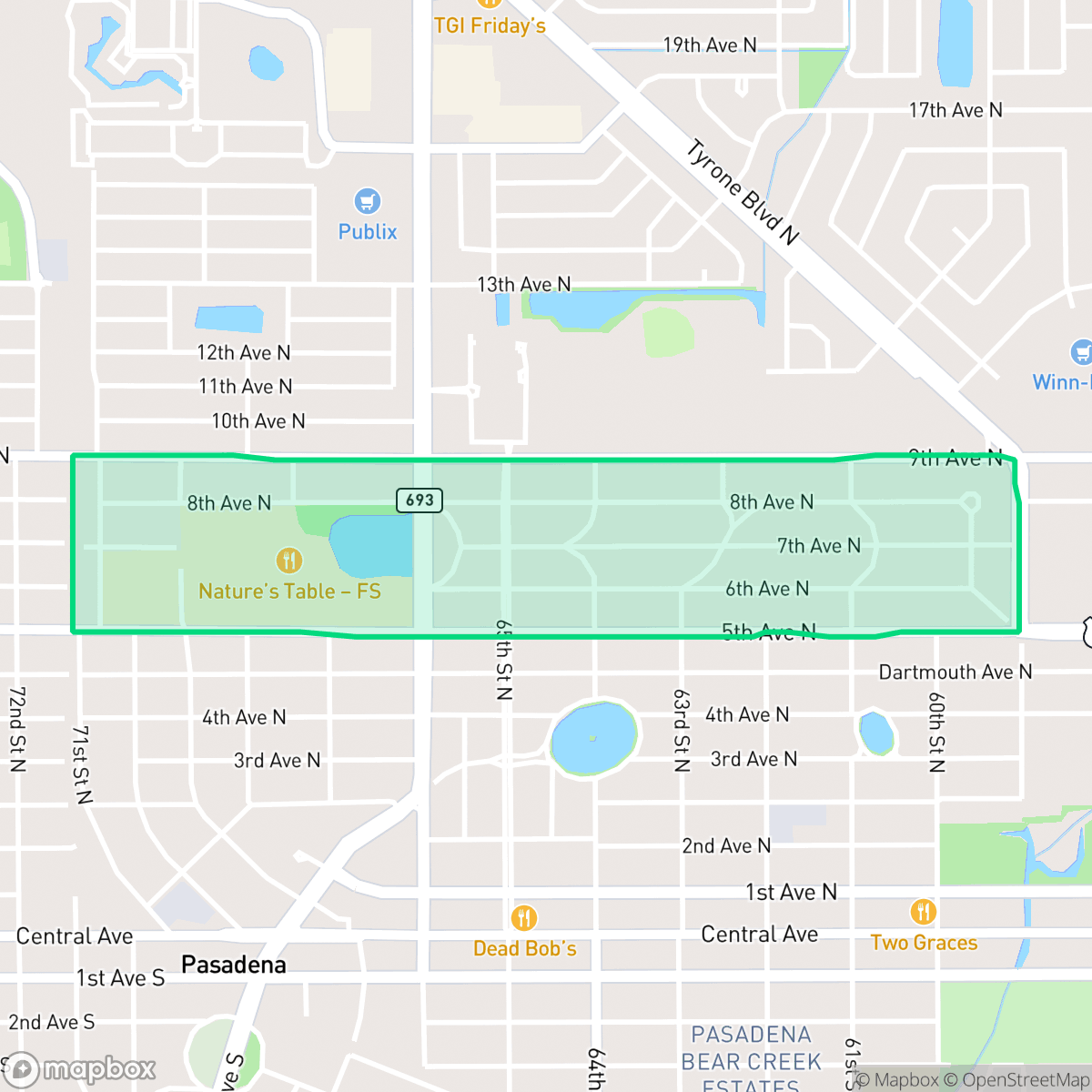
Eagle Crest is a historic St. Petersburg neighborhood defined by its walkable grid, mature oak canopies, and a blend of Mediterranean and mid-century architecture. It offers a semi-rural atmosphere with easy access to local commerce, providing a balanced and multigenerational living environment.
Key Highlights
About Eagle Crest
Developed in 1925 during the Florida land boom by Charles K. Eagle, a prominent silk magnate, Eagle Crest was envisioned as a premier residential community on the western outskirts of St. Petersburg. Although the Great Depression stalled initial development, the neighborhood eventually flourished, particularly following the 1942 establishment of the nearby St. Petersburg Junior College. Today, the area is defined by its historic character, featuring original brick-paved streets, granite curbing, and mature oak canopies. The neighborhood’s architectural stock includes a mix of 1920s Mediterranean and bungalow styles alongside mid-century homes. A central landmark is Eagle Crest Park, which occupies a portion of the former Eagle Lake, a site once intended to be the centerpiece of Eagle’s original development plan.
The neighborhood functions as an active mixed-use hub where residents benefit from a high degree of walkability and access to essential services. Its layout, characterized by continuous sidewalks and a grid street system, encourages pedestrian activity while maintaining a semi-rural feel through the presence of scattered woodlands and open spaces. The community supports a diverse age range, fostering a stable environment for families and professionals alike. Residents also enjoy strong health insurance coverage and a politically balanced atmosphere that mirrors the broader city trends. While the area is largely shielded from heavy industrial activity, it maintains a steady rhythm of local commerce and wellness services that contribute to its functional daily life. Living in the area requires navigating a few specific trade-offs, including moderate traffic noise from nearby busy streets and a higher vulnerability to flooding compared to other parts of the region. Air quality levels can occasionally pose challenges for sensitive groups, which is a common occurrence across the wider metropolitan area. Despite these factors, the neighborhood remains a resilient choice for those seeking a blend of historic charm and modern convenience. The local school district provides stable academic opportunities, backed by strong voter support and consistent leadership, even as it manages the operational shifts associated with changing student enrollment numbers.
Neighborhood Scores Across 15 Qualities
Residential spacing provides a moderate buffer between neighbors, offering slightly more separation than the St. Petersburg average. According to iHuus data, the area features a mix of single-family homes and denser multi-unit housing within a typical suburban grid layout.
Continuous sidewalks and a grid street layout make much of the area easily navigable on foot, offering significantly better connectivity than the St. Petersburg average. While some large parking lots can disrupt path continuity, residential streets generally feature safe crossings and accessible pedestrian infrastructure.
Residential views consist of single-family homes with private pools and small yards. This level of visual variety is consistent with the average for St. Petersburg.
Accessible public parks and consistent sidewalk verges provide reliable areas for pet exercise. According to iHuus data, this level of amenities is slightly above the St. Petersburg average.
Open land and scattered homes create a more spacious, semi-rural atmosphere than the typical St. Petersburg urban environment; according to iHuus data, this area features more frequent woodlands and fields compared to the city average.
Steady rhythms of local commerce and wellness services create an atmosphere more active than the St. Petersburg average. Residents benefit from a functional mix of dining, retail, and walkable access to nearby parks and educational institutions.
Steady sounds from nearby busy streets are present, though the acoustic environment remains more tranquil than much of St. Petersburg.
Frequent unhealthy air quality levels pose a significant risk to sensitive groups. This condition is consistent with the broader St. Petersburg area according to iHuus data.
Residential life in Eagle Crest is largely unaffected by heavy industry, as the area consists primarily of residential pockets and light commercial amenities. While some larger retail buildings and warehouses may introduce minor traffic noise, the lack of significant industrial activity is slightly better than the St. Petersburg average.
Health insurance access among residents is notably higher than the St. Petersburg average, according to iHuus data.
Political views in Eagle Crest are largely split, reflecting a level of ideological diversity that is very similar to the broader St. Petersburg area.
A diverse age range of young adults, families, and seniors characterizes this area. According to iHuus data, the community features a more balanced age distribution than much of St. Petersburg.
Flood risk in this area is higher than the St. Petersburg average, though current FEMA data lacks a detailed study to fully determine precise vulnerability.
Address-Level Insights for Eagle Crest


iHuus Neighborhood Intelligence Insights
Get address-level neighborhood insights for Eagle Crest
- Street-level scores — see how individual blocks compare, not just neighborhood averages
- Micro-zone boundaries — identify quiet pockets, flood boundaries, and walkable clusters before you visit
- 15 dimensions in full — walkability, noise, air quality, school quality, insurance coverage, population age profile, urban/rural index, and more
- Boundary risk alerts — know if your address sits near a block boundary where scores drop, the kind of detail no listing will ever mention
- School insights — individual school ratings and insights, not just district-level data
- Compare before you commit — side-by-side data across neighborhoods, down to block precision
No credit card required
Compare with Any Neighborhood
| Dimension | Eagle Crest | Albert Whitted Airport |
|---|---|---|
| 🚶 Walkabilityavg 6.61 | ||
| 🔊 Acoustic Comfortavg 3.78 | ||
| 🤫 Privacy Indexavg 5.45 | ||
| 🎨 Visual Appealavg 6.33 | ||
| 🐕 Dog Friendlinessavg 5.45 | ||
| 🗺️ Urban-Rural Indexavg 6.19 | ||
| ✨ Neighborhood Vibeavg 3.5 | ||
| 🏥 Health Insurance Coverageavg 6.88 | ||
| 🌿 Air Qualityavg 1.87 | ||
| 🏭 Industrial Proximityavg 7.55 | ||
| 🌊 Flood Safetyavg 4.61 | ||
| 🗳️ Ideological Leanavg 6.01 | ||
| 👥 Population Age Profileavg 5.11 | ||
| 🔥 Fire Safety | ||
| 🏫 School Quality |
Eagle Crest Rankings
School Districts Serving Eagle Crest
School Insights for Eagle Crest
Below average outcomes; significant attendance and academic challenges.
School Insights
See what's really behind every school rating near Eagle Crest
- Individual school ratings — each school's own score with outcome context, not just a district average
- Enrollment & class size data — student-to-teacher ratio and how it compares to the state average
- Full demographics breakdown — ethnicity and gender composition for every school in the enrollment zone
- Every school in the district — all schools within the enrollment boundary ranked by rating, not just the closest one
- Grade levels & benchmarks — elementary through high school, with below/above state-average flags
No credit card required