Downtown, St. Petersburg
Updated · 4,745 residents
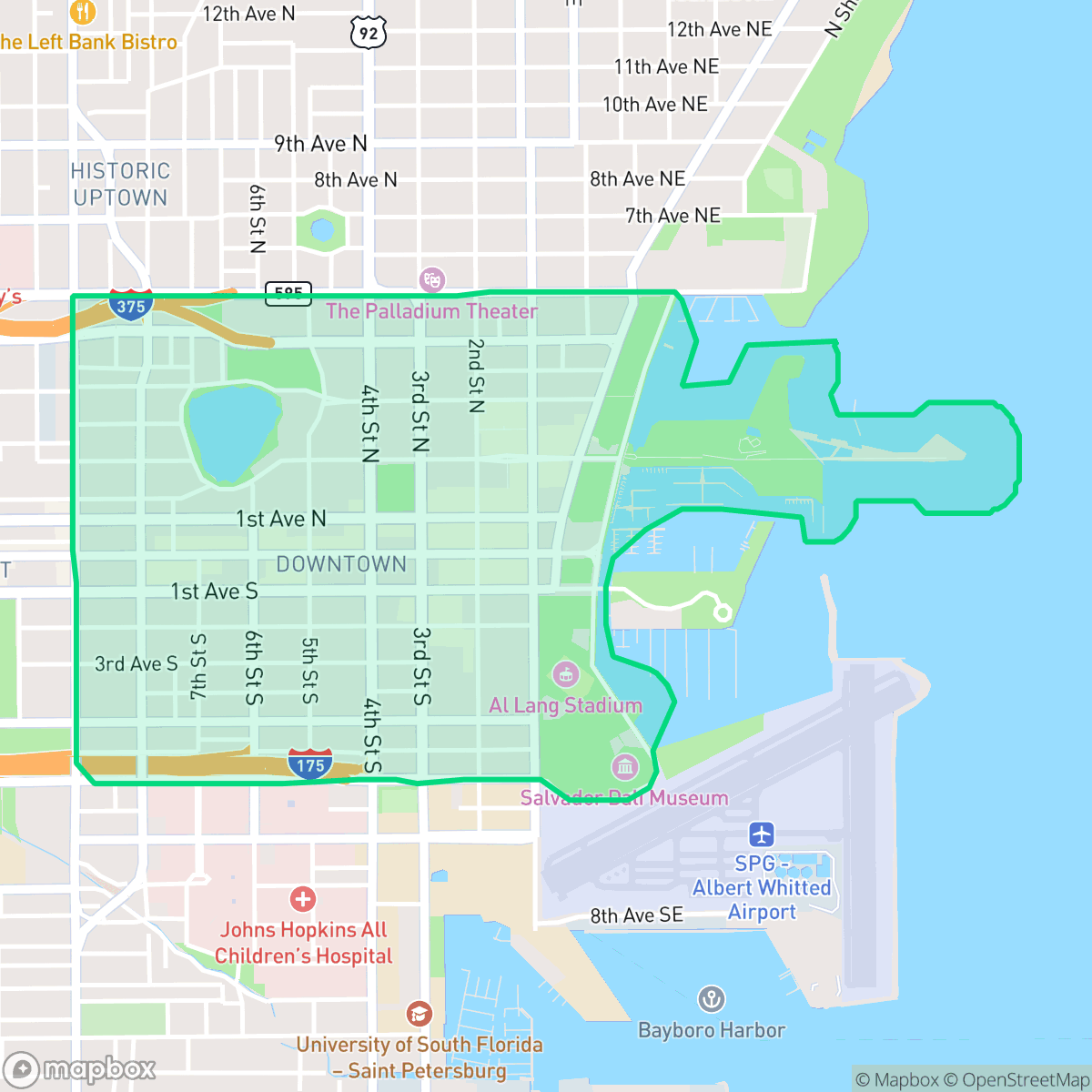
Downtown St. Petersburg is a highly walkable urban core defined by its dense mix of high-rise architecture and vibrant waterfront activity. Residents enjoy exceptional access to city amenities and parks, though the area experiences noticeable traffic noise and limited residential privacy due to its compact, built-up nature.
Key Highlights
About Downtown
Downtown St. Petersburg, Florida, traces its origins to 1888, when it was established as the southern terminus of the Orange Belt Railroad. Platted by John C. Williams and named after Peter Demens’s birthplace in Russia, the area evolved from a small railroad outpost into a premier winter resort. The neighborhood is defined by its 1920s Florida Land Boom architecture, characterized by Mediterranean Revival landmarks like the Vinoy Hotel and the Snell Arcade. The Downtown St. Petersburg Historic District, listed on the National Register of Historic Places, preserves 367 historic buildings and central public parks like Williams Park. Historically, the area served as a commercial and cultural hub, later transitioning through mid-century shifts that saw the removal of streetcars and the development of a waterfront-focused civic core, including the municipal marina and various cultural institutions.
This neighborhood serves as the bustling heart of the city, offering a high-energy environment characterized by constant movement and a dense concentration of commercial and residential structures. The area is exceptionally pedestrian-friendly, with wide sidewalks and a grid layout that connects residents to extensive waterfront parks and maritime amenities. The aesthetic is defined by a blend of modern high-rise condominiums and historic landmarks, creating an upscale urban backdrop that remains active throughout the day and evening.
Living here requires an adjustment to a dense, urban lifestyle where privacy is limited and traffic noise is a common feature of the environment. According to iHuus data, air quality can occasionally reach unhealthy levels, and residents should consider the moderate flood risk associated with the coastal location. This area is best suited for those who prioritize immediate access to city life, cultural institutions, and a social atmosphere over the quiet seclusion of suburban living. Families may find the nearby Pinellas County School District a stable option, as the system maintains strong academic performance and significant community financial support despite ongoing enrollment shifts.
Neighborhood Scores Across 15 Qualities
Dense urban structures and multi-unit housing create minimal buffer between neighbors; this level of privacy is lower than the St. Petersburg average according to iHuus data.
Pedestrian connectivity is exceptionally high due to a dense grid of wide sidewalks, frequent crossings, and accessible waterfront paths. According to iHuus data, this area offers far greater ease for walking than the typical St. Petersburg neighborhood.
Waterfront condos and rooftop amenities contribute to a visual environment that is more aesthetically pleasing than the St. Petersburg average. According to iHuus data, the area features a mix of dense multi-story architecture and well-maintained maritime properties.
Abundant waterfront parks and lakeside trails with wide, grassy sidewalk verges provide much more accessible space for pets than the city average. According to iHuus data, these connected green spaces and buffered paths offer a safer environment for walking dogs away from traffic.
High concentrations of multi-story buildings and significant concrete coverage create a much more built-up environment than the St. Petersburg average. This area features a dense mix of commercial blocks, parking garages, and high-rise structures with very little suburban greenery.
Constant movement and dense commercial activity define this area, providing a much higher level of vibrancy than most parts of the city. Residents can expect a bustling atmosphere centered around diverse dining, waterfront parks, and frequent pedestrian traffic.
Steady traffic sounds from nearby busy streets are common in this area. Acoustic levels are slightly higher than the St. Petersburg average, according to iHuus data.
Frequent unhealthy air quality levels present a significant health risk for sensitive groups. According to iHuus data, conditions in this area are slightly worse than the St. Petersburg average.
Heavy manufacturing is largely absent from this area, though residents may encounter some transit-related noise and activity near the airport and major highways. This level of industrial proximity is roughly in line with the rest of St. Petersburg.
Health insurance enrollment among residents is slightly below the St. Petersburg average, according to iHuus data.
Political leanings in this area are notably more liberal than the St. Petersburg average, characterized by a significant majority of liberal-leaning residents and a modest presence of opposing viewpoints.
Residents will encounter a varied demographic ranging from young professionals to retirees. This population distribution is more balanced than the city average, according to iHuus data.
Flood safety levels in this area are higher than the St. Petersburg average, though a detailed FEMA study has not yet been completed for this specific zone. Residents should remain aware of moderate risk factors identified by iHuus data.
Address-Level Insights for Downtown


iHuus Neighborhood Intelligence Insights
Get address-level neighborhood insights for Downtown
- Street-level scores — see how individual blocks compare, not just neighborhood averages
- Micro-zone boundaries — identify quiet pockets, flood boundaries, and walkable clusters before you visit
- 15 dimensions in full — walkability, noise, air quality, school quality, insurance coverage, population age profile, urban/rural index, and more
- Boundary risk alerts — know if your address sits near a block boundary where scores drop, the kind of detail no listing will ever mention
- School insights — individual school ratings and insights, not just district-level data
- Compare before you commit — side-by-side data across neighborhoods, down to block precision
No credit card required
Compare with Any Neighborhood
| Dimension | Downtown | Albert Whitted Airport |
|---|---|---|
| 🚶 Walkabilityavg 6.61 | ||
| 🔊 Acoustic Comfortavg 3.78 | ||
| 🤫 Privacy Indexavg 5.45 | ||
| 🎨 Visual Appealavg 6.33 | ||
| 🐕 Dog Friendlinessavg 5.45 | ||
| 🗺️ Urban-Rural Indexavg 6.19 | ||
| ✨ Neighborhood Vibeavg 3.5 | ||
| 🏥 Health Insurance Coverageavg 6.88 | ||
| 🌿 Air Qualityavg 1.87 | ||
| 🏭 Industrial Proximityavg 7.55 | ||
| 🌊 Flood Safetyavg 4.61 | ||
| 🗳️ Ideological Leanavg 6.01 | ||
| 👥 Population Age Profileavg 5.11 | ||
| 🔥 Fire Safety | ||
| 🏫 School Quality |
Downtown Rankings
School Districts Serving Downtown
School Insights for Downtown
Below average outcomes; significant attendance and academic challenges.
School Insights
See what's really behind every school rating near Downtown
- Individual school ratings — each school's own score with outcome context, not just a district average
- Enrollment & class size data — student-to-teacher ratio and how it compares to the state average
- Full demographics breakdown — ethnicity and gender composition for every school in the enrollment zone
- Every school in the district — all schools within the enrollment boundary ranked by rating, not just the closest one
- Grade levels & benchmarks — elementary through high school, with below/above state-average flags
No credit card required