Cromwell Heights, St. Petersburg
Updated · 604 residents
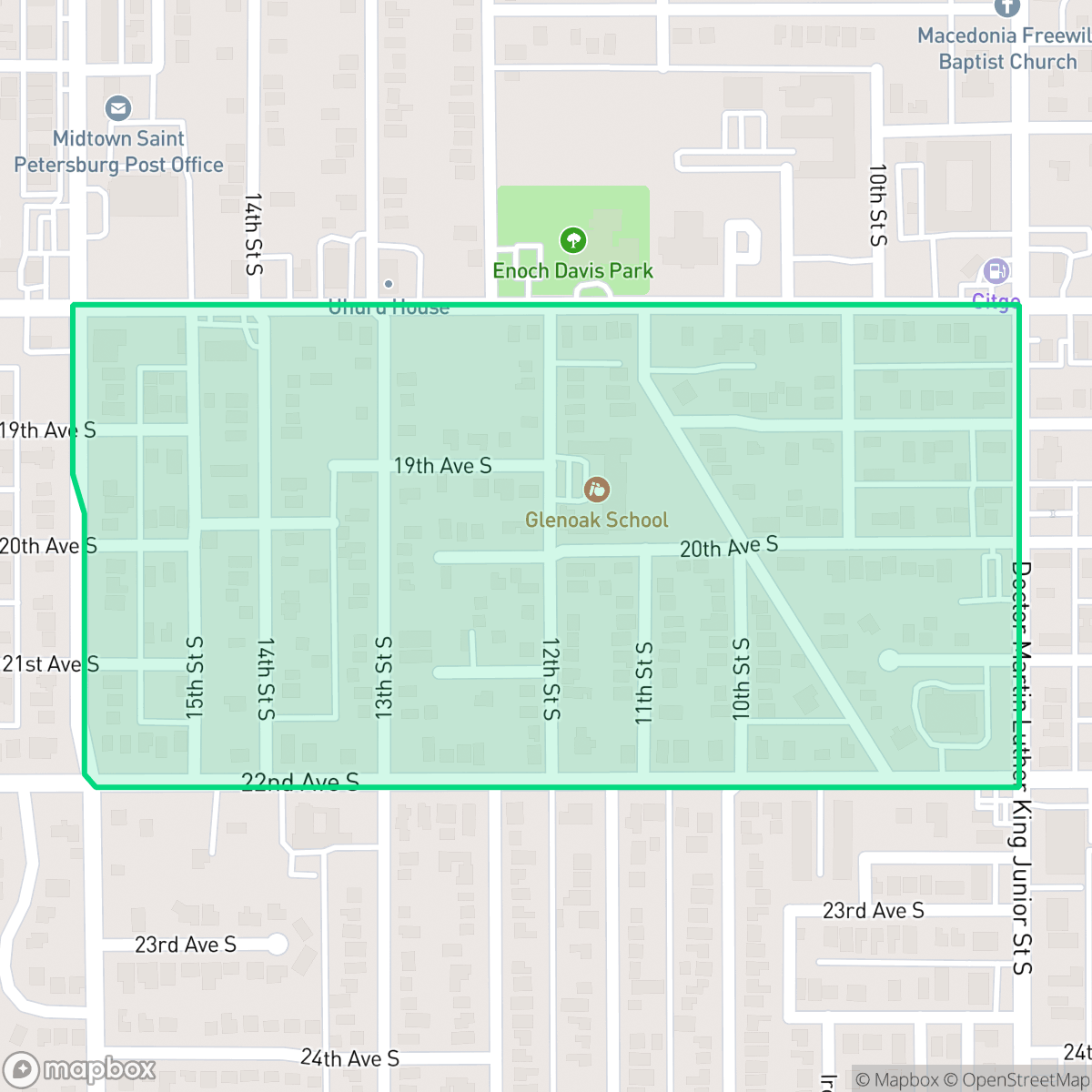
Cromwell Heights is a residential community north of Lake Maggiore featuring a mix of mid-century bungalows and ranch-style homes. The neighborhood offers a balanced suburban atmosphere with a consistent grid system that supports pedestrian movement and local activity.
Key Highlights
About Cromwell Heights
Cromwell Heights is a residential neighborhood in St. Petersburg, Florida, situated north of Lake Maggiore. Historically characterized by its mid-20th-century architectural stock, the area features a mix of bungalows and ranch-style homes. By the late 1960s, the neighborhood underwent a significant demographic transformation, transitioning to a majority Black population amid broader patterns of residential segregation and urban change in St. Petersburg. Often discussed alongside neighboring areas like Thirteenth Street Heights and Childs Park, Cromwell Heights reflects the city's mid-century social and residential evolution, moving from its earlier development period into a distinct community identity shaped by these historical shifts.
The area maintains a steady urban rhythm, characterized by modest residential architecture and a layout that encourages walking. Residents benefit from proximity to local green spaces and a community feel that balances quiet residential streets with accessible small-scale commercial zones. The neighborhood is noted for its strong liberal political leanings and a demographic mix that reflects the broader St. Petersburg population. While the industrial presence is minimal, the community remains a distinct residential enclave within the city.
Prospective residents should consider the local environment, as the area experiences challenges with air quality and a higher risk of flooding during extreme weather events. While the grid layout provides good connectivity, the housing density offers moderate levels of privacy. Families are served by the Pinellas County School District, which is recognized for its academic stability and strong community financial support, despite ongoing efforts to consolidate campuses due to changing enrollment trends.
Neighborhood Scores Across 15 Qualities
Residential spacing varies across the area, with some homes situated closely together on a traditional grid. This level of density is slightly higher than the St. Petersburg average according to iHuus data.
A consistent grid system with visible sidewalks and safe crossings makes navigating the area easier than in much of St. Petersburg. While some residential streets lack dedicated paths, many parts of the neighborhood benefit from a mature tree canopy and accessible pedestrian infrastructure.
Standard middle-class housing characterizes the area, featuring regular lots and simple rooflines. Visual variety is slightly lower than the St. Petersburg average due to the prevalence of modest, uniform residential structures.
Access to large public green spaces for dogs is slightly above the St. Petersburg average due to a central park featuring a lake and sports fields. Other areas within Cromwell Heights feature narrower verges and primarily consist of private fenced yards.
Residential streets and green spaces are distributed in nearly equal measure, offering a suburban character that is less dense than the St. Petersburg average. According to iHuus data, the area features a consistent grid of single-family homes interspersed with small commercial structures.
Local dining and small businesses provide a level of activity that is higher than the St. Petersburg average. Residents benefit from a moderately walkable grid featuring accessible community spaces and neighborhood cafes.
Steady traffic sounds from nearby thoroughfares are present, though levels remain noticeably quieter than the city average. According to iHuus data, residents can expect a consistent but manageable ambient hum.
Frequent unhealthy air quality levels pose a significant risk to sensitive groups. This area experiences much-needed degradation in breathable air compared to the St. Petersburg average, according to iHuus data.
Primarily residential with only light commercial clusters along main roads, this area features a lower presence of heavy industrial hazards than the St. Petersburg average.
Health insurance access among residents is slightly lower than the St. Petersburg average, according to iHuus data.
Voting patterns and census indicators show a much more liberal leaning than the St. Petersburg average, according to iHuus data.
A balanced mix of young adults, families, and older residents characterizes this area. This demographic distribution is largely consistent with the broader St. Petersburg average according to iHuus data.
Flood risk in this area is higher than the St. Petersburg average, though a lack of detailed FEMA studies makes the precise level of danger difficult to determine. Residents should remain aware of potential vulnerabilities during significant weather events according to iHuus data.
Address-Level Insights for Cromwell Heights


iHuus Neighborhood Intelligence Insights
Get address-level neighborhood insights for Cromwell Heights
- Street-level scores — see how individual blocks compare, not just neighborhood averages
- Micro-zone boundaries — identify quiet pockets, flood boundaries, and walkable clusters before you visit
- 15 dimensions in full — walkability, noise, air quality, school quality, insurance coverage, population age profile, urban/rural index, and more
- Boundary risk alerts — know if your address sits near a block boundary where scores drop, the kind of detail no listing will ever mention
- School insights — individual school ratings and insights, not just district-level data
- Compare before you commit — side-by-side data across neighborhoods, down to block precision
No credit card required
Compare with Any Neighborhood
| Dimension | Cromwell Heights | Albert Whitted Airport |
|---|---|---|
| 🚶 Walkabilityavg 6.61 | ||
| 🔊 Acoustic Comfortavg 3.78 | ||
| 🤫 Privacy Indexavg 5.45 | ||
| 🎨 Visual Appealavg 6.33 | ||
| 🐕 Dog Friendlinessavg 5.45 | ||
| 🗺️ Urban-Rural Indexavg 6.19 | ||
| ✨ Neighborhood Vibeavg 3.5 | ||
| 🏥 Health Insurance Coverageavg 6.88 | ||
| 🌿 Air Qualityavg 1.87 | ||
| 🏭 Industrial Proximityavg 7.55 | ||
| 🌊 Flood Safetyavg 4.61 | ||
| 🗳️ Ideological Leanavg 6.01 | ||
| 👥 Population Age Profileavg 5.11 | ||
| 🔥 Fire Safety | ||
| 🏫 School Quality |
Cromwell Heights Rankings
School Districts Serving Cromwell Heights
School Insights for Cromwell Heights
Below average outcomes; significant attendance and academic challenges.
School Insights
See what's really behind every school rating near Cromwell Heights
- Individual school ratings — each school's own score with outcome context, not just a district average
- Enrollment & class size data — student-to-teacher ratio and how it compares to the state average
- Full demographics breakdown — ethnicity and gender composition for every school in the enrollment zone
- Every school in the district — all schools within the enrollment boundary ranked by rating, not just the closest one
- Grade levels & benchmarks — elementary through high school, with below/above state-average flags
No credit card required