Crescent Lake, St. Petersburg
Updated · 1,406 residents
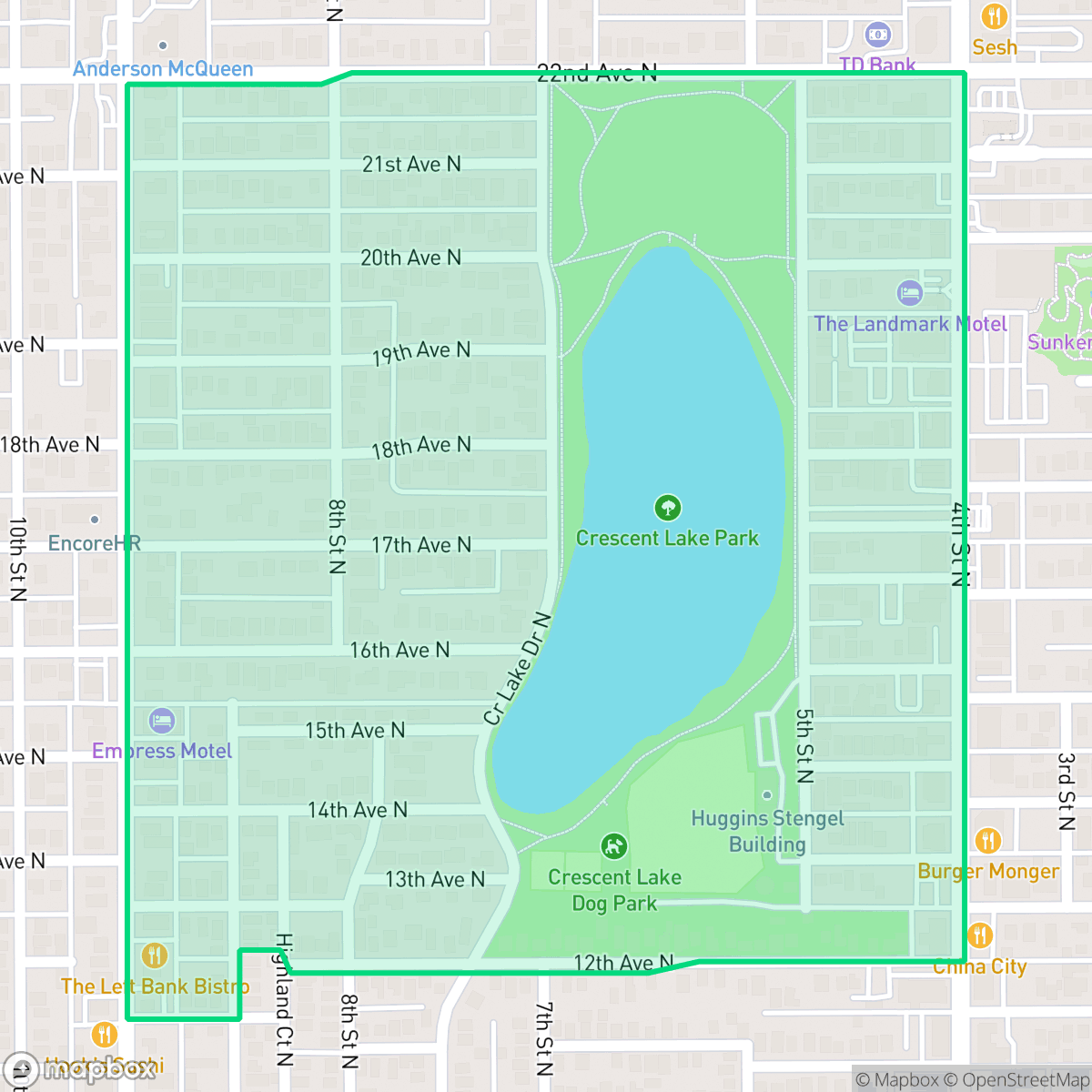
Crescent Lake is a historic, highly walkable neighborhood known for its architectural diversity and a namesake 56-acre park that serves as a central hub for the community. The area offers a vibrant, pet-friendly atmosphere with a semi-rural feel, though residents should be aware of occasional traffic noise and air quality concerns.
Key Highlights
About Crescent Lake
Crescent Lake, located just north of downtown St. Petersburg, evolved from 19th-century citrus groves into a residential neighborhood following the 1914 arrival of a streetcar line. Its development was significantly shaped by master developer Perry Snell, who facilitated the 1927 opening of the 56-acre Crescent Lake Park. The neighborhood is architecturally diverse, featuring a blend of 1920s Craftsman bungalows, Tudor, and Mediterranean Revival homes alongside mid-century styles. Distinctive landmarks include the Huggins-Stengel Field, which served as a spring training site for the New York Yankees, hosting legends like Babe Ruth and Joe DiMaggio, and a 1923 water tower adorned with a local mural. The area’s historical character is further defined by preserved brick streets, hex-block sidewalks, and a cypress dugout canoe dating to the 1500s discovered within the namesake lake.
Located just north of downtown, the neighborhood balances a polished, upscale aesthetic with a strong sense of community. The streetscape is defined by mature landscaping and well-maintained private properties, creating a visually cohesive environment that feels both established and welcoming. Residents enjoy exceptional walkability, allowing for easy access to a variety of local cafes, cultural venues, and wellness studios that contribute to the area's energetic profile. The demographic mix is diverse, spanning young adults, families, and seniors, which fosters a balanced and inclusive social environment.
This neighborhood is well-suited for those who value an active lifestyle and proximity to cultural amenities without sacrificing a sense of space. While the area provides excellent access to healthcare and maintains high academic standards through the local school district, prospective residents should consider that the proximity to busy transit corridors can result in noticeable traffic noise. Additionally, while the community is largely protected from industrial impacts, it is important to note the potential for occasional air quality issues and a moderate risk of flooding. Families will find stability in the local school district, which benefits from strong community financial support and a commitment to arts and education.
Neighborhood Scores Across 15 Qualities
Residential spacing offers a moderate amount of separation between homes, providing slightly more buffer from neighbors than the St. Petersburg average. Most properties feature consistent yard distances and fenced boundaries that maintain a degree of privacy.
Pedestrian infrastructure is exceptionally robust, featuring a complete grid of wide sidewalks and frequent crossings that significantly surpass the St. Petersburg average. Residents can navigate both residential streets and commercial zones with ease, as confirmed by iHuus data.
Large residential structures, mature landscaping, and frequent private pools contribute to a visual landscape that is more polished than the St. Petersburg average. According to iHuus data, many properties feature well-maintained yards and expansive driveways.
Abundant green spaces, including a central park with a lake and accessible trails, offer much more space for pet walking than the St. Petersburg average. Tree-lined streets and wide paths provide safe, continuous routes away from traffic.
Residential pockets feature frequent open land and scattered homes amid woodland, providing a slightly more suburban and spacious atmosphere than the St. Petersburg average.
High levels of activity and pedestrian-friendly streets define this area, which offers significantly more energy and diverse dining options than the St. Petersburg average. According to iHuus data, residents have easy access to a dense mix of cultural venues, wellness studios, and various cafes throughout the neighborhood.
A steady hum of local traffic originates from nearby busy streets. According to iHuus data, acoustic levels are notably higher than the St. Petersburg city average.
Unhealthy air quality levels occur frequently in this area, posing a significant risk to sensitive groups. According to iHuus data, these conditions are slightly worse than the average seen across St. Petersburg.
Residential and light commercial uses dominate the area, with no heavy manufacturing or hazardous industrial sites detected. This lack of industrial presence makes the neighborhood cleaner and quieter than the St. Petersburg average.
Health insurance coverage among residents in this area is higher than the St. Petersburg average, according to iHuus data.
Voting patterns and census indicators in Crescent Lake reflect a significantly more liberal political leaning than the St. Petersburg average, according to iHuus data.
Residents live alongside a balanced mix of young adults, families, and seniors. This demographic variety in Crescent Lake is slightly higher than the St. Petersburg average, according to iHuus data.
Residual flood risk exists within this area as it sits partially within a 500-year floodplain. However, the level of safety remains notably higher than the average for St. Petersburg according to iHuus data.
Address-Level Insights for Crescent Lake


iHuus Neighborhood Intelligence Insights
Get address-level neighborhood insights for Crescent Lake
- Street-level scores — see how individual blocks compare, not just neighborhood averages
- Micro-zone boundaries — identify quiet pockets, flood boundaries, and walkable clusters before you visit
- 15 dimensions in full — walkability, noise, air quality, school quality, insurance coverage, population age profile, urban/rural index, and more
- Boundary risk alerts — know if your address sits near a block boundary where scores drop, the kind of detail no listing will ever mention
- School insights — individual school ratings and insights, not just district-level data
- Compare before you commit — side-by-side data across neighborhoods, down to block precision
No credit card required
Compare with Any Neighborhood
| Dimension | Crescent Lake | Albert Whitted Airport |
|---|---|---|
| 🚶 Walkabilityavg 6.61 | ||
| 🔊 Acoustic Comfortavg 3.78 | ||
| 🤫 Privacy Indexavg 5.45 | ||
| 🎨 Visual Appealavg 6.33 | ||
| 🐕 Dog Friendlinessavg 5.45 | ||
| 🗺️ Urban-Rural Indexavg 6.19 | ||
| ✨ Neighborhood Vibeavg 3.5 | ||
| 🏥 Health Insurance Coverageavg 6.88 | ||
| 🌿 Air Qualityavg 1.87 | ||
| 🏭 Industrial Proximityavg 7.55 | ||
| 🌊 Flood Safetyavg 4.61 | ||
| 🗳️ Ideological Leanavg 6.01 | ||
| 👥 Population Age Profileavg 5.11 | ||
| 🔥 Fire Safety | ||
| 🏫 School Quality |
Crescent Lake Rankings
School Districts Serving Crescent Lake
School Insights for Crescent Lake
Below average outcomes; significant attendance and academic challenges.
School Insights
See what's really behind every school rating near Crescent Lake
- Individual school ratings — each school's own score with outcome context, not just a district average
- Enrollment & class size data — student-to-teacher ratio and how it compares to the state average
- Full demographics breakdown — ethnicity and gender composition for every school in the enrollment zone
- Every school in the district — all schools within the enrollment boundary ranked by rating, not just the closest one
- Grade levels & benchmarks — elementary through high school, with below/above state-average flags
No credit card required