Coquina Key, St. Petersburg
Updated · 2,795 residents
Coquina Key is a quiet, waterfront neighborhood defined by its mid-century ranch architecture and distinct island geography. While it offers a peaceful, semi-rural atmosphere with scenic bayou views, residents should be aware of high noise levels from transit corridors and a significant risk of flooding.
Key Highlights
About Coquina Key
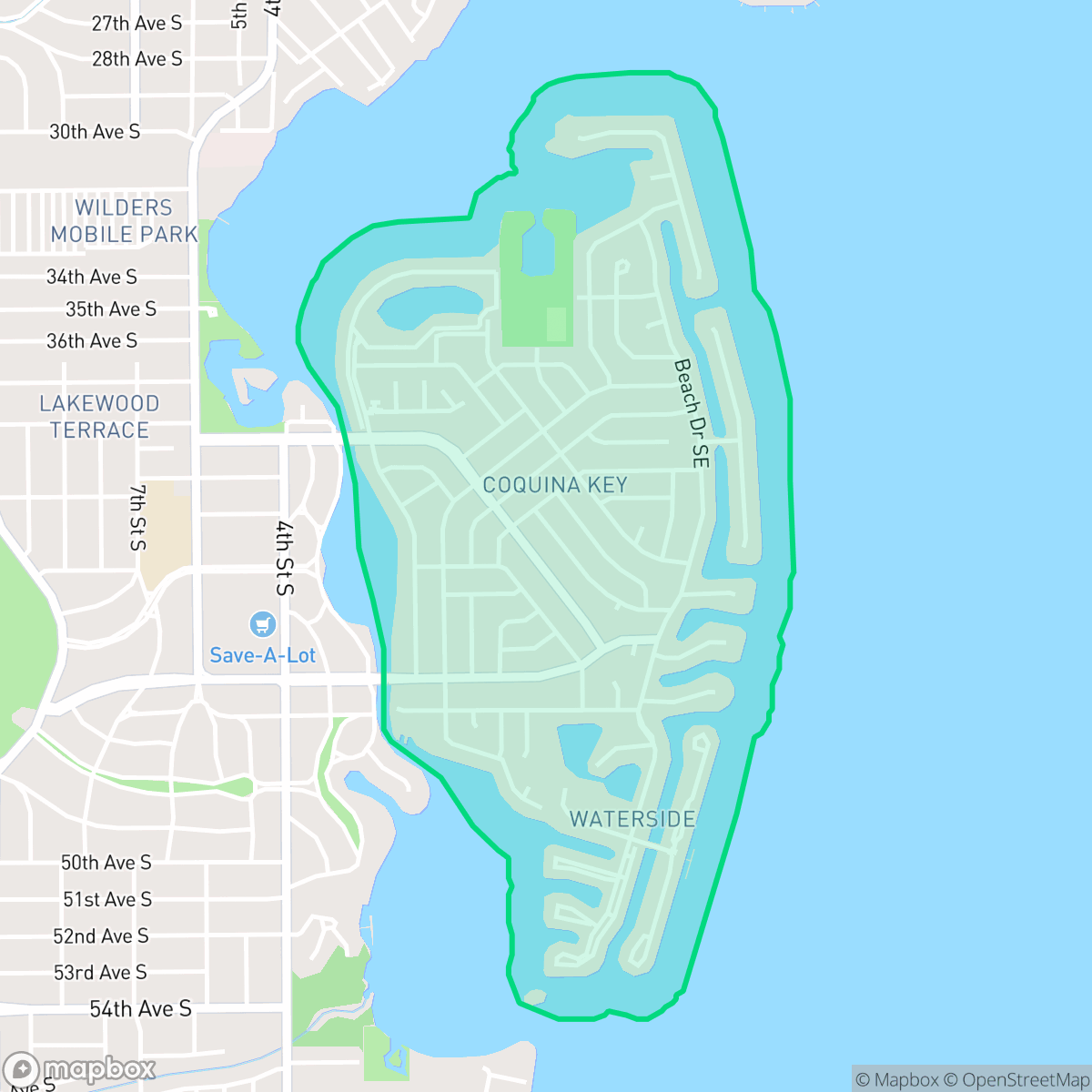
Coquina Key, originally a peninsula known as Goat Island or Lewis Island, was transformed into a man-made island following a 1920 dredging project that separated it from the mainland. While early 20th-century development attempts failed due to its remote location, the area saw rapid growth during the 1950s and 1960s under the Mackle brothers, who envisioned a large-scale suburban community. Renamed "Coquina Key" through a 1957 community contest, it adopted the enduring nickname "The Friendly Island." The neighborhood is defined by its nautical character, mid-century ranch-style architecture, and extensive waterfront access along Big and Little Bayous. Today, the landscape is a mix of these original homes and later multi-family developments like the Waterside complex, maintaining a distinct identity centered on its island geography and maritime lifestyle.
The neighborhood functions as a secluded residential retreat, characterized by its lack of industrial presence and a strong focus on private, waterfront living. The aesthetic is notably polished, featuring well-maintained homes and backyard pools that contribute to an upscale visual appeal. Demographically, the area hosts a diverse, multi-generational mix of residents who generally lean toward liberal civic perspectives. With limited commercial activity, the environment remains subdued and calm, making it well-suited for those who prioritize a quiet, nature-oriented lifestyle over urban density.
Prospective residents should weigh the benefits of this coastal setting against several livability trade-offs. The area experiences frequent noise disturbances from nearby transit corridors and flight paths, and walkability is restricted by limited sidewalk infrastructure. Furthermore, because of its location within a designated floodplain, the neighborhood carries a high risk of flooding that may require specialized insurance considerations. Despite these challenges, the community benefits from high levels of health insurance coverage and a sense of privacy that remains higher than the city average.
Neighborhood Scores Across 15 Qualities
Homes in this area feature mixed spacing with some distance between properties, though certain canal-side developments have houses positioned closely together. This level of privacy is slightly higher than the average for St. Petersburg.
Low-traffic streets and interconnected cul-de-sacs provide a safe environment for walking, though sidewalk availability is limited to one side of many roads. This level of walkability is slightly below the St. Petersburg average.
Waterfront properties and private backyard pools contribute to a highly polished aesthetic that sits well above the St. Petersburg average. Large homes and premium amenities define the visual landscape of this area, according to iHuus data.
Green verges between sidewalks and nearby recreation areas provide decent space for walking pets, though overall accessibility is slightly below the St. Petersburg average according to iHuus data.
Open land and scattered residential pockets provide a slightly more spacious, less dense environment than the St. Petersburg average. Low-rise complexes and canal-front properties create a landscape characterized by suburban sprawl rather than high-density urban development.
Limited commercial activity and few points of interest create a subdued atmosphere that is notably less lively than the St. Petersburg average. This suburban coastal area serves primarily as a calm residential retreat centered around nature preserves and parks.
Frequent noise disturbances from nearby transit corridors and flight paths are common in this area. According to iHuus data, acoustic comfort is significantly lower than the St. Petersburg average.
Frequent unhealthy air quality levels pose significant risks to sensitive groups. According to iHuus data, conditions in Coquina Key are slightly worse than the St. Petersburg average.
Industrial presence is nearly nonexistent here, providing a landscape free from warehouses or heavy manufacturing. This separation from industrial zones is significantly higher than the St. Petersburg average, leaving only light local services and residential areas.
Health insurance accessibility is significantly higher in Coquina Key than the St. Petersburg average, according to iHuus data.
Political leanings in Coquina Key are notably more liberal than the St. Petersburg average. This demographic trend is reflected in local community engagement and civic perspectives according to iHuus data.
Residents will find a diverse age distribution including young adults, families, and older populations. This demographic spread is slightly more varied than the average found throughout St. Petersburg.
Significant flood vulnerability exists here due to the neighborhood's location within a designated floodplain. This level of risk is notably higher than the average for St. Petersburg, which may necessitate specialized insurance coverage according to iHuus data.
Address-Level Insights for Coquina Key


iHuus Neighborhood Intelligence Insights
Get address-level neighborhood insights for Coquina Key
- Street-level scores — see how individual blocks compare, not just neighborhood averages
- Micro-zone boundaries — identify quiet pockets, flood boundaries, and walkable clusters before you visit
- 15 dimensions in full — walkability, noise, air quality, school quality, insurance coverage, population age profile, urban/rural index, and more
- Boundary risk alerts — know if your address sits near a block boundary where scores drop, the kind of detail no listing will ever mention
- School insights — individual school ratings and insights, not just district-level data
- Compare before you commit — side-by-side data across neighborhoods, down to block precision
No credit card required
Compare with Any Neighborhood
| Dimension | Coquina Key | Albert Whitted Airport |
|---|---|---|
| 🚶 Walkabilityavg 6.61 | ||
| 🔊 Acoustic Comfortavg 3.78 | ||
| 🤫 Privacy Indexavg 5.45 | ||
| 🎨 Visual Appealavg 6.33 | ||
| 🐕 Dog Friendlinessavg 5.45 | ||
| 🗺️ Urban-Rural Indexavg 6.19 | ||
| ✨ Neighborhood Vibeavg 3.5 | ||
| 🏥 Health Insurance Coverageavg 6.88 | ||
| 🌿 Air Qualityavg 1.87 | ||
| 🏭 Industrial Proximityavg 7.55 | ||
| 🌊 Flood Safetyavg 4.61 | ||
| 🗳️ Ideological Leanavg 6.01 | ||
| 👥 Population Age Profileavg 5.11 | ||
| 🔥 Fire Safety | ||
| 🏫 School Quality |
Coquina Key Rankings
School Districts Serving Coquina Key
School Insights for Coquina Key
Below average outcomes; significant attendance and academic challenges.
School Insights
See what's really behind every school rating near Coquina Key
- Individual school ratings — each school's own score with outcome context, not just a district average
- Enrollment & class size data — student-to-teacher ratio and how it compares to the state average
- Full demographics breakdown — ethnicity and gender composition for every school in the enrollment zone
- Every school in the district — all schools within the enrollment boundary ranked by rating, not just the closest one
- Grade levels & benchmarks — elementary through high school, with below/above state-average flags
No credit card required