Clam Bayou, St. Petersburg
Updated · 1,797 residents
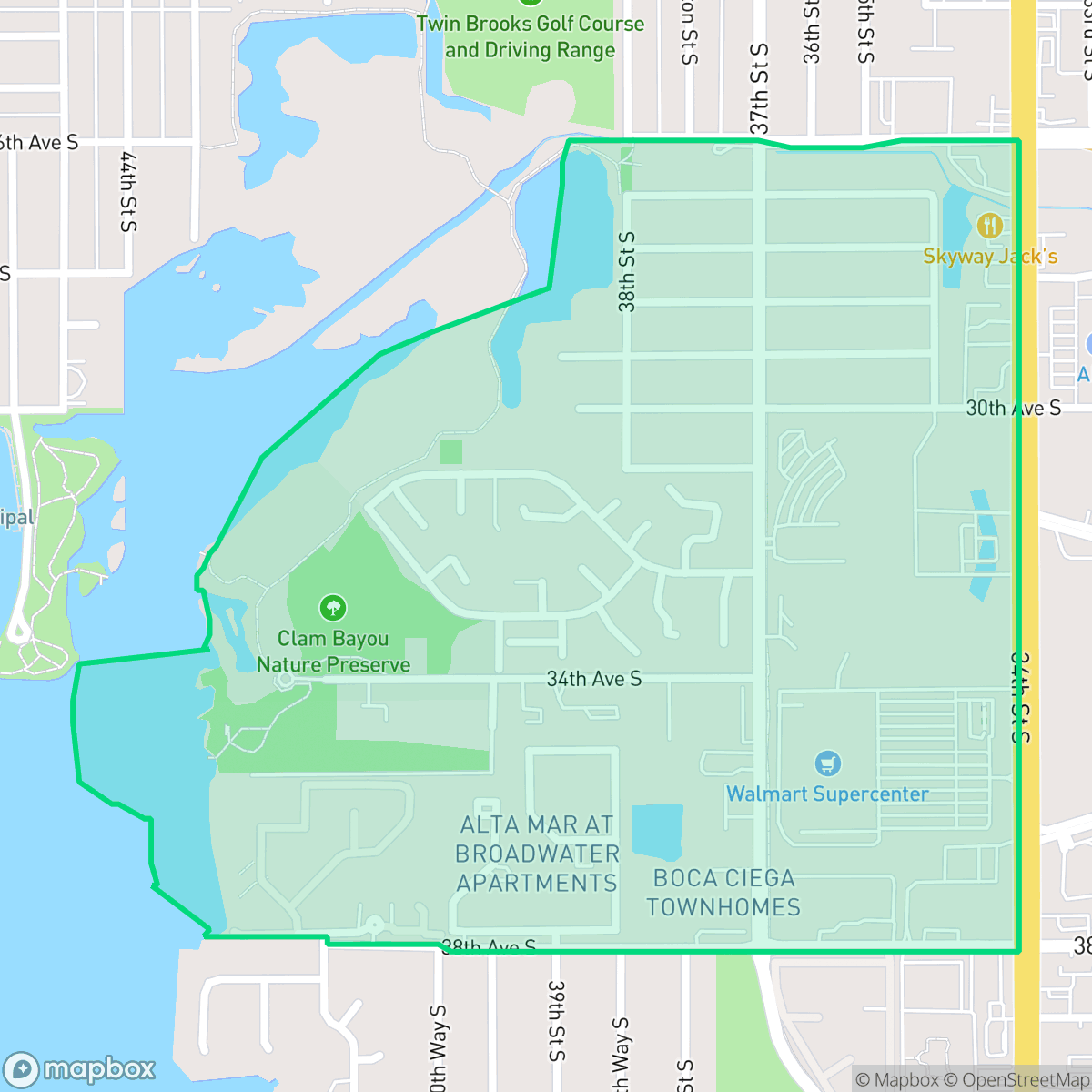
Clam Bayou is a coastal enclave defined by its namesake nature preserve, offering residents a blend of upscale suburban aesthetics and high walkability. While the area provides scenic access to trails and water, it faces challenges regarding flood risk and noise levels from nearby transit corridors.
Key Highlights
About Clam Bayou
Clam Bayou is a 170-acre tidal estuary and nature preserve situated between St. Petersburg and Gulfport. Historically undeveloped until the 1920s, the area suffered significant degradation as surrounding urban growth introduced untreated stormwater, trash, and pollutants into the ecosystem. Once locally known in part as Osgood Point—a site formerly utilized for custom boat building—the bayou became a focal point for environmental concern due to its role as a drainage corridor. In the early 21st century, the site underwent major multi-agency restoration, including the 2010–2011 project to dredge accumulated sediments and create stormwater treatment ponds. Today, the area serves as a vital ecological corridor and recreational space, featuring boardwalks and kayak launches that highlight the successful transition from a neglected industrial drainage point to a protected coastal habitat.
The neighborhood features a mix of well-maintained homes with private amenities and significant green space. It maintains a semi-rural feel despite its proximity to urban centers, characterized by a progressive community and a diverse age demographic. Residents benefit from a robust network of sidewalks that facilitate easy movement through the area, making it a highly walkable environment for those who enjoy outdoor activity.
Potential residents should consider that the neighborhood experiences higher levels of noise from transit and rail lines, as well as significant flood risk due to its low-lying topography. Air quality can occasionally be a concern for sensitive groups. However, the area remains an attractive option for those who prioritize a strong sense of community, aesthetic appeal, and proximity to nature, all supported by the well-regarded Pinellas County school system.
Neighborhood Scores Across 15 Qualities
Residential spacing varies between detached homes with yards and denser apartment clusters, offering slightly more separation than the St. Petersburg average.
Low traffic residential streets and a dense sidewalk network provide safe environments for pedestrians. These connected paths allow for easier access to nearby commercial zones than is typical for the St. Petersburg area, according to iHuus data.
Well-maintained properties with complex architectural designs and private pools create a visual environment that is more polished than the St. Petersburg average. According to iHuus data, the area features spacious driveways and frequent upscale amenities throughout the neighborhood.
Abundant green spaces and nature trails bordering residential areas provide much more access to pet-friendly environments than the St. Petersburg average. Large parks and interconnected paths offer safe, low-traffic routes for exercise.
Open land and wooded areas are common throughout the area, providing a slightly more rural atmosphere than much of St. Petersburg.
Local activity levels are slightly higher than the St. Petersburg average, ranging from quiet residential stretches to more active pockets near transit hubs and educational institutions. While much of the area feels low-key and suburban, certain nodes near Clam Bayou Nature Preserve offer walkable access to dining and civic services.
Frequent noise disturbances from nearby transit corridors and rail lines are common in this area. This level of acoustic activity is notably higher than the average found throughout St. Petersburg.
Frequent unhealthy air quality levels pose a significant risk to sensitive groups. According to iHuus data, pollution levels in this area are slightly worse than the St. Petersburg average.
Light commercial activity and logistics hubs are present, though heavy industrial presence remains very low. Residents may encounter occasional utility odors or freight traffic near specific storage and retail zones, but the area is comparable to the rest of St. Petersburg in terms of industrial proximity.
Health insurance coverage among Clam Bayou residents is slightly higher than the St. Petersburg average, according to iHuus data.
Voting patterns and census indicators show a predominantly liberal political leaning, which is notably more progressive than the average for St. Petersburg.
Residents live alongside a balanced variety of young adults, families, and seniors. This demographic spread is more diverse than the typical age distribution found across St. Petersburg.
Property flooding is a significant concern here as much of the area sits within a designated floodplain. According to iHuus data, this level of flood risk is higher than the St. Petersburg average and often necessitates specialized insurance coverage.
Address-Level Insights for Clam Bayou


iHuus Neighborhood Intelligence Insights
Get address-level neighborhood insights for Clam Bayou
- Street-level scores — see how individual blocks compare, not just neighborhood averages
- Micro-zone boundaries — identify quiet pockets, flood boundaries, and walkable clusters before you visit
- 15 dimensions in full — walkability, noise, air quality, school quality, insurance coverage, population age profile, urban/rural index, and more
- Boundary risk alerts — know if your address sits near a block boundary where scores drop, the kind of detail no listing will ever mention
- School insights — individual school ratings and insights, not just district-level data
- Compare before you commit — side-by-side data across neighborhoods, down to block precision
No credit card required
Compare with Any Neighborhood
| Dimension | Clam Bayou | Albert Whitted Airport |
|---|---|---|
| 🚶 Walkabilityavg 6.61 | ||
| 🔊 Acoustic Comfortavg 3.78 | ||
| 🤫 Privacy Indexavg 5.45 | ||
| 🎨 Visual Appealavg 6.33 | ||
| 🐕 Dog Friendlinessavg 5.45 | ||
| 🗺️ Urban-Rural Indexavg 6.19 | ||
| ✨ Neighborhood Vibeavg 3.5 | ||
| 🏥 Health Insurance Coverageavg 6.88 | ||
| 🌿 Air Qualityavg 1.87 | ||
| 🏭 Industrial Proximityavg 7.55 | ||
| 🌊 Flood Safetyavg 4.61 | ||
| 🗳️ Ideological Leanavg 6.01 | ||
| 👥 Population Age Profileavg 5.11 | ||
| 🔥 Fire Safety | ||
| 🏫 School Quality |
Clam Bayou Rankings
School Districts Serving Clam Bayou
School Insights for Clam Bayou
Below average outcomes; significant attendance and academic challenges.
School Insights
See what's really behind every school rating near Clam Bayou
- Individual school ratings — each school's own score with outcome context, not just a district average
- Enrollment & class size data — student-to-teacher ratio and how it compares to the state average
- Full demographics breakdown — ethnicity and gender composition for every school in the enrollment zone
- Every school in the district — all schools within the enrollment boundary ranked by rating, not just the closest one
- Grade levels & benchmarks — elementary through high school, with below/above state-average flags
No credit card required