Campbell Park, St. Petersburg
Updated · 671 residents
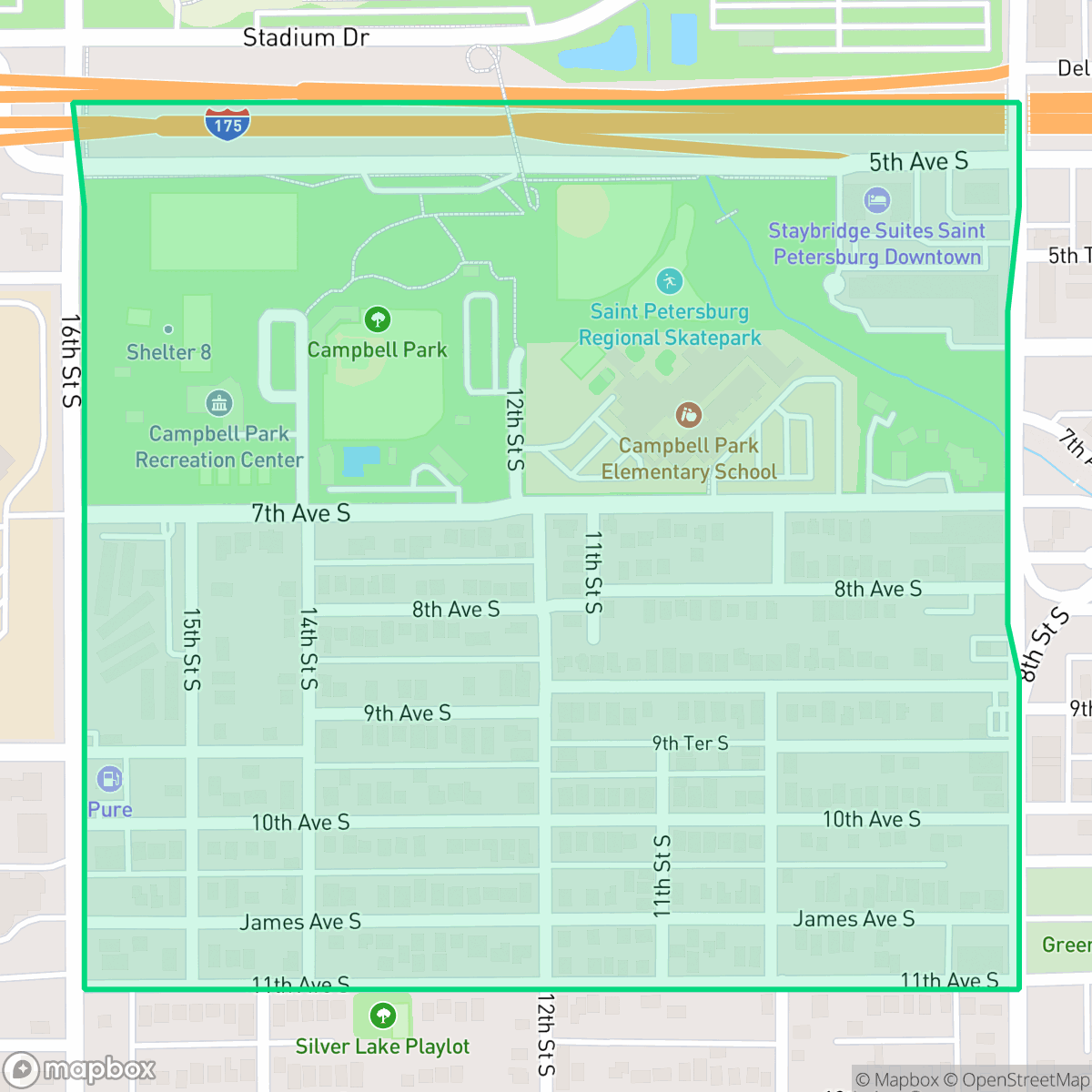
Campbell Park is a historic St. Petersburg neighborhood defined by its deep roots in the local African-American community and its highly walkable, grid-based street layout. Residents benefit from a semi-rural atmosphere with scattered greenery and a lively, accessible environment near major city amenities.
Key Highlights
About Campbell Park
The Campbell Park neighborhood in St. Petersburg, Florida, traces its origins to the 1920s when developer Thomas Church Campbell purchased land—formerly citrus groves—and subdivided it for Black residents. The neighborhood is anchored by the historic Campbell Park, which served as the city's first park designated for the African-American community. During the segregation era, the park acted as a vital social and recreational hub, hosting the Dreamland Dance Hall, Gibbs High School football games, and professional Negro League baseball, including the St. Petersburg Pelicans. Often referred to as the 'Dust Bowl' due to its early sandlot conditions, the park remains a cornerstone of the area's identity. Today, the neighborhood retains historic residential character, featuring homes dating back to the 1920s and 1930s, alongside a legacy of community-led efforts to preserve its significant Black history.
The neighborhood offers a distinct semi-rural character within the city, featuring a grid of streets that makes it exceptionally walkable for those commuting to nearby hubs like Tropicana Field. The presence of mature trees and open spaces provides a quiet, accessible environment that balances residential life with a diverse selection of local amenities. While the area enjoys minimal industrial presence and a strong sense of community, it is best suited for those who prioritize neighborhood connectivity and walkability over suburban seclusion.
Prospective residents should consider certain trade-offs, including occasional traffic noise and air quality concerns that are slightly more prevalent here than in other parts of the city. Health insurance coverage rates are lower than the city average, and the neighborhood maintains a modest visual aesthetic with standard single-family homes. Despite these factors, the area remains a resilient, politically active community that is well-supported by the Pinellas County School District, making it a viable option for families and young professionals seeking a central location with a rich cultural legacy.
Neighborhood Scores Across 15 Qualities
Residential structures feature typical suburban spacing with some buffer between neighbors, offering slightly more separation than the St. Petersburg average. Backyard fencing is common throughout the area to provide additional boundaries between closely spaced homes.
Pedestrians benefit from an established grid with safe crossings and a mature tree canopy that provides shade. This area offers better walkability than the St. Petersburg average due to the consistent presence of sidewalks and well-defined street layouts.
Standard single-family homes with small yards and simple roof geometries define the area. According to iHuus data, the visual variety in this neighborhood sits below the St. Petersburg average.
Accessible public parks and wide, grassy sidewalk verges make this area significantly more accommodating for dogs than the St. Petersburg average. According to iHuus data, many streets offer safe buffer zones between pedestrians and traffic.
Open land and scattered greenery provide a slightly more rural atmosphere than most of St. Petersburg. Residential areas feature a mix of single-family homes alongside low-density institutional clusters, according to iHuus data.
Frequent activity and a diverse selection of dining and entertainment options make this area significantly more lively than the St. Petersburg average. Residents near Tropicana Field can access various walkable amenities, ranging from local pubs to wellness services.
Steady traffic sounds from nearby busy streets are present, though the area remains notably quieter than the average for St. Petersburg.
Frequent unhealthy air quality levels pose a significant risk to sensitive groups. According to iHuus data, conditions in Campbell Park are slightly worse than the St. Petersburg average.
Primarily residential streets and light commercial uses define the area, ensuring a lack of heavy manufacturing. This absence of industrial activity is slightly better than the St. Petersburg average, according to iHuus data.
Health insurance enrollment among residents is below the St. Petersburg average, according to iHuus data.
Voting patterns and census indicators reflect a significantly more liberal political leaning than the St. Petersburg average, according to iHuus data.
Residents live alongside a varied demographic of young adults, families, and seniors. This age distribution is slightly lower than the St. Petersburg average according to iHuus data.
Flood safety in this area is notably higher than the St. Petersburg average, though some residual risk remains as portions of the neighborhood sit within a 500-year floodplain according to iHuus data.
Address-Level Insights for Campbell Park


iHuus Neighborhood Intelligence Insights
Get address-level neighborhood insights for Campbell Park
- Street-level scores — see how individual blocks compare, not just neighborhood averages
- Micro-zone boundaries — identify quiet pockets, flood boundaries, and walkable clusters before you visit
- 15 dimensions in full — walkability, noise, air quality, school quality, insurance coverage, population age profile, urban/rural index, and more
- Boundary risk alerts — know if your address sits near a block boundary where scores drop, the kind of detail no listing will ever mention
- School insights — individual school ratings and insights, not just district-level data
- Compare before you commit — side-by-side data across neighborhoods, down to block precision
No credit card required
Compare with Any Neighborhood
| Dimension | Campbell Park | Albert Whitted Airport |
|---|---|---|
| 🚶 Walkabilityavg 6.61 | ||
| 🔊 Acoustic Comfortavg 3.78 | ||
| 🤫 Privacy Indexavg 5.45 | ||
| 🎨 Visual Appealavg 6.33 | ||
| 🐕 Dog Friendlinessavg 5.45 | ||
| 🗺️ Urban-Rural Indexavg 6.19 | ||
| ✨ Neighborhood Vibeavg 3.5 | ||
| 🏥 Health Insurance Coverageavg 6.88 | ||
| 🌿 Air Qualityavg 1.87 | ||
| 🏭 Industrial Proximityavg 7.55 | ||
| 🌊 Flood Safetyavg 4.61 | ||
| 🗳️ Ideological Leanavg 6.01 | ||
| 👥 Population Age Profileavg 5.11 | ||
| 🔥 Fire Safety | ||
| 🏫 School Quality |
Campbell Park Rankings
School Districts Serving Campbell Park
School Insights for Campbell Park
Below average outcomes; significant attendance and academic challenges.
School Insights
See what's really behind every school rating near Campbell Park
- Individual school ratings — each school's own score with outcome context, not just a district average
- Enrollment & class size data — student-to-teacher ratio and how it compares to the state average
- Full demographics breakdown — ethnicity and gender composition for every school in the enrollment zone
- Every school in the district — all schools within the enrollment boundary ranked by rating, not just the closest one
- Grade levels & benchmarks — elementary through high school, with below/above state-average flags
No credit card required