Broadwater, St. Petersburg
Updated · 1,304 residents
Broadwater is a quiet, waterfront enclave defined by its mid-century architecture and canal-front access. While the area offers an upscale, semi-rural atmosphere, residents must navigate high flood risks and frequent noise from nearby transit corridors.
Key Highlights
About Broadwater
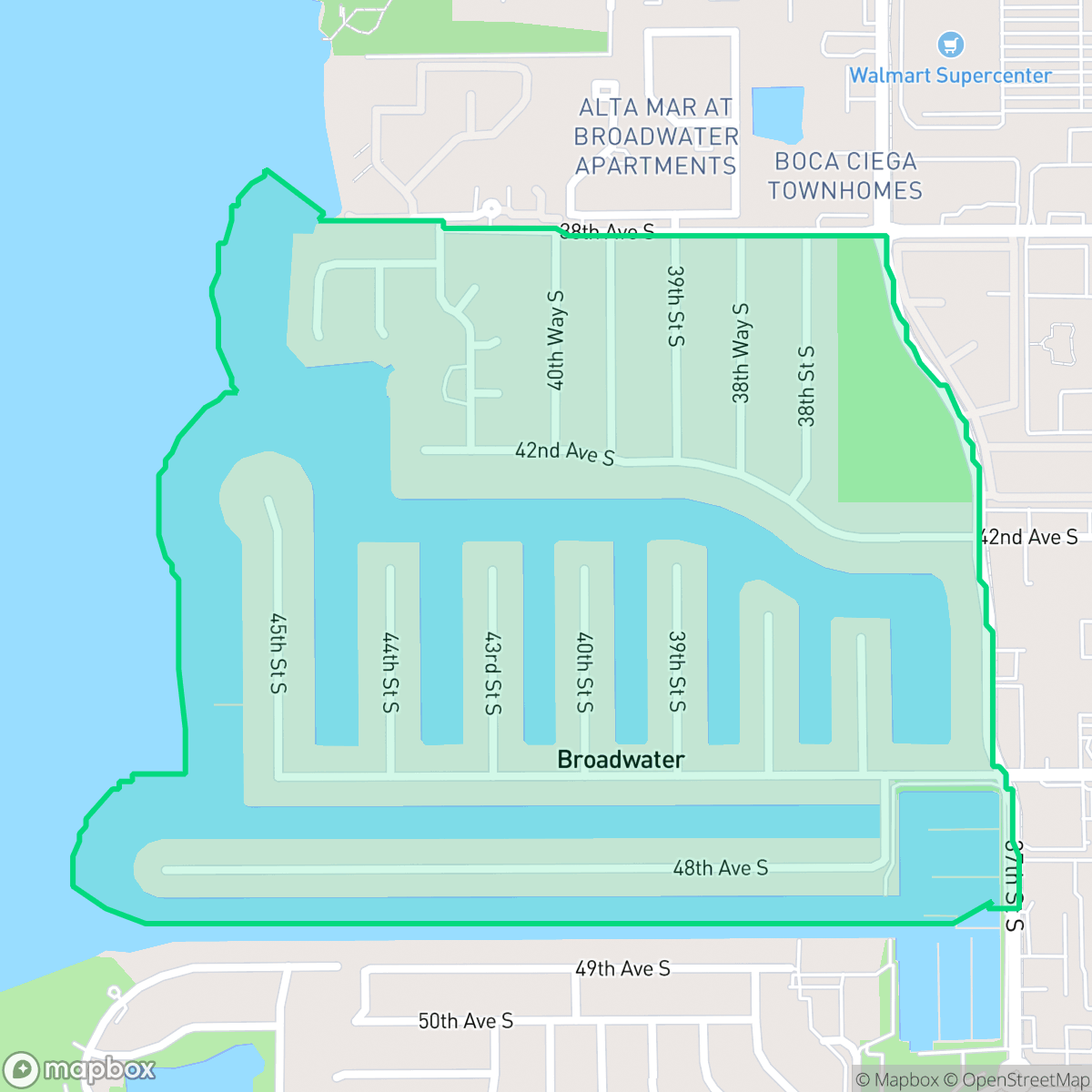
Broadwater was developed in the mid-1950s following the extension of US 19 to connect St. Petersburg with the newly opened Sunshine Skyway Bridge. The neighborhood was conceived by R.C. Huffman, Sr., owner of a dredging and shell company, who transformed the southwest corner of Pinellas Point into a residential community. The area's distinctive layout was created by dredging deep-water canals into Boca Ciega Bay, with the resulting spoils used as fill to establish dry land for housing. This project transformed the landscape from its earlier agricultural and natural state into a waterfront enclave characterized by mid-century Florida-style architecture, featuring one-story homes with stucco construction and tile roofs. Today, the neighborhood remains a primarily residential community defined by its canal-front access and proximity to the Maximo area, which holds historical significance as one of Pinellas County's oldest continuously inhabited sites.
The neighborhood maintains a calm, residential character with a mature demographic and a predominantly liberal political lean. The landscape is marked by large estates featuring private docks and swimming pools, contributing to a high level of visual appeal. Despite its suburban nature, the area provides a semi-rural feel with open land and greenery, though the lack of sidewalks near the canals limits pedestrian connectivity and walkability compared to other parts of the city.
Prospective residents should consider the trade-offs of living in this coastal community, including a high vulnerability to flooding and occasional poor air quality that may affect sensitive groups. The area experiences significant noise from nearby transit infrastructure, and limited public park space makes it less ideal for dog owners. While the local school district remains stable and high-performing, those moving to the area should account for its quiet, low-key nature and the necessity of flood insurance when considering their lifestyle needs.
Neighborhood Scores Across 15 Qualities
Residential spacing offers a balanced level of seclusion, sitting slightly above the St. Petersburg average. Some areas feature closely packed homes along narrow canal lots, though most properties maintain some buffer between neighbors.
Residential cul-de-sacs and safe crossings allow for easy movement within certain pockets, though connectivity is limited near canals due to a lack of sidewalks. This level of pedestrian access is slightly below the St. Petersburg average.
Large estates with private docks and swimming pools characterize the landscape, providing a level of visual quality that is notably higher than the St. Petersburg average.
Man-made canals and dense residential lot coverage result in fewer accessible public parks and green verges for pets. According to iHuus data, the availability of walking areas is below the St. Petersburg average.
Open land and scattered greenery provide a more semi-rural atmosphere than the typical St. Petersburg urban core. Residents will find significant canal infrastructure and dense suburban tracts integrated with pockets of woodland, according to iHuus data.
Primarily characterized by a calm, suburban atmosphere, this area features pockets of activity near transit hubs but remains largely low-key compared to the St. Petersburg average. Most streets are residential in nature with sparse commercial amenities, though certain sections offer walkable access to local dining and hospitality services.
Frequent disruptions from nearby transit corridors and infrastructure characterize this area. According to iHuus data, acoustic comfort levels are notably lower than the St. Petersburg average.
Frequent unhealthy air quality levels pose a significant risk to sensitive groups, with conditions appearing slightly worse than the St. Petersburg average according to iHuus data.
Residential streets and open green spaces dominate the area, though a local storage facility introduces some heavy freight traffic and loading activity. This level of industrial presence is lower than the St. Petersburg average according to iHuus data.
Health insurance enrollment among Broadwater residents is notably higher than the St. Petersburg average, according to iHuus data.
Political leanings in Broadwater trend more liberal than the St. Petersburg average, though a modest opposing presence remains present.
Older adults constitute the majority of the population, representing a significantly more mature demographic than the average St. Petersburg resident. According to iHuus data, there is only a modest presence of younger residents in the area.
Properties in this area are situated within a designated floodplain, making flood insurance a common requirement for residents. According to iHuus data, the vulnerability to flooding in Broadwater is notably higher than the St. Petersburg average.
Address-Level Insights for Broadwater


iHuus Neighborhood Intelligence Insights
Get address-level neighborhood insights for Broadwater
- Street-level scores — see how individual blocks compare, not just neighborhood averages
- Micro-zone boundaries — identify quiet pockets, flood boundaries, and walkable clusters before you visit
- 15 dimensions in full — walkability, noise, air quality, school quality, insurance coverage, population age profile, urban/rural index, and more
- Boundary risk alerts — know if your address sits near a block boundary where scores drop, the kind of detail no listing will ever mention
- School insights — individual school ratings and insights, not just district-level data
- Compare before you commit — side-by-side data across neighborhoods, down to block precision
No credit card required
Compare with Any Neighborhood
| Dimension | Broadwater | Albert Whitted Airport |
|---|---|---|
| 🚶 Walkabilityavg 6.61 | ||
| 🔊 Acoustic Comfortavg 3.78 | ||
| 🤫 Privacy Indexavg 5.45 | ||
| 🎨 Visual Appealavg 6.33 | ||
| 🐕 Dog Friendlinessavg 5.45 | ||
| 🗺️ Urban-Rural Indexavg 6.19 | ||
| ✨ Neighborhood Vibeavg 3.5 | ||
| 🏥 Health Insurance Coverageavg 6.88 | ||
| 🌿 Air Qualityavg 1.87 | ||
| 🏭 Industrial Proximityavg 7.55 | ||
| 🌊 Flood Safetyavg 4.61 | ||
| 🗳️ Ideological Leanavg 6.01 | ||
| 👥 Population Age Profileavg 5.11 | ||
| 🔥 Fire Safety | ||
| 🏫 School Quality |
Broadwater Rankings
School Districts Serving Broadwater
School Insights for Broadwater
Below average outcomes; significant attendance and academic challenges.
School Insights
See what's really behind every school rating near Broadwater
- Individual school ratings — each school's own score with outcome context, not just a district average
- Enrollment & class size data — student-to-teacher ratio and how it compares to the state average
- Full demographics breakdown — ethnicity and gender composition for every school in the enrollment zone
- Every school in the district — all schools within the enrollment boundary ranked by rating, not just the closest one
- Grade levels & benchmarks — elementary through high school, with below/above state-average flags
No credit card required