Boyd Hill Nature Preserve, St. Petersburg
Updated · 709 residents
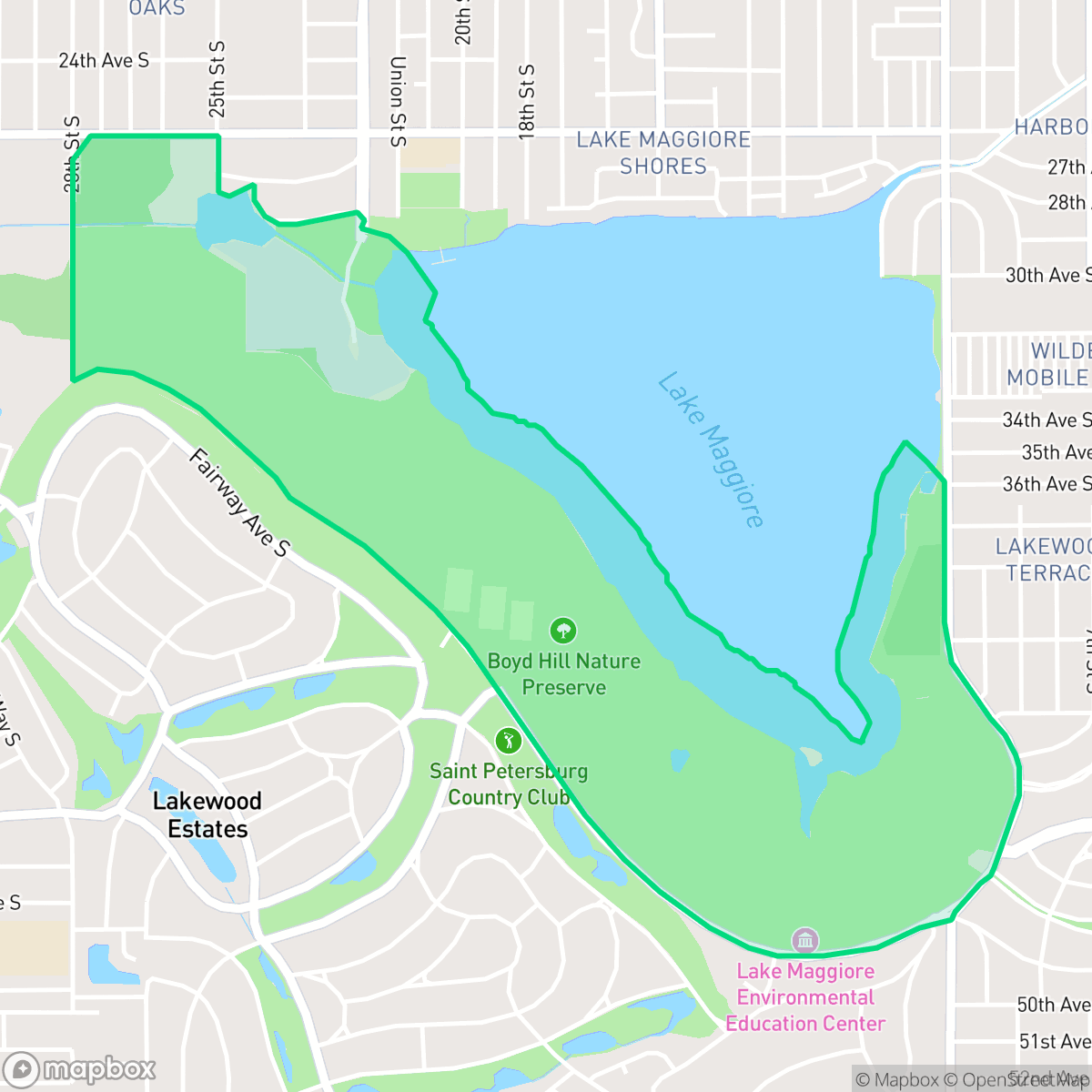
Boyd Hill Nature Preserve is a quiet, nature-focused neighborhood defined by its expansive green spaces and proximity to Lake Maggiore. The area offers a semi-rural atmosphere with a diverse demographic and is well-suited for those who prioritize pet-friendly walking paths over high-energy commercial activity.
Key Highlights
About Boyd Hill Nature Preserve
Boyd Hill Nature Preserve, located in south St. Petersburg on the shores of Lake Maggiore, evolved from early 20th-century land preservation efforts. Originally known as Salt Lake, the area was protected following the 1929 stock market crash, which halted private development plans. In the 1940s, the land was acquired for public use, eventually becoming Lake Maggiore Park. It was renamed in 1958 to honor Boyd Hill, a dedicated city parks superintendent who championed the integration of urban life with natural conservation. The site historically featured a zoo and introduced exotic flora, but has since undergone extensive restoration to return the landscape to its native ecosystems, including pine flatwoods and hardwood hammocks. Today, the preserve is defined by its environmental education center, raptor rehabilitation aviary, and distinctive metal sculptures by local artist Paul Eppling.
The neighborhood is characterized by a subdued, nature-oriented environment that stands out for its lack of industrial presence and its semi-rural aesthetic. Residents enjoy a varied visual landscape that ranges from large, upscale single-family homes to denser mobile home communities, creating a unique residential mix. Families in the area are served by the Pinellas County School District, which maintains a reputation for academic stability and strong voter support, even as the district manages long-term enrollment shifts and campus consolidations. According to iHuus data, the community benefits from stable health insurance access and a balanced age distribution that spans from young adults to retirees.
Living in this area requires navigating specific trade-offs, such as moderate background noise from nearby traffic and occasional air quality concerns that may affect sensitive individuals. While the streets are generally quiet and suitable for walking, the lack of consistent sidewalk infrastructure limits overall pedestrian connectivity. The area also faces moderate flood risks, and prospective residents should consider this when evaluating property locations. This neighborhood is best suited for individuals or families who value a tranquil, green-centric lifestyle and prioritize proximity to natural conservation areas over immediate access to dense urban commercial hubs.
Neighborhood Scores Across 15 Qualities
Residential spacing varies across the area, with single-family homes providing more buffer than the denser mobile home park. According to iHuus data, overall privacy levels are slightly higher than the St. Petersburg average.
Low traffic volumes and quiet streets allow for easy walking, though the lack of sidewalks in certain sections makes it slightly less walkable than much of St. Petersburg.
Visual aesthetics range from large homes with upscale amenities to high-density mobile home parks with shared pools. This mix of residential styles results in a landscape that is slightly more varied than the St. Petersburg average, according to iHuus data.
Connected green spaces and wide, traffic-free paths offer significantly better opportunities for pet exercise than the St. Petersburg average.
Frequent open land and scattered woodlands provide a more rural feel than the St. Petersburg average; however, some areas feature a denser mix of single-family homes and commercial structures.
This area offers a calm, nature-focused environment with limited commercial activity. According to iHuus data, the local energy is lower than the St. Petersburg average due to the scarcity of street life and points of interest.
Steady sounds from nearby thoroughfares create a consistent background hum. This level of acoustic activity is notably higher than the city average according to iHuus data.
Frequent unhealthy air quality levels pose a significant health risk to sensitive groups. According to iHuus data, the atmospheric conditions in this area are slightly worse than the St. Petersburg average.
Residential streets and open green spaces dominate the area with very little heavy industry nearby. According to iHuus data, this lack of large-scale industrial activity is slightly better than the St. Petersburg average.
Health insurance coverage among residents is high and remains nearly consistent with the St. Petersburg average, according to iHuus data.
Voting patterns and census indicators show a significantly more liberal political leaning than the St. Petersburg average, according to iHuus data.
A balanced mix of young adults, families, and seniors characterizes this area. According to iHuus data, the demographic spread is slightly more varied than the St. Petersburg average.
Flood risk in this area is higher than the St. Petersburg average, though a definitive assessment remains unavailable because FEMA has not completed a detailed study for this location.
Address-Level Insights for Boyd Hill Nature Preserve


iHuus Neighborhood Intelligence Insights
Get address-level neighborhood insights for Boyd Hill Nature Preserve
- Street-level scores — see how individual blocks compare, not just neighborhood averages
- Micro-zone boundaries — identify quiet pockets, flood boundaries, and walkable clusters before you visit
- 15 dimensions in full — walkability, noise, air quality, school quality, insurance coverage, population age profile, urban/rural index, and more
- Boundary risk alerts — know if your address sits near a block boundary where scores drop, the kind of detail no listing will ever mention
- School insights — individual school ratings and insights, not just district-level data
- Compare before you commit — side-by-side data across neighborhoods, down to block precision
No credit card required
Compare with Any Neighborhood
| Dimension | Boyd Hill Nature Preserve | Albert Whitted Airport |
|---|---|---|
| 🚶 Walkabilityavg 6.61 | ||
| 🔊 Acoustic Comfortavg 3.78 | ||
| 🤫 Privacy Indexavg 5.45 | ||
| 🎨 Visual Appealavg 6.33 | ||
| 🐕 Dog Friendlinessavg 5.45 | ||
| 🗺️ Urban-Rural Indexavg 6.19 | ||
| ✨ Neighborhood Vibeavg 3.5 | ||
| 🏥 Health Insurance Coverageavg 6.88 | ||
| 🌿 Air Qualityavg 1.87 | ||
| 🏭 Industrial Proximityavg 7.55 | ||
| 🌊 Flood Safetyavg 4.61 | ||
| 🗳️ Ideological Leanavg 6.01 | ||
| 👥 Population Age Profileavg 5.11 | ||
| 🔥 Fire Safety | ||
| 🏫 School Quality |
Boyd Hill Nature Preserve Rankings
School Districts Serving Boyd Hill Nature Preserve
School Insights for Boyd Hill Nature Preserve
Below average outcomes; significant attendance and academic challenges.
School Insights
See what's really behind every school rating near Boyd Hill Nature Preserve
- Individual school ratings — each school's own score with outcome context, not just a district average
- Enrollment & class size data — student-to-teacher ratio and how it compares to the state average
- Full demographics breakdown — ethnicity and gender composition for every school in the enrollment zone
- Every school in the district — all schools within the enrollment boundary ranked by rating, not just the closest one
- Grade levels & benchmarks — elementary through high school, with below/above state-average flags
No credit card required