Big Bayou, St. Petersburg
Updated · 438 residents
Big Bayou is a quiet, upscale residential enclave defined by its well-manicured properties, private pools, and lush tree canopy. While the area offers a serene, semi-rural atmosphere free from industrial activity, residents should anticipate steady traffic noise and occasional air quality fluctuations.
Key Highlights
About Big Bayou
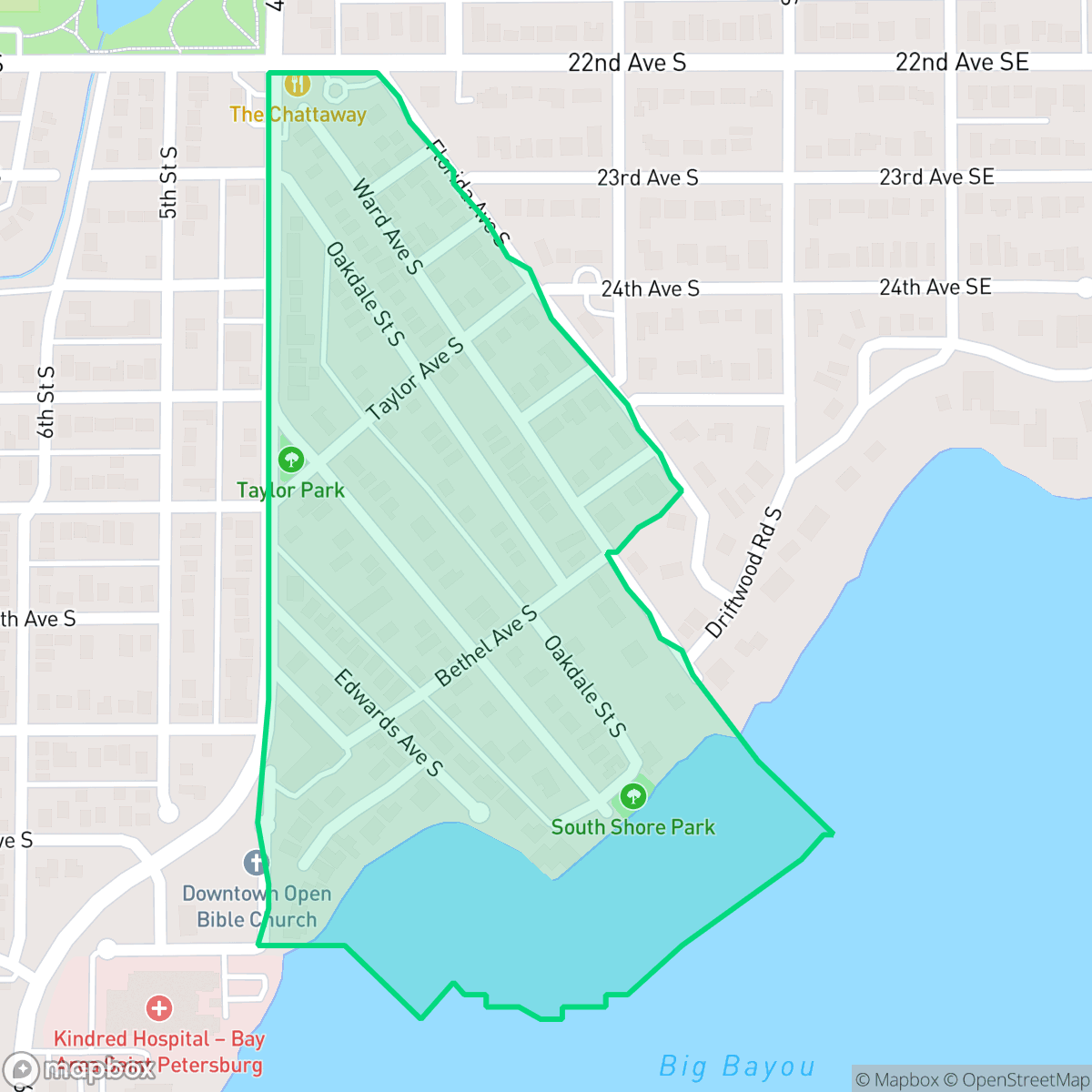
Big Bayou represents the earliest European settlement in the St. Petersburg area, historically known as Pinellas Village. Established in the mid-19th century by pioneers Abel Miranda and John Bethell, the area served as a hub for fishing and farming long before the city’s official incorporation. It holds a unique place in local history as the site of a Civil War skirmish in 1862 between Union forces and local settlers. By the early 20th century, the neighborhood became a destination for early tourism, notably home to the St. Petersburg Alligator Farm, which operated near the intersection of 6th Street and 36th Avenue. Today, much of the historic Big Bayou area is encompassed by the Driftwood neighborhood, which remains recognized for its deep-rooted connection to these 1800s pioneer homesteads and its significant, preserved natural landscape.
The neighborhood features a distinct, polished aesthetic characterized by spacious lots, mature greenery, and a notable lack of industrial development. Its semi-rural character provides a dispersed, tranquil environment that contrasts with the denser urban core of St. Petersburg. The area is highly regarded for its visual appeal, with many residences boasting premium amenities that create a private, cohesive community feel.
Prospective residents should weigh the quiet, low-activity lifestyle against specific trade-offs, including steady ambient noise from nearby arterial roads and occasional air quality challenges. While the grid-based street layout and sidewalks support moderate walkability and dog-friendly outings, the area lacks significant commercial amenities. It is best suited for those prioritizing a peaceful, established residential setting over immediate access to bustling social or commercial centers.
Neighborhood Scores Across 15 Qualities
Standard suburban lot spacing and fenced yards provide more separation between neighbors than the St. Petersburg average. According to iHuus data, residential density remains moderate throughout the area.
Residential streets feature a grid layout with sidewalks and mature trees that provide safe environments for walking. While many areas are comparable to the city average, some arterial roads experience higher traffic speeds.
Well-manicured lots and large homes with private pools create a highly attractive landscape that is notably more polished than the St. Petersburg average. According to iHuus data, waterfront properties and premium amenities contribute to an overall aesthetic that exceeds the city standard.
Direct access to coastal greenspace and large parks makes this area more dog friendly than much of St. Petersburg. Wide paths and substantial residential greenery provide ample space for pet owners to walk their dogs away from traffic.
Open land and woodland areas provide a more dispersed residential feel than the typical St. Petersburg landscape. This area features a mix of low density housing and significant tree canopy coverage, offering slightly more greenery than the city average.
Residential streets here are generally subdued and lack significant commercial activity. According to iHuus data, the area features fewer local amenities and less social energy than the St. Petersburg average.
Local traffic from a nearby busy street creates a consistent level of ambient noise. This acoustic profile is slightly more active than the city average, according to iHuus data.
Frequent unhealthy air quality levels pose a significant risk to sensitive groups. This condition is slightly worse than the average seen across St. Petersburg, according to iHuus data.
Industrial presence is virtually non-existent in this area, providing a landscape free from warehouses or heavy manufacturing. According to iHuus data, this neighborhood offers much higher separation from industrial hazards than the St. Petersburg average.
Health insurance accessibility in Big Bayou is slightly lower than the St. Petersburg city average, according to iHuus data.
Voting patterns and census indicators show a significantly more liberal political leaning than the St. Petersburg average, according to iHuus data.
A balanced distribution of young adults, families, and older residents characterizes the area. This demographic spread is largely consistent with the broader St. Petersburg population according to iHuus data.
Flood safety levels in this area are slightly below the St. Petersburg average due to a lack of detailed FEMA flood studies. Residents should remain cautious as current assessments for Big Bayou are considered moderate and undetermined.
Address-Level Insights for Big Bayou


iHuus Neighborhood Intelligence Insights
Get address-level neighborhood insights for Big Bayou
- Street-level scores — see how individual blocks compare, not just neighborhood averages
- Micro-zone boundaries — identify quiet pockets, flood boundaries, and walkable clusters before you visit
- 15 dimensions in full — walkability, noise, air quality, school quality, insurance coverage, population age profile, urban/rural index, and more
- Boundary risk alerts — know if your address sits near a block boundary where scores drop, the kind of detail no listing will ever mention
- School insights — individual school ratings and insights, not just district-level data
- Compare before you commit — side-by-side data across neighborhoods, down to block precision
No credit card required
Compare with Any Neighborhood
| Dimension | Big Bayou | Albert Whitted Airport |
|---|---|---|
| 🚶 Walkabilityavg 6.61 | ||
| 🔊 Acoustic Comfortavg 3.78 | ||
| 🤫 Privacy Indexavg 5.45 | ||
| 🎨 Visual Appealavg 6.33 | ||
| 🐕 Dog Friendlinessavg 5.45 | ||
| 🗺️ Urban-Rural Indexavg 6.19 | ||
| ✨ Neighborhood Vibeavg 3.5 | ||
| 🏥 Health Insurance Coverageavg 6.88 | ||
| 🌿 Air Qualityavg 1.87 | ||
| 🏭 Industrial Proximityavg 7.55 | ||
| 🌊 Flood Safetyavg 4.61 | ||
| 🗳️ Ideological Leanavg 6.01 | ||
| 👥 Population Age Profileavg 5.11 | ||
| 🔥 Fire Safety | ||
| 🏫 School Quality |
Big Bayou Rankings
School Districts Serving Big Bayou
School Insights for Big Bayou
Below average outcomes; significant attendance and academic challenges.
School Insights
See what's really behind every school rating near Big Bayou
- Individual school ratings — each school's own score with outcome context, not just a district average
- Enrollment & class size data — student-to-teacher ratio and how it compares to the state average
- Full demographics breakdown — ethnicity and gender composition for every school in the enrollment zone
- Every school in the district — all schools within the enrollment boundary ranked by rating, not just the closest one
- Grade levels & benchmarks — elementary through high school, with below/above state-average flags
No credit card required