Bartlett Park, St. Petersburg
Updated · 1,911 residents
Bartlett Park is a historic residential neighborhood defined by its namesake 30-acre park, mature oak-lined streets, and a highly walkable grid layout. Residents enjoy a quiet, suburban atmosphere with easy access to recreational facilities and a strong sense of community.
Key Highlights
About Bartlett Park
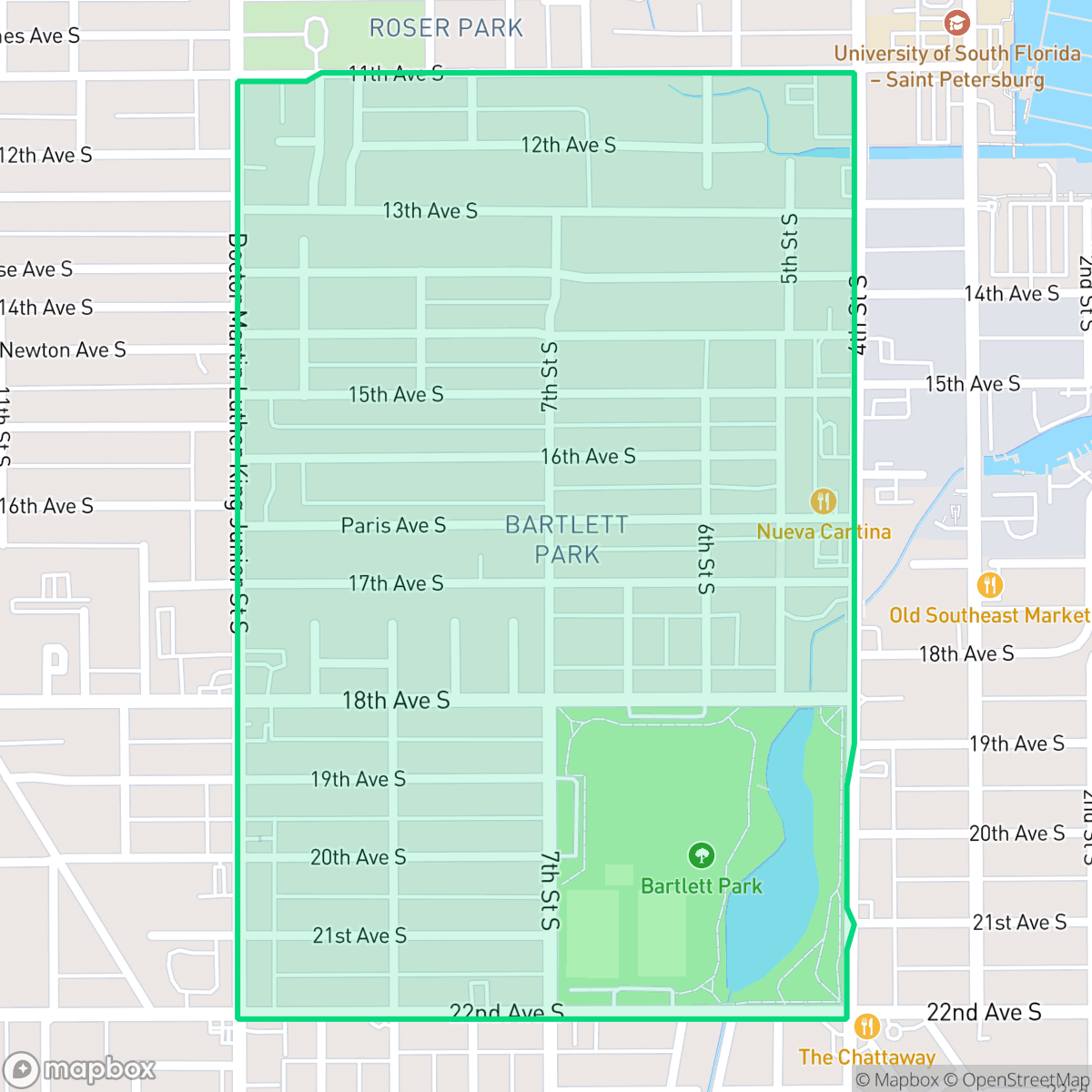
Bartlett Park, named after civic leader A.F. Bartlett, began as a residential suburb platted between 1913 and the early 1920s. The neighborhood is anchored by its namesake 30-acre park, which was developed as a Civil Works Administration project in the 1930s. The area features a traditional grid pattern with vernacular cottages, bungalows, and occasional Mediterranean Revival structures. Historically, the neighborhood served as a hub for tennis, hosting the 1954 Davis Cup and providing courts where tennis legend Chris Evert achieved early career victories. While the neighborhood faced significant economic challenges and demographic shifts in the late 20th century, it has since experienced revitalization. Distinctive local features include brick streets, hexagon block sidewalks, and oak-lined rights-of-way, alongside long-standing local institutions like the Frank W. Pierce Recreation Center and the St. Petersburg Tennis Center.
The area offers a distinct residential aesthetic that blends modest single-family homes with larger estates, all connected by a grid of sidewalks and tree-shaded streets. Its layout encourages pedestrian activity, making it a notably accessible environment for those who prefer to navigate the neighborhood on foot. The presence of the St. Petersburg Tennis Center and local recreation facilities continues to anchor the community as a hub for outdoor activity and public engagement, supported by a street network that remains quieter than the city average according to iHuus data.
While the neighborhood provides a peaceful acoustic environment, prospective residents should be aware of certain environmental factors, including air quality levels that are lower than the city average. The area maintains a suburban feel with a balanced demographic, appealing to those who value proximity to public greenspace and a community with a strongly liberal political leaning. Families may also benefit from the stability of the Pinellas County School District, though they should consider the ongoing district-wide efforts to manage enrollment shifts through school consolidations.
Neighborhood Scores Across 15 Qualities
Housing spacing in Bartlett Park is consistent with the city average, featuring a mix of standard suburban lots and more closely clustered homes. Some areas contain small rectangular lots where neighbors live in closer proximity than in the surrounding St. Petersburg area.
A consistent grid layout with visible sidewalks and safe crossings makes navigating the area on foot highly accessible. According to iHuus data, the street network provides a more walkable environment than much of St. Petersburg due to mature tree canopy and low traffic volume.
Residential scenery ranges from upscale estates with private pools to modest single-family homes. This area maintains a visual appeal slightly above the St. Petersburg average, according to iHuus data.
Direct access to large central parks and nearby coastal greenspace makes this area slightly more dog friendly than the St. Petersburg average. While street-side verges are narrow, much of the neighborhood's greenery is found in private backyards or expansive public recreational areas.
Residential streets and green spaces are distributed in roughly equal measure, providing a suburban feel that is slightly less dense than the St. Petersburg average according to iHuus data.
Local amenities and dining options provide a level of activity significantly higher than the St. Petersburg average. Residents can access various transit hubs, restaurants, and community outdoor spaces within a highly walkable landscape.
Acoustic levels remain low with only infrequent sounds from distant traffic or trains. This area offers a significantly more peaceful environment than the St. Petersburg average, according to iHuus data.
Frequent unhealthy air quality levels pose significant risks to sensitive groups. According to iHuus data, the pollution levels in Bartlett Park are slightly worse than the St. Petersburg average.
Residents can expect a largely residential environment with only light commercial clusters along main roads. According to iHuus data, this area lacks heavy industrial hazards and maintains a higher level of separation from industrial activity than the St. Petersburg average.
Health insurance accessibility in Bartlett Park is slightly lower than the St. Petersburg average, according to iHuus data.
Voting patterns and census indicators show a significantly more liberal political leaning than the St. Petersburg average, according to iHuus data.
Residents live alongside a diverse mix of young adults, families, and seniors. According to iHuus data, the demographic spread is slightly less varied than the St. Petersburg city average.
Flood risk in this area remains undetermined due to a lack of detailed federal studies, though it sits higher than the St. Petersburg average according to iHuus data.
Address-Level Insights for Bartlett Park


iHuus Neighborhood Intelligence Insights
Get address-level neighborhood insights for Bartlett Park
- Street-level scores — see how individual blocks compare, not just neighborhood averages
- Micro-zone boundaries — identify quiet pockets, flood boundaries, and walkable clusters before you visit
- 15 dimensions in full — walkability, noise, air quality, school quality, insurance coverage, population age profile, urban/rural index, and more
- Boundary risk alerts — know if your address sits near a block boundary where scores drop, the kind of detail no listing will ever mention
- School insights — individual school ratings and insights, not just district-level data
- Compare before you commit — side-by-side data across neighborhoods, down to block precision
No credit card required
Compare with Any Neighborhood
| Dimension | Bartlett Park | Albert Whitted Airport |
|---|---|---|
| 🚶 Walkabilityavg 6.61 | ||
| 🔊 Acoustic Comfortavg 3.78 | ||
| 🤫 Privacy Indexavg 5.45 | ||
| 🎨 Visual Appealavg 6.33 | ||
| 🐕 Dog Friendlinessavg 5.45 | ||
| 🗺️ Urban-Rural Indexavg 6.19 | ||
| ✨ Neighborhood Vibeavg 3.5 | ||
| 🏥 Health Insurance Coverageavg 6.88 | ||
| 🌿 Air Qualityavg 1.87 | ||
| 🏭 Industrial Proximityavg 7.55 | ||
| 🌊 Flood Safetyavg 4.61 | ||
| 🗳️ Ideological Leanavg 6.01 | ||
| 👥 Population Age Profileavg 5.11 | ||
| 🔥 Fire Safety | ||
| 🏫 School Quality |
Bartlett Park Rankings
School Districts Serving Bartlett Park
School Insights for Bartlett Park
Below average outcomes; significant attendance and academic challenges.
School Insights
See what's really behind every school rating near Bartlett Park
- Individual school ratings — each school's own score with outcome context, not just a district average
- Enrollment & class size data — student-to-teacher ratio and how it compares to the state average
- Full demographics breakdown — ethnicity and gender composition for every school in the enrollment zone
- Every school in the district — all schools within the enrollment boundary ranked by rating, not just the closest one
- Grade levels & benchmarks — elementary through high school, with below/above state-average flags
No credit card required