Bahama Shores, St. Petersburg
Updated · 520 residents
Bahama Shores is a tranquil, upscale waterfront community defined by its manicured lawns and mid-century architectural charm. While it offers a peaceful residential environment, residents should be aware of the area's susceptibility to flooding and the presence of noticeable traffic noise from nearby corridors.
Key Highlights
About Bahama Shores
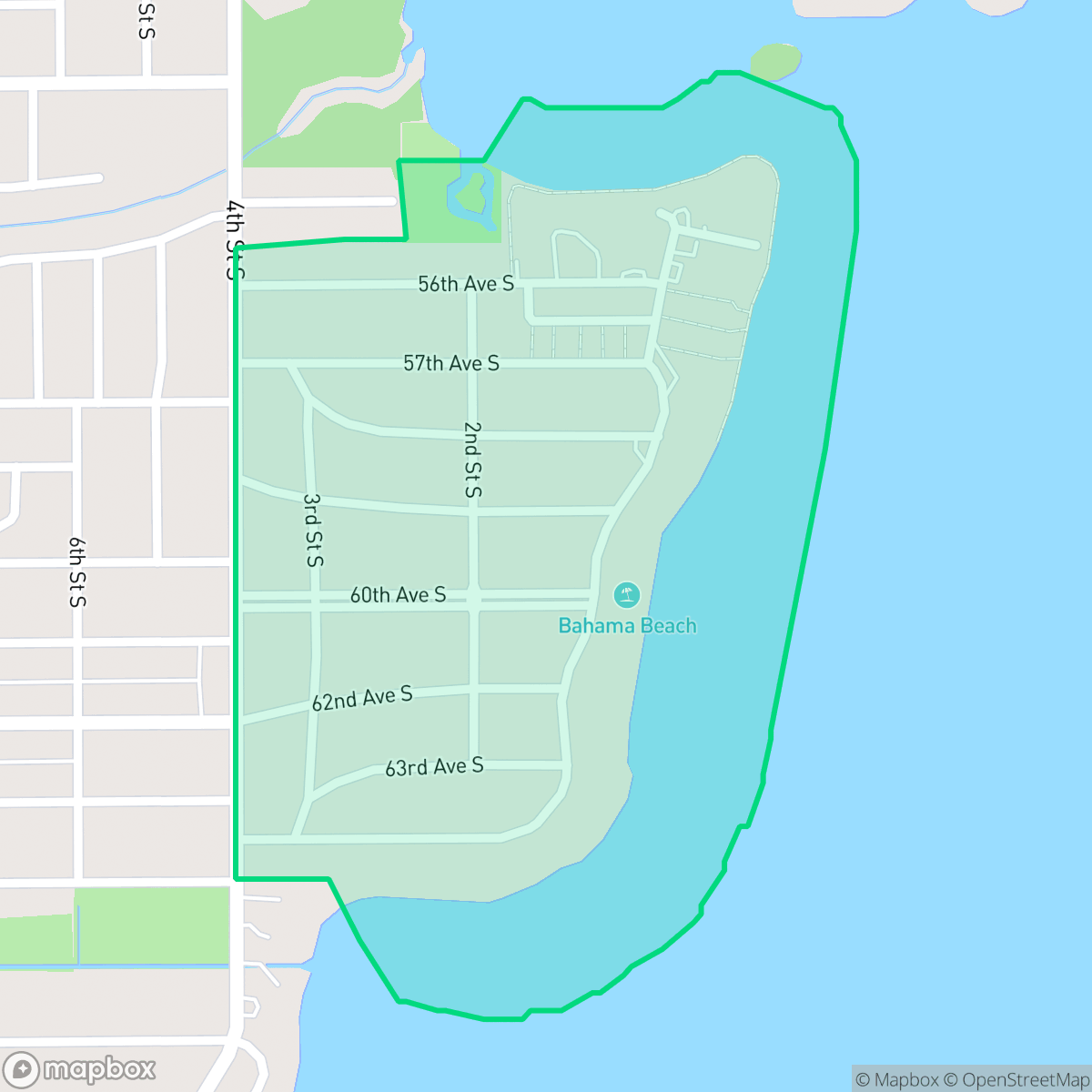
Bahama Shores, located on the southern waterfront of St. Petersburg, was originally envisioned in the 1920s as 'Alta Marina' by developer B.F. Stephenson. Though early construction featured Mediterranean Revival homes by architect Edgar Ferdon, the Great Depression stalled progress. Following World War II, developer Robert Lyons acquired the site, renamed it Bahama Beach, and expanded the land through extensive fill operations. The neighborhood was eventually rebranded as Bahama Shores. Its character is defined by its nautical identity, winding streets, and the historic Bahama Shores Neighborhood Association, established in 1948. A central landmark is the community-stewarded Dolphin Park, a waterfront space that serves as a focal point for local traditions. The area remains notable for its mid-century development and enduring architectural integrity.
The neighborhood maintains a distinct identity as a quiet, purely residential enclave that prioritizes privacy and aesthetic appeal. Large, well-maintained homes and private landscaping define the streetscape, creating a semi-rural feeling despite its urban location. The area serves as a calm retreat from the city, characterized by a lack of industrial activity and a strong sense of community stability according to iHuus data.
Prospective residents should consider the trade-offs of this location, as the area experiences higher than average flood risks and persistent traffic noise from surrounding transportation routes. While the neighborhood lacks significant commercial amenities or nightlife, its demographic diversity and high levels of health insurance coverage contribute to a secure living environment. It is best suited for individuals who value a quiet, established atmosphere and are comfortable navigating the specific environmental challenges associated with coastal living.
Neighborhood Scores Across 15 Qualities
Standard suburban spacing provides a modest buffer between homes, offering slightly more seclusion than the typical St. Petersburg density according to iHuus data. Most properties feature private backyards and fenced boundaries that separate adjacent lots.
Low traffic volumes and a consistent grid pattern make for pleasant strolls, although the lack of sidewalks in some areas means walking is slightly less accessible than the St. Petersburg average. Dense tree canopy occasionally obscures paths along residential streets according to iHuus data.
Large homes, private pools, and well-maintained lawns characterize this area. According to iHuus data, the visual quality of the neighborhood is notably higher than the St. Petersburg average.
Limited public park access and narrow street verges make finding open green space difficult for pet owners. According to iHuus data, this neighborhood offers fewer opportunities for outdoor dog walking than the St. Petersburg average.
Open land and scattered greenery provide a slightly more rural character than the typical St. Petersburg urban landscape, according to iHuus data.
Primarily residential in nature, this area offers a much lower level of activity and fewer local destinations than the St. Petersburg average. Residents can expect a tranquil environment centered around natural spaces like Little Bayou Preserve, though the neighborhood lacks significant commercial amenities or nightlife.
Frequent sounds from nearby major roadways and transportation corridors are common in this area. According to iHuus data, acoustic comfort levels are lower than the St. Petersburg average.
Frequent unhealthy air quality levels pose a significant risk to sensitive groups. This condition is consistent with the broader St. Petersburg area according to iHuus data.
No warehouses, industrial facilities, or hazardous sites are present within the neighborhood. This area offers a much cleaner profile than the St. Petersburg average, consisting entirely of residential and institutional spaces according to iHuus data.
Health insurance access among residents is notably higher than the St. Petersburg average, according to iHuus data.
Voting patterns and census indicators reveal a much more liberal political leaning than the St. Petersburg average. Residents may find a highly progressive social environment according to iHuus data.
Residents live alongside a diverse mix of young adults, families, and older populations. This demographic spread is more balanced than the typical age profile found across St. Petersburg.
Frequent flooding concerns exist here due to the area's location within a designated floodplain; according to iHuus data, this level of risk is notably higher than the St. Petersburg average.
Address-Level Insights for Bahama Shores


iHuus Neighborhood Intelligence Insights
Get address-level neighborhood insights for Bahama Shores
- Street-level scores — see how individual blocks compare, not just neighborhood averages
- Micro-zone boundaries — identify quiet pockets, flood boundaries, and walkable clusters before you visit
- 15 dimensions in full — walkability, noise, air quality, school quality, insurance coverage, population age profile, urban/rural index, and more
- Boundary risk alerts — know if your address sits near a block boundary where scores drop, the kind of detail no listing will ever mention
- School insights — individual school ratings and insights, not just district-level data
- Compare before you commit — side-by-side data across neighborhoods, down to block precision
No credit card required
Compare with Any Neighborhood
| Dimension | Bahama Shores | Albert Whitted Airport |
|---|---|---|
| 🚶 Walkabilityavg 6.61 | ||
| 🔊 Acoustic Comfortavg 3.78 | ||
| 🤫 Privacy Indexavg 5.45 | ||
| 🎨 Visual Appealavg 6.33 | ||
| 🐕 Dog Friendlinessavg 5.45 | ||
| 🗺️ Urban-Rural Indexavg 6.19 | ||
| ✨ Neighborhood Vibeavg 3.5 | ||
| 🏥 Health Insurance Coverageavg 6.88 | ||
| 🌿 Air Qualityavg 1.87 | ||
| 🏭 Industrial Proximityavg 7.55 | ||
| 🌊 Flood Safetyavg 4.61 | ||
| 🗳️ Ideological Leanavg 6.01 | ||
| 👥 Population Age Profileavg 5.11 | ||
| 🔥 Fire Safety | ||
| 🏫 School Quality |
Bahama Shores Rankings
School Districts Serving Bahama Shores
School Insights for Bahama Shores
Below average outcomes; significant attendance and academic challenges.
School Insights
See what's really behind every school rating near Bahama Shores
- Individual school ratings — each school's own score with outcome context, not just a district average
- Enrollment & class size data — student-to-teacher ratio and how it compares to the state average
- Full demographics breakdown — ethnicity and gender composition for every school in the enrollment zone
- Every school in the district — all schools within the enrollment boundary ranked by rating, not just the closest one
- Grade levels & benchmarks — elementary through high school, with below/above state-average flags
No credit card required