Allendale Terrace, St. Petersburg
Updated · 695 residents
Allendale Terrace offers a distinct residential atmosphere characterized by its winding brick streets and mature tree canopies. The neighborhood provides high walkability and a vibrant, mixed-use environment that supports both quiet living and easy access to local amenities.
Key Highlights
About Allendale Terrace
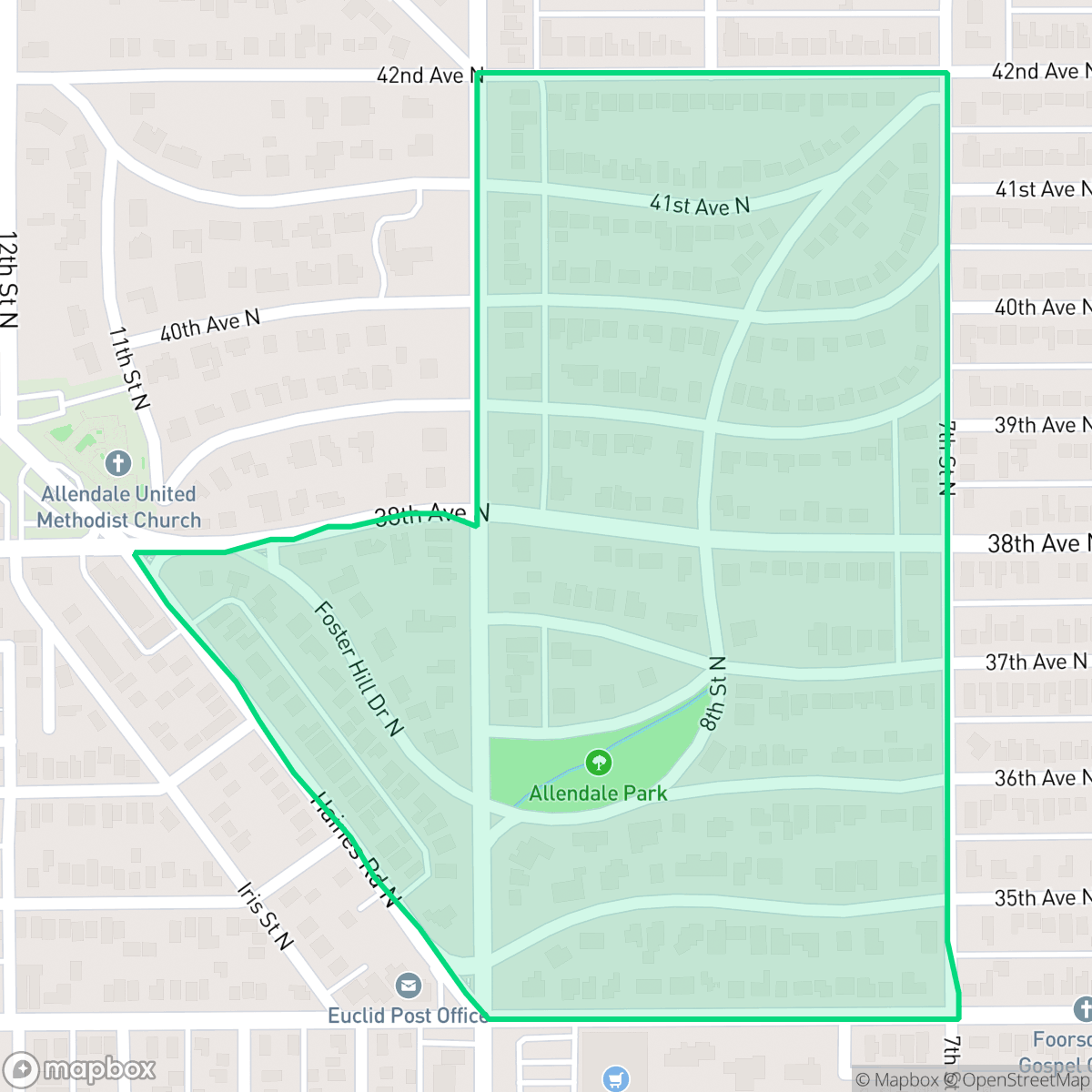
Allendale Terrace, located just north of downtown St. Petersburg, was developed in the 1920s during the Florida land boom by Cade B. Allen, who purchased the 160-acre tract previously known as Foster Grove. Designed as a residential enclave, the neighborhood is distinct for its winding brick streets and mature oak tree canopies, which contrast with the city’s standard grid system. The area is situated on high ground, a feature often highlighted by residents as it historically negated the need for flood insurance. Architectural character is defined by a significant stock of Mediterranean Revival, Colonial Revival, and Craftsman-style homes. Anchored by Allendale Park, the neighborhood is recognized for its large estate-style lots and has maintained its reputation as one of St. Petersburg’s premier non-waterfront residential communities.
The area serves as a unique enclave in St. Petersburg, blending historic architectural charm with an active, modern lifestyle. Residents enjoy a high level of walkability, supported by a well-connected grid of sidewalks that makes local dining and retail hubs easily accessible on foot. The demographic profile is notably diverse, bringing together young professionals, families, and retirees in a setting that feels more open and suburban than the dense urban core of the city.
While the community offers significant appeal, prospective residents should consider specific environmental factors. According to iHuus data, the area experiences moderate traffic noise from nearby arterial roads, and air quality can occasionally reach levels that may concern sensitive groups. Although the neighborhood is highly walkable, pet owners may find limited public green space compared to other parts of the city. The local school district remains a stable institution, recently bolstered by voter-approved funding, though it is currently undergoing consolidation efforts to manage shifting enrollment trends.
Neighborhood Scores Across 15 Qualities
Residential spacing varies throughout the area, with some homes featuring large wooded buffers while others are positioned closely together. According to iHuus data, this level of density provides slightly more separation between neighbors than is found in most of St. Petersburg.
Pedestrian access is well-supported by an extensive network of sidewalks and safe crossings, making it significantly more walkable than the St. Petersburg average. While some larger arterial roads present challenges for crossing, the residential grid remains very accessible for those traveling on foot.
Well-maintained properties and large homes with private pools create an aesthetic that sits above the St. Petersburg average. According to iHuus data, the landscape features a mix of upscale estates and established middle-class residential streets.
Narrow sidewalk verges and a lack of visible public parks make for fewer opportunities to exercise dogs in open areas. While mature tree canopies provide shade for walks, the neighborhood offers less accessible green space for pets than the St. Petersburg average.
Residential pockets offer a balance of single-family homes and mature greenery, feeling slightly more open than the dense urban core of St. Petersburg. According to iHuus data, the area maintains a mix of wooded spaces and established suburban blocks.
Local dining and retail options provide a level of activity significantly higher than the St. Petersburg average. While some residential pockets remain quiet and suburban, other blocks serve as bustling hubs for independent shops and restaurants according to iHuus data.
A steady hum of local traffic from a nearby busy street defines the acoustic environment. According to iHuus data, sound levels are notably higher than the St. Petersburg city average.
Frequent unhealthy air quality levels pose a significant risk to sensitive groups. This condition is consistent with the broader St. Petersburg area according to iHuus data.
Minimal industrial activity defines this area, which features mostly residential and light commercial uses. Residents may encounter occasional utility odors or transit traffic near local gas stations and printing services, but the level of heavy industry is below the St. Petersburg average.
Health insurance coverage among residents is higher than the St. Petersburg average, according to iHuus data.
Political demographics in this area favor liberal perspectives more than the typical St. Petersburg neighborhood. Residents may find a community culture that aligns with progressive values according to iHuus data.
Residents live alongside a balanced mix of young adults, families, and seniors. This demographic variety is slightly more diverse than the average found across St. Petersburg.
Flood safety in this area is slightly higher than the St. Petersburg average, though a lack of detailed FEMA studies means specific risks remain undetermined. According to iHuus data, residents should remain mindful of potential water vulnerabilities during heavy rain events.
Address-Level Insights for Allendale Terrace


iHuus Neighborhood Intelligence Insights
Get address-level neighborhood insights for Allendale Terrace
- Street-level scores — see how individual blocks compare, not just neighborhood averages
- Micro-zone boundaries — identify quiet pockets, flood boundaries, and walkable clusters before you visit
- 15 dimensions in full — walkability, noise, air quality, school quality, insurance coverage, population age profile, urban/rural index, and more
- Boundary risk alerts — know if your address sits near a block boundary where scores drop, the kind of detail no listing will ever mention
- School insights — individual school ratings and insights, not just district-level data
- Compare before you commit — side-by-side data across neighborhoods, down to block precision
No credit card required
Compare with Any Neighborhood
| Dimension | Allendale Terrace | Albert Whitted Airport |
|---|---|---|
| 🚶 Walkabilityavg 6.61 | ||
| 🔊 Acoustic Comfortavg 3.78 | ||
| 🤫 Privacy Indexavg 5.45 | ||
| 🎨 Visual Appealavg 6.33 | ||
| 🐕 Dog Friendlinessavg 5.45 | ||
| 🗺️ Urban-Rural Indexavg 6.19 | ||
| ✨ Neighborhood Vibeavg 3.5 | ||
| 🏥 Health Insurance Coverageavg 6.88 | ||
| 🌿 Air Qualityavg 1.87 | ||
| 🏭 Industrial Proximityavg 7.55 | ||
| 🌊 Flood Safetyavg 4.61 | ||
| 🗳️ Ideological Leanavg 6.01 | ||
| 👥 Population Age Profileavg 5.11 | ||
| 🔥 Fire Safety | ||
| 🏫 School Quality |
Allendale Terrace Rankings
School Districts Serving Allendale Terrace
School Insights for Allendale Terrace
Below average outcomes; significant attendance and academic challenges.
School Insights
See what's really behind every school rating near Allendale Terrace
- Individual school ratings — each school's own score with outcome context, not just a district average
- Enrollment & class size data — student-to-teacher ratio and how it compares to the state average
- Full demographics breakdown — ethnicity and gender composition for every school in the enrollment zone
- Every school in the district — all schools within the enrollment boundary ranked by rating, not just the closest one
- Grade levels & benchmarks — elementary through high school, with below/above state-average flags
No credit card required