Albert Whitted Airport, St. Petersburg
Updated · 1,823 residents
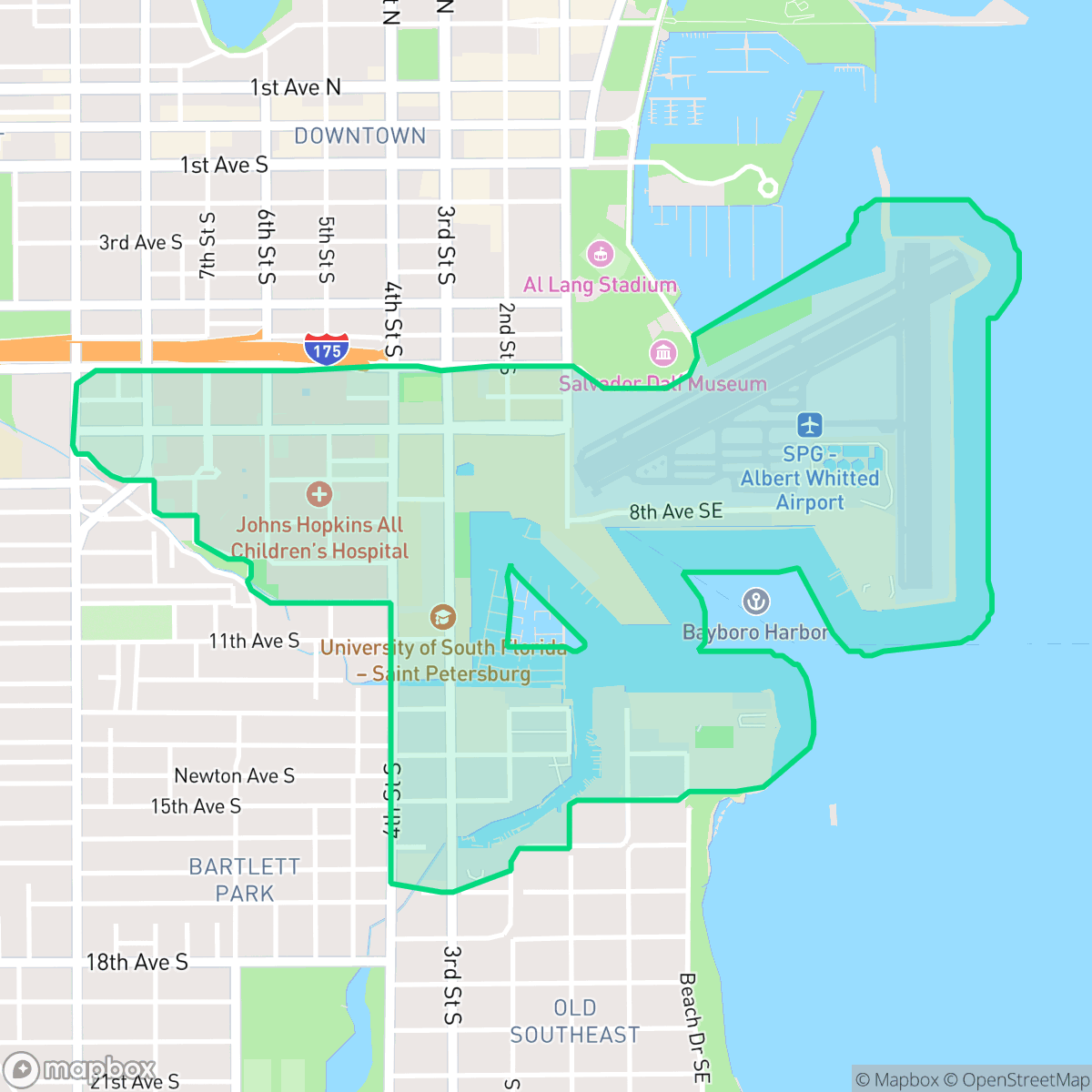
Albert Whitted Airport is a distinct waterfront neighborhood defined by its historic aviation facility and high pedestrian connectivity. While residents enjoy a lively coastal atmosphere and easy access to downtown amenities, they must contend with frequent aircraft noise and air quality challenges.
Key Highlights
About Albert Whitted Airport
Albert Whitted Airport is a historic general aviation facility situated on the downtown St. Petersburg waterfront. Established in 1929 on land reclaimed from Bayboro Harbor dredging, it was named for James Albert Whitted, a pioneering St. Petersburg native and naval aviator. The site holds significant aviation heritage, located near the area where the world's first scheduled commercial airline flight took off in 1914. During World War II, the airport served as a primary training base for U.S. Navy and Marine Corps cadets. Today, the airport functions as a critical general aviation reliever and a key landmark, hosting medical transport services for Johns Hopkins All Children’s Hospital and serving as a prominent feature of the annual Grand Prix of St. Petersburg course.
The area serves as a vibrant urban hub where the historic airfield meets the St. Petersburg waterfront. Residents benefit from an extensive network of sidewalks and bridges, making it one of the most walkable locations in the city. The neighborhood maintains a lively social environment, with numerous parks and local dining options creating a bustling atmosphere throughout the day. Living here involves specific trade-offs, particularly regarding environmental and acoustic comfort. The proximity to active flight paths results in regular aircraft noise, and local air quality metrics indicate potential concerns for sensitive groups. Additionally, the urban layout features a mix of housing styles with limited privacy in some areas, and residents should remain mindful of moderate flood risks associated with the coastal location. It is an ideal setting for those who prioritize walkability and a central, active lifestyle over absolute quiet or seclusion.
Neighborhood Scores Across 15 Qualities
Residential spacing is somewhat mixed, with certain areas containing shared-wall structures that offer less separation than the St. Petersburg average. According to iHuus data, some parts of this neighborhood feature a dense urban layout with minimal buffer between neighbors.
Extensive sidewalk networks and pedestrian bridges provide superior connectivity within the urban core. This level of accessibility is significantly higher than the average for St. Petersburg.
Visual surroundings consist of a mix of institutional buildings, commercial blocks, and apartment complexes with rooftop amenities. According to iHuus data, the aesthetic quality is slightly above the St. Petersburg average.
Public green space and grass verges are sparse within this neighborhood. According to iHuus data, the area offers slightly more access to open areas than the St. Petersburg average despite the dense street grid.
Street layouts and green spaces are distributed in a suburban pattern, though this area feels less dense than the St. Petersburg average due to pockets of high density near major highways. According to iHuus data, the neighborhood presents an even mix of developed infrastructure and open space.
Bustling social hubs and outdoor dining options create a noticeably more lively atmosphere than the St. Petersburg average. This coastal area features concentrated activity around parks and local eateries, according to iHuus data.
Persistent noise levels are expected due to the proximity of active flight paths. This level of acoustic disturbance is consistent with the city average.
Frequent unhealthy air quality levels pose significant risks to sensitive groups. According to iHuus data, the pollution levels in this area are slightly worse than the St. Petersburg average.
Light commercial activities and airport-related traffic are present alongside residential areas, though levels of industrial density remain below the St. Petersburg average. According to iHuus data, residents should expect a mix of daytime business activity without the presence of heavy manufacturing.
Health insurance coverage among residents remains largely in line with the St. Petersburg average, according to iHuus data.
Voting patterns and census indicators show a predominantly liberal political leaning that is notably more progressive than the St. Petersburg average.
Residents live alongside a varied mix of young professionals, families, and seniors. This demographic spread is slightly less diverse than the broader St. Petersburg area according to iHuus data.
Flood safety in this area carries a moderate level of uncertainty because FEMA has not yet finalized a detailed flood study for this specific location. According to iHuus data, the risk profile remains slightly higher than the average seen across St. Petersburg.
Address-Level Insights for Albert Whitted Airport


iHuus Neighborhood Intelligence Insights
Get address-level neighborhood insights for Albert Whitted Airport
- Street-level scores — see how individual blocks compare, not just neighborhood averages
- Micro-zone boundaries — identify quiet pockets, flood boundaries, and walkable clusters before you visit
- 15 dimensions in full — walkability, noise, air quality, school quality, insurance coverage, population age profile, urban/rural index, and more
- Boundary risk alerts — know if your address sits near a block boundary where scores drop, the kind of detail no listing will ever mention
- School insights — individual school ratings and insights, not just district-level data
- Compare before you commit — side-by-side data across neighborhoods, down to block precision
No credit card required
Compare with Any Neighborhood
| Dimension | Albert Whitted Airport | Allendale Terrace |
|---|---|---|
| 🚶 Walkabilityavg 6.61 | ||
| 🔊 Acoustic Comfortavg 3.78 | ||
| 🤫 Privacy Indexavg 5.45 | ||
| 🎨 Visual Appealavg 6.33 | ||
| 🐕 Dog Friendlinessavg 5.45 | ||
| 🗺️ Urban-Rural Indexavg 6.19 | ||
| ✨ Neighborhood Vibeavg 3.5 | ||
| 🏥 Health Insurance Coverageavg 6.88 | ||
| 🌿 Air Qualityavg 1.87 | ||
| 🏭 Industrial Proximityavg 7.55 | ||
| 🌊 Flood Safetyavg 4.61 | ||
| 🗳️ Ideological Leanavg 6.01 | ||
| 👥 Population Age Profileavg 5.11 | ||
| 🔥 Fire Safety | ||
| 🏫 School Quality |
Albert Whitted Airport Rankings
School Districts Serving Albert Whitted Airport
School Insights for Albert Whitted Airport
Below average outcomes; significant attendance and academic challenges.
School Insights
See what's really behind every school rating near Albert Whitted Airport
- Individual school ratings — each school's own score with outcome context, not just a district average
- Enrollment & class size data — student-to-teacher ratio and how it compares to the state average
- Full demographics breakdown — ethnicity and gender composition for every school in the enrollment zone
- Every school in the district — all schools within the enrollment boundary ranked by rating, not just the closest one
- Grade levels & benchmarks — elementary through high school, with below/above state-average flags
No credit card required