Downtown, Pensacola
Updated · 555 residents
Downtown Pensacola is a vibrant cultural hub centered on Palafox Street, known for its exceptional walkability and dense concentration of dining and retail options. Residents enjoy a lively, active atmosphere with fresh air, though the area experiences moderate traffic noise and currently lacks finalized flood risk assessments.
Key Highlights
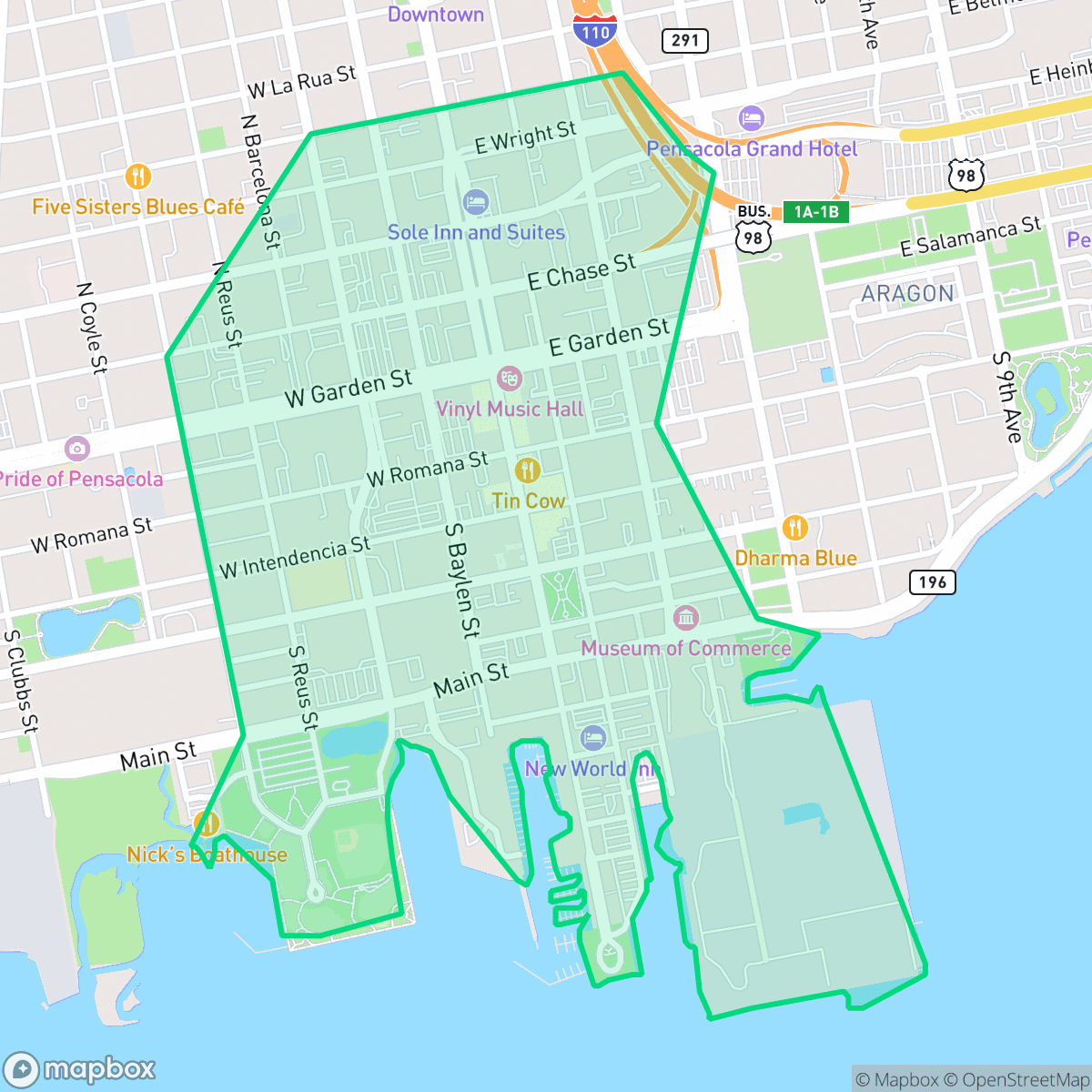
About Downtown
Downtown Pensacola, centered on the historic Palafox Street, traces its origins to Spanish colonial foundations, earning the city its 'City of Five Flags' moniker. The neighborhood's layout was formalized in 1764 by British surveyor Elias Durnford, establishing a grid that persists today. It features a rich architectural tapestry, including Victorian, Georgian Revival, and Neoclassical styles, with 19th-century wrought-iron storefronts lining Palafox. Key landmarks include Plaza Ferdinand VII, where Florida was formally ceded to the United States in 1821, and Seville Square, a former British parade ground. Over the last two decades, the area has undergone a significant transformation, with historic buildings—such as the Old City Hall, now the T.T. Wentworth Jr. Florida State Museum—undergoing adaptive reuse to anchor a vibrant cultural district defined by its preserved colonial-era character and thriving arts scene.
This neighborhood serves as the primary commercial and social engine of the city. With its high degree of walkability, residents can easily access local businesses, breweries, and cultural venues without relying on a vehicle. The area maintains a diverse age demographic, attracting a mix of professionals and families who value proximity to the city's active core. The physical environment is well-maintained, featuring historic architectural details that contribute to a pleasant visual experience for those living and working in the district.
While the area offers significant energy and convenience, prospective residents should consider the moderate ambient noise from street traffic and the presence of mixed commercial and industrial activities. The local school district currently faces significant governance and academic challenges, which is an important factor for families to evaluate. Additionally, because official flood risk assessments are still pending for many blocks in this zone, residents should perform their own due diligence regarding property safety.
Neighborhood Scores Across 15 Qualities
Residential spacing in this area provides a moderate level of separation between neighbors, matching the typical density found throughout Pensacola.
Pedestrian infrastructure is extensive, featuring wide sidewalks and many street crossings. Most daily activities can be completed without a vehicle, which is significantly higher than the Pensacola average according to iHuus data.
Upscale amenities and well-maintained properties provide a visual experience that is slightly above the Pensacola average. According to iHuus data, the area features frequent architectural details and spacious layouts.
Connected green spaces and wide, traffic-safe paths make this area more dog friendly than the Pensacola average. Walking routes are well-integrated with accessible parkland according to iHuus data.
Frequent open land and scattered greenery characterize this area, aligning closely with the broader city average for development density.
Constant movement and a dense concentration of diverse dining, nightlife, and retail shops create an environment significantly more active than the Pensacola average. This area serves as a high-activity center for the city, characterized by strong commercial pull and continuous pedestrian interest according to iHuus data.
Steady traffic sounds from nearby busy streets create a consistent ambient hum. According to iHuus data, acoustic comfort in this area is higher than the city average.
Air quality remains mostly clean with only rare instances of elevated readings. According to iHuus data, the atmosphere in this area is notably fresher than the Pensacola city average.
Active commercial uses like breweries and printing services introduce occasional operational hum and loading activity. This area features more industrial-adjacent elements than the Pensacola average, including proximity to a nearby Superfund site.
Health insurance access among residents is notably lower than the Pensacola average, according to iHuus data.
Political viewpoints in this area are balanced between conservative and liberal leanings, representing a more even ideological split than the broader Pensacola area. According to iHuus data, no single political orientation dominates the neighborhood.
Residents will find a balanced mix of young professionals, families, and seniors. This demographic variety is slightly more pronounced than in other parts of Pensacola, according to iHuus data.
Flood safety levels in this area are lower than the Pensacola average because FEMA has not yet finished a detailed study for this zone. Residents should exercise caution as official risk assessments for these specific blocks remain undetermined according to iHuus data.
Address-Level Insights for Downtown


iHuus Neighborhood Intelligence Insights
Get address-level neighborhood insights for Downtown
- Street-level scores — see how individual blocks compare, not just neighborhood averages
- Micro-zone boundaries — identify quiet pockets, flood boundaries, and walkable clusters before you visit
- 15 dimensions in full — walkability, noise, air quality, school quality, insurance coverage, population age profile, urban/rural index, and more
- Boundary risk alerts — know if your address sits near a block boundary where scores drop, the kind of detail no listing will ever mention
- School insights — individual school ratings and insights, not just district-level data
- Compare before you commit — side-by-side data across neighborhoods, down to block precision
No credit card required
Compare with Any Neighborhood
| Dimension | Downtown | Baymarc |
|---|---|---|
| 🚶 Walkabilityavg 5.69 | ||
| 🔊 Acoustic Comfortavg 3.55 | ||
| 🤫 Privacy Indexavg 5.74 | ||
| 🎨 Visual Appealavg 6.1 | ||
| 🐕 Dog Friendlinessavg 5.17 | ||
| 🗺️ Urban-Rural Indexavg 6.57 | ||
| ✨ Neighborhood Vibeavg 3.9 | ||
| 🏥 Health Insurance Coverageavg 6.07 | ||
| 🌿 Air Qualityavg 6.61 | ||
| 🏭 Industrial Proximityavg 6.4 | ||
| 🌊 Flood Safetyavg 6.74 | ||
| 🗳️ Ideological Leanavg 4.7 | ||
| 👥 Population Age Profileavg 5.15 | ||
| 🔥 Fire Safety | ||
| 🏫 School Quality |
Downtown Rankings
School Districts Serving Downtown
School Insights for Downtown
Below average outcomes; significant attendance and academic challenges.
School Insights
See what's really behind every school rating near Downtown
- Individual school ratings — each school's own score with outcome context, not just a district average
- Enrollment & class size data — student-to-teacher ratio and how it compares to the state average
- Full demographics breakdown — ethnicity and gender composition for every school in the enrollment zone
- Every school in the district — all schools within the enrollment boundary ranked by rating, not just the closest one
- Grade levels & benchmarks — elementary through high school, with below/above state-average flags
No credit card required