Uptown, Palmetto
Updated · 1,049 residents
Uptown is a central Palmetto district that balances residential and light industrial use with a semi-rural atmosphere. While the area offers a diverse demographic and clean air, residents often navigate high noise levels from nearby transit and limited pedestrian infrastructure.
Key Highlights
About Uptown
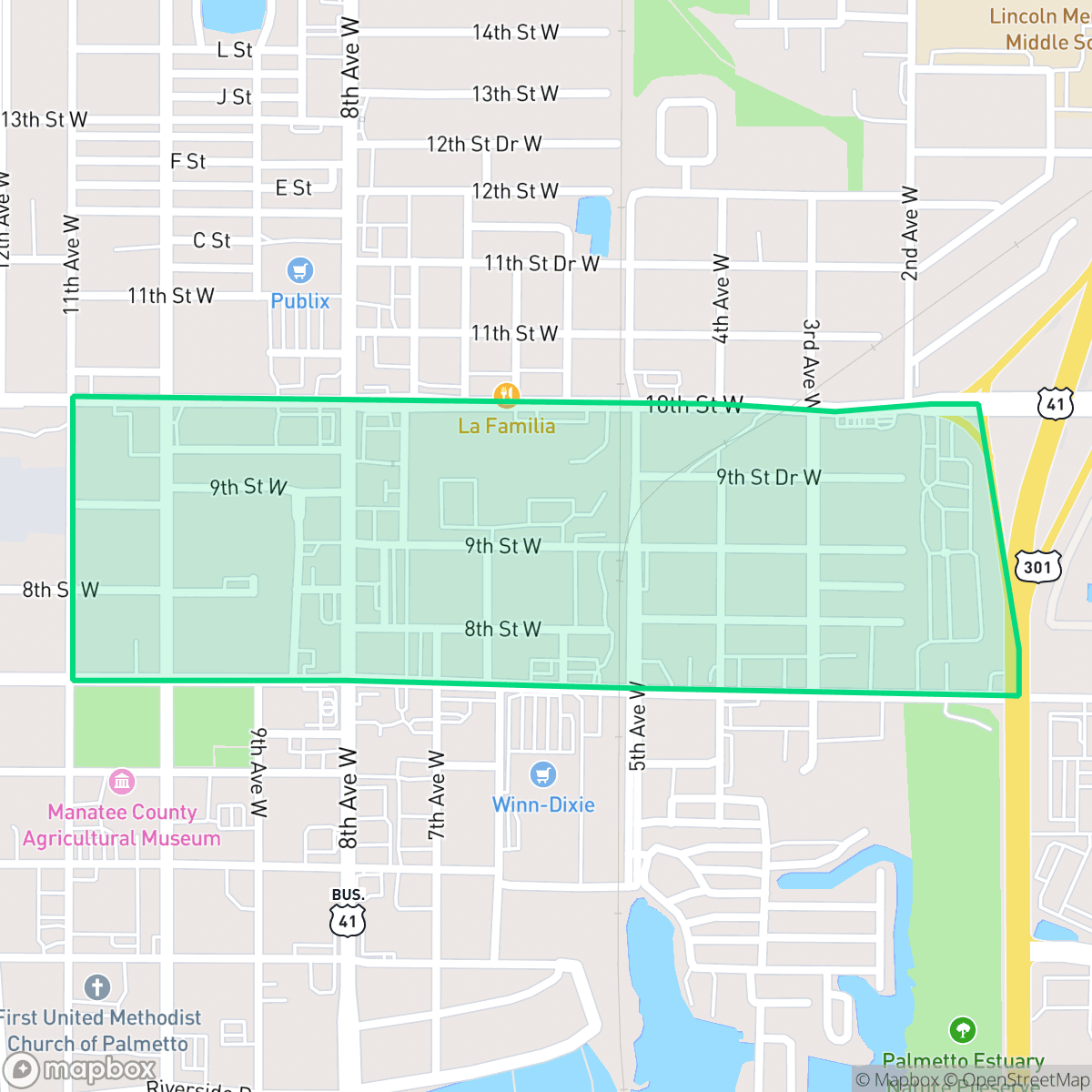
The Uptown district in Palmetto, Florida, is officially designated as a character district within the city's Downtown Core Design Code. Geographically bounded by 7th Street West, 11th Avenue West, 10th Street West, and U.S. 41/301, the area is central to the city's urban planning efforts to foster a vibrant, pedestrian-oriented environment. The district's regulatory framework emphasizes contextual design, architectural diversity, and the rehabilitation of historic structures to preserve Palmetto's identity. While the broader city is known for its Manatee River waterfront and historic charm, the Uptown district specifically functions as an administrative and zoning designation intended to balance residential density with commercial activity, distinguishing its development path from the adjacent waterfront and midtown character districts.
The neighborhood functions as a functional, mixed-use area characterized by a blend of tract housing, mobile home parks, and light industrial facilities. The landscape maintains a semi-rural feel, featuring scattered homes and open land that contrasts with the more densely developed parts of the city. According to iHuus data, the area provides a unique, active environment that blends suburban residential life with energetic commercial pockets, though the visual profile remains largely utilitarian rather than ornamental.
Neighborhood Scores Across 15 Qualities
Residential spacing varies due to dense mobile home parks where structures sit very close together. This level of privacy is lower than the Palmetto average according to iHuus data.
Fragmented sidewalk networks and high traffic arterials make navigating the area on foot difficult. While quiet residential streets exist, walkability is lower than the Palmetto city average according to iHuus data.
Landscape features include mobile home parks and industrial warehouses, resulting in a visual profile that is below the Palmetto average. Residential structures primarily consist of standard tract housing with modest yards and functional infrastructure.
Frequent industrial pavement and narrow roadside verges limit opportunities for off-leash walking. According to iHuus data, access to public green space is below the Palmetto average.
Low density residential pockets and light industrial zones create a semi-rural feel that is slightly less developed than the Palmetto city average. According to iHuus data, the landscape features frequent open land and scattered homes interspersed with mobile home parks.
Local activity levels are significantly higher than the Palmetto average, offering a blend of suburban residential life and energetic commercial pockets. Residents have access to a diverse selection of dining and amenities near transit hubs, according to iHuus data.
Frequent acoustic disturbances from nearby transit corridors and flight paths characterize this area. According to iHuus data, noise levels are notably higher than the Palmetto city average.
Air quality remains consistently high with negligible health concerns. This level of clarity and freshness is slightly better than the average found throughout Palmetto, according to iHuus data.
Light industrial and commercial utilities, such as a printing service and gas station, are present alongside residential areas. This level of industrial proximity is slightly lower than the Palmetto city average.
Health insurance access is significantly lower in this area than the Palmetto average, according to iHuus data.
Political demographics in Uptown are largely conservative, showing a slightly more right-leaning presence than the Palmetto city average according to iHuus data.
A balanced mix of young adults, families, and older residents defines the local demographic. This age distribution remains largely consistent with the broader Palmetto area according to iHuus data.
Frequent flooding is a significant concern in this area because much of the neighborhood sits within a designated floodplain. According to iHuus data, the risk of inundation here is notably higher than the Palmetto city average.
Address-Level Insights for Uptown


iHuus Neighborhood Intelligence Insights
Get address-level neighborhood insights for Uptown
- Street-level scores — see how individual blocks compare, not just neighborhood averages
- Micro-zone boundaries — identify quiet pockets, flood boundaries, and walkable clusters before you visit
- 15 dimensions in full — walkability, noise, air quality, school quality, insurance coverage, population age profile, urban/rural index, and more
- Boundary risk alerts — know if your address sits near a block boundary where scores drop, the kind of detail no listing will ever mention
- School insights — individual school ratings and insights, not just district-level data
- Compare before you commit — side-by-side data across neighborhoods, down to block precision
No credit card required
Compare with Any Neighborhood
| Dimension | Uptown | Midtown |
|---|---|---|
| 🚶 Walkabilityavg 5.58 | ||
| 🔊 Acoustic Comfortavg 3.79 | ||
| 🤫 Privacy Indexavg 5.21 | ||
| 🎨 Visual Appealavg 6.11 | ||
| 🐕 Dog Friendlinessavg 5.32 | ||
| 🗺️ Urban-Rural Indexavg 6.84 | ||
| ✨ Neighborhood Vibeavg 2.69 | ||
| 🏥 Health Insurance Coverageavg 6.47 | ||
| 🌿 Air Qualityavg 9.74 | ||
| 🏭 Industrial Proximityavg 6.63 | ||
| 🌊 Flood Safetyavg 4.27 | ||
| 🗳️ Ideological Leanavg 2.54 | ||
| 👥 Population Age Profileavg 5.47 | ||
| 🔥 Fire Safety | ||
| 🏫 School Quality |
Uptown Rankings
School Districts Serving Uptown
School Insights for Uptown
Below average outcomes; significant attendance and academic challenges.
School Insights
See what's really behind every school rating near Uptown
- Individual school ratings — each school's own score with outcome context, not just a district average
- Enrollment & class size data — student-to-teacher ratio and how it compares to the state average
- Full demographics breakdown — ethnicity and gender composition for every school in the enrollment zone
- Every school in the district — all schools within the enrollment boundary ranked by rating, not just the closest one
- Grade levels & benchmarks — elementary through high school, with below/above state-average flags
No credit card required