Windhover, Orlando
Updated · 1,659 residents
Windhover is a garden-style residential enclave in Orlando's Dr. Phillips area, offering a unique blend of mature landscaping and convenient access to the Universal Orlando Resort. While the community provides a walkable environment with scenic ponds, residents should anticipate higher noise levels due to its proximity to major transit corridors.
Key Highlights
About Windhover
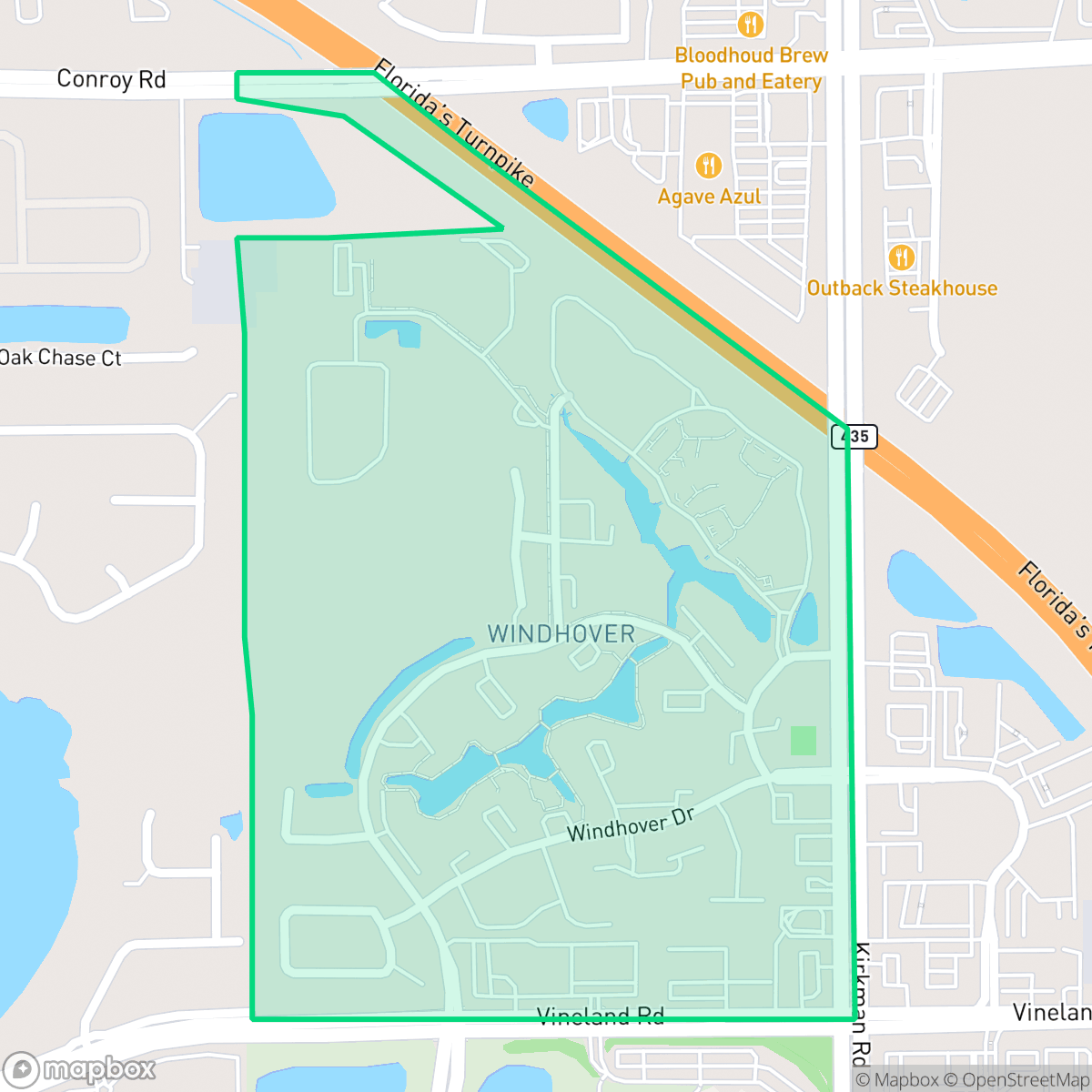
Windhover is a residential condominium community in Orlando’s Dr. Phillips area, developed in 1973–1974. As one of the earlier residential developments in the Southwest Orlando corridor, it predates much of the modern tourist-focused infrastructure surrounding it. The neighborhood is characterized by garden-style architecture, featuring 340 units integrated into a park-like landscape of mature oak trees, scenic ponds, and winding walking paths. Situated directly across from the Universal Orlando Resort, the community serves as an established enclave that bridges the area’s residential history with its current role as a primary tourism hub. Its design prioritizes natural, low-density aesthetics, offering a contrast to the high-density commercial development that defines much of the adjacent Kirkman Road and International Drive corridors.
The neighborhood maintains a distinct character defined by its lush, park-like setting and low-density architecture. It serves as an active social hub, benefiting from a vibrant mix of nearby dining and retail options that provide a more energetic atmosphere than typical suburban developments. Residents enjoy a semi-rural aesthetic characterized by mature oak trees and retention ponds, which provide a sense of privacy and visual appeal that exceeds the city average. According to iHuus data, the area maintains a notably liberal-leaning demographic and a diverse mix of age groups, fostering a balanced community environment that feels removed from the industrial activity found elsewhere in the region.
Living in this area involves balancing the benefits of a highly walkable, green environment with specific urban trade-offs. While the interior paths are well-maintained for pedestrians and pet owners, the neighborhood faces significant acoustic disturbances from surrounding major roadways. Prospective residents should also be aware of a moderate flood risk and the need for proactive health insurance planning, as coverage rates are slightly lower than the regional average. Families are served by the Orange County Public School District, which offers stable leadership and significant facility investment, though the district continues to navigate enrollment shifts and operational transitions. This location is best suited for those who prioritize proximity to Orlando's entertainment corridor while seeking a more secluded, nature-focused living space.
Neighborhood Scores Across 15 Qualities
Residential layouts offer more separation between neighbors than the typical Orlando area. While some dense apartment clusters exist, much of the neighborhood benefits from buffers provided by wooded areas and retention ponds.
Sidewalks are well-established within residential complexes and along many main roads, making this area significantly more walkable than the Orlando average. However, large parking lots and major highways can disrupt continuous pedestrian paths throughout the neighborhood.
Manicured landscapes and large private estates contribute to a sense of openness that sits well above the Orlando average. While some areas feature standard multi-family housing and retail, much of the neighborhood is characterized by premium amenities and spacious properties.
Lakeside paths and wooded areas provide ample space for pet exercise, making this area more dog friendly than the Orlando average. While internal green buffers are significant, navigating the perimeter can be difficult due to high traffic roads.
Frequent open land and woodland buffers provide a more open feel than the typical Orlando urban landscape. According to iHuus data, this area features a blend of scattered homes amid greenery and larger suburban developments.
Local dining and transit hubs provide a noticeably higher level of activity than the Orlando average. Residents can find a concentrated mix of retail, dining, and cultural venues that create a much more vibrant atmosphere than most suburban areas in the city.
Frequent acoustic disturbances from nearby major roadways and transit corridors characterize this area. According to iHuus data, noise levels in Windhover are notably higher than the Orlando city average.
Air quality remains consistently good with rare instances of elevated readings. This level of cleanliness is notably higher than the Orlando average, according to iHuus data.
Predominantly residential land use characterizes this area, which lacks the heavy industrial presence found more frequently across Orlando. While a few utility structures and light commercial services are present, they do not dominate the landscape.
Health insurance enrollment among residents is slightly below the Orlando average, according to iHuus data.
Political leanings in this area are notably more liberal than the Orlando average, according to iHuus data.
A balanced mix of young adults, families, and seniors defines the local demographic. According to iHuus data, this age distribution is slightly more varied than the typical Orlando profile.
Flood risk in this area is higher than the Orlando average, though official FEMA assessments for this specific location remain incomplete. Residents should remain aware of potential vulnerabilities during heavy rain events according to iHuus data.
Address-Level Insights for Windhover


iHuus Neighborhood Intelligence Insights
Get address-level neighborhood insights for Windhover
- Street-level scores — see how individual blocks compare, not just neighborhood averages
- Micro-zone boundaries — identify quiet pockets, flood boundaries, and walkable clusters before you visit
- 15 dimensions in full — walkability, noise, air quality, school quality, insurance coverage, population age profile, urban/rural index, and more
- Boundary risk alerts — know if your address sits near a block boundary where scores drop, the kind of detail no listing will ever mention
- School insights — individual school ratings and insights, not just district-level data
- Compare before you commit — side-by-side data across neighborhoods, down to block precision
No credit card required
Compare with Any Neighborhood
| Dimension | Windhover | 33rd St. Industrial |
|---|---|---|
| 🚶 Walkabilityavg 5.62 | ||
| 🔊 Acoustic Comfortavg 3.33 | ||
| 🤫 Privacy Indexavg 4.6 | ||
| 🎨 Visual Appealavg 5.36 | ||
| 🐕 Dog Friendlinessavg 5.01 | ||
| 🗺️ Urban-Rural Indexavg 5.48 | ||
| ✨ Neighborhood Vibeavg 2.98 | ||
| 🏥 Health Insurance Coverageavg 5.11 | ||
| 🌿 Air Qualityavg 5.87 | ||
| 🏭 Industrial Proximityavg 5.75 | ||
| 🌊 Flood Safetyavg 4.98 | ||
| 🗳️ Ideological Leanavg 5.62 | ||
| 👥 Population Age Profileavg 3.78 | ||
| 🔥 Fire Safety | ||
| 🏫 School Quality |
Windhover Rankings
School Districts Serving Windhover
School Insights for Windhover
Below average outcomes; significant attendance and academic challenges.
School Insights
See what's really behind every school rating near Windhover
- Individual school ratings — each school's own score with outcome context, not just a district average
- Enrollment & class size data — student-to-teacher ratio and how it compares to the state average
- Full demographics breakdown — ethnicity and gender composition for every school in the enrollment zone
- Every school in the district — all schools within the enrollment boundary ranked by rating, not just the closest one
- Grade levels & benchmarks — elementary through high school, with below/above state-average flags
No credit card required