Washington Shores, Orlando
Updated · 1,244 residents
Washington Shores is a historically significant residential enclave known for its semi-rural atmosphere and modest suburban charm. The neighborhood offers good pedestrian access and high levels of health insurance coverage for its multi-generational population, although residents should expect noticeable noise from nearby traffic corridors.
Key Highlights
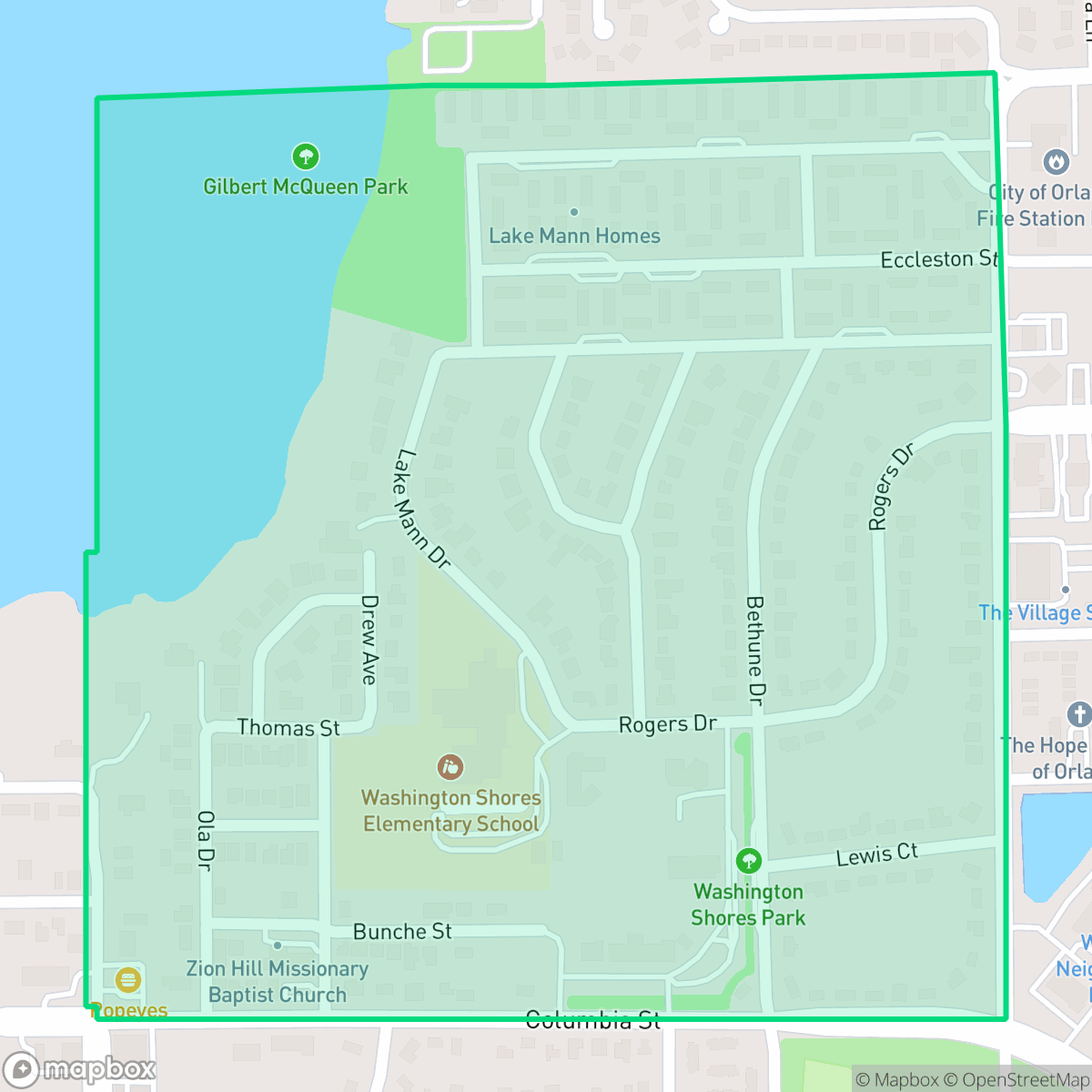
About Washington Shores
Washington Shores, established in the late 1940s and early 1950s, stands as a landmark of post-World War II Black suburbanization in Orlando, Florida. Developed as a planned community, it was designed to address the housing crisis faced by African Americans during an era of rigid segregation. The neighborhood gained historical significance as a symbol of Black economic empowerment, notably serving as the home of Florida’s first Black-owned savings and loan bank, established in 1963. While its creation was influenced by both local Black leaders and city authorities, Washington Shores remains a distinct residential enclave that expanded the footprint of Orlando’s Black community beyond the traditional downtown Parramore district. Today, it is recognized for its historical role in navigating the complexities of mid-century urban development and residential segregation in the American South.
The neighborhood maintains a distinct identity defined by its spacious, semi-rural feel and a complete absence of industrial facilities. Residents enjoy a clean environment characterized by tidy greenery, private pools, and a balanced mix of age groups. The landscape is primarily residential, offering a sense of community that is supported by high rates of health insurance coverage among the local population.
When considering a move to the area, it is important to note that while the neighborhood provides good pedestrian infrastructure, some interior streets lack dedicated walkways. Prospective residents should also be aware of moderate flood risks and consistent noise from surrounding transit routes. The area is served by the Orange County School District, which provides stable institutional leadership and significant facility investment, even as the district navigates broader regional enrollment shifts.
Neighborhood Scores Across 15 Qualities
Residential spacing is varied, offering more buffer between neighbors than the Orlando average. According to iHuus data, most detached homes maintain a standard distance from adjacent structures, though some apartment complexes feature higher density.
Main roads and several residential subdivisions feature sidewalks and safe crossings, making this area more walkable than the Orlando average. Some interior residential streets lack clear pedestrian infrastructure, according to iHuus data.
Standard tract housing and multi-family apartments define the landscape, which features more tidy greenery and private pools than the Orlando average. According to iHuus data, the area presents a typical suburban aesthetic with modest yards and shared community amenities.
Access to public sports fields and lakefront greenery provides decent space for pets, making this area slightly more dog friendly than the Orlando average. Residential blocks feature moderate sidewalk verges, though much of the neighborhood's green space remains within privately fenced yards.
Open land and scattered homes amidst woodlands provide a more spacious, semi-rural atmosphere than the typical Orlando urban landscape. According to iHuus data, this area features frequent pockets of undeveloped space compared to the denser city average.
Local energy levels are higher than the Orlando average, offering a varied mix of quiet residential pockets and active dining corridors. While some areas remain low-key and semi-rural, other sections provide walkable access to diverse eateries and entertainment venues.
Frequent noise from nearby transit corridors and infrastructure is a regular presence here. According to iHuus data, acoustic comfort levels are slightly below the Orlando city average.
Air quality in this area fluctuates between acceptable and unhealthy levels, which may cause occasional concern for sensitive groups. According to iHuus data, these conditions are largely consistent with the average seen across Orlando.
Industrial presence is virtually non-existent here, providing a much cleaner environment than the Orlando average. According to iHuus data, the area consists of residential and institutional zones with no detected warehouses or heavy industrial facilities.
Health insurance enrollment among residents is significantly higher than the Orlando average, according to iHuus data. This indicates a well-covered population with greater access to medical services.
Voting patterns and census indicators show a significantly more liberal political leaning than the Orlando average, according to iHuus data.
Residents encounter a diverse range of age groups, including young professionals and families. This demographic spread is more balanced than the average found across Orlando.
Flood risk levels in this area are higher than the Orlando average, though FEMA has not yet finalized a detailed study for this specific zone. Residents should remain aware of potential vulnerabilities during heavy rain events according to iHuus data.
Address-Level Insights for Washington Shores


iHuus Neighborhood Intelligence Insights
Get address-level neighborhood insights for Washington Shores
- Street-level scores — see how individual blocks compare, not just neighborhood averages
- Micro-zone boundaries — identify quiet pockets, flood boundaries, and walkable clusters before you visit
- 15 dimensions in full — walkability, noise, air quality, school quality, insurance coverage, population age profile, urban/rural index, and more
- Boundary risk alerts — know if your address sits near a block boundary where scores drop, the kind of detail no listing will ever mention
- School insights — individual school ratings and insights, not just district-level data
- Compare before you commit — side-by-side data across neighborhoods, down to block precision
No credit card required
Compare with Any Neighborhood
| Dimension | Washington Shores | 33rd St. Industrial |
|---|---|---|
| 🚶 Walkabilityavg 5.62 | ||
| 🔊 Acoustic Comfortavg 3.33 | ||
| 🤫 Privacy Indexavg 4.6 | ||
| 🎨 Visual Appealavg 5.36 | ||
| 🐕 Dog Friendlinessavg 5.01 | ||
| 🗺️ Urban-Rural Indexavg 5.48 | ||
| ✨ Neighborhood Vibeavg 2.98 | ||
| 🏥 Health Insurance Coverageavg 5.11 | ||
| 🌿 Air Qualityavg 5.87 | ||
| 🏭 Industrial Proximityavg 5.75 | ||
| 🌊 Flood Safetyavg 4.98 | ||
| 🗳️ Ideological Leanavg 5.62 | ||
| 👥 Population Age Profileavg 3.78 | ||
| 🔥 Fire Safety | ||
| 🏫 School Quality |
Washington Shores Rankings
School Districts Serving Washington Shores
School Insights for Washington Shores
Below average outcomes; significant attendance and academic challenges.
School Insights
See what's really behind every school rating near Washington Shores
- Individual school ratings — each school's own score with outcome context, not just a district average
- Enrollment & class size data — student-to-teacher ratio and how it compares to the state average
- Full demographics breakdown — ethnicity and gender composition for every school in the enrollment zone
- Every school in the district — all schools within the enrollment boundary ranked by rating, not just the closest one
- Grade levels & benchmarks — elementary through high school, with below/above state-average flags
No credit card required