Vista East, Orlando
Updated · 11,303 residents
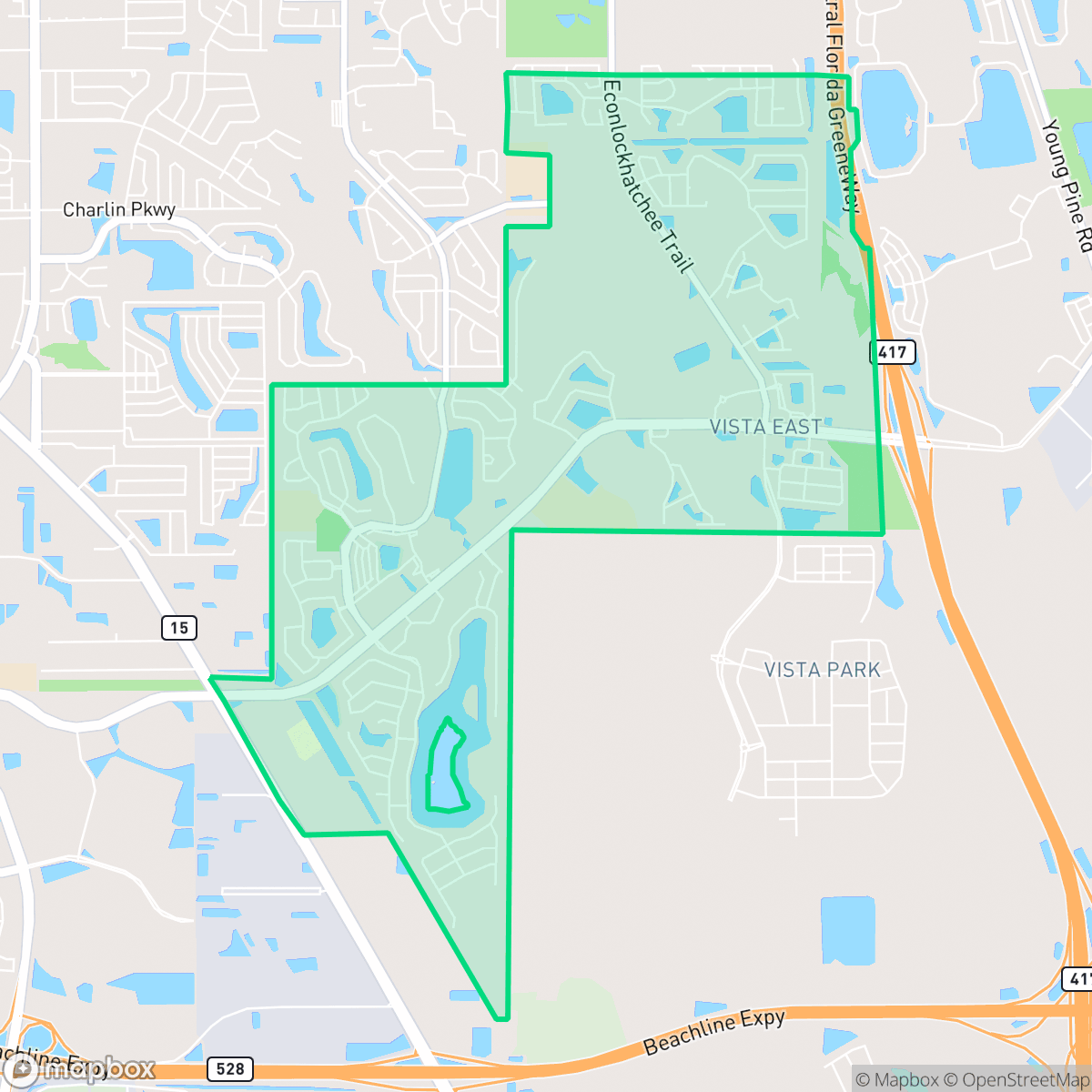
Vista East is a modern, master-planned community in Southeast Orlando defined by its upscale suburban scenery and expansive green spaces. Residents benefit from a highly walkable environment with extensive sidewalk networks and a quiet, residential atmosphere that remains distinct from the city's denser urban centers.
Key Highlights
About Vista East
Vista East is a modern master-planned community in Southeast Orlando, primarily developed in the early 2000s through the annexation of over 1,000 acres of rural land into the city. A significant portion of the area, known as the former Pine Castle Bombing Range, required extensive environmental remediation to clear unexploded ordnance left from its use as a World War II Army Air Force practice site. This cleanup, completed in 2020, is recognized as one of the largest private remediations of a formerly used defense site in the United States. The neighborhood, which encompasses residential communities like Vista Lakes and Tivoli Woods alongside the Beltway Commerce Center, was established through a public-private partnership that transformed the landscape into a suburban corridor of single-family homes, apartments, and regional retail infrastructure.
The area is characterized by a semi-rural feel, featuring scattered homes nestled amidst woodlands, wetlands, and preserved conservation areas. Its visual appeal is marked by large residences with private pools and well-maintained landscapes, offering a refined suburban aesthetic. The neighborhood maintains a tranquil environment with minimal commercial activity, making it a peaceful retreat for those who prioritize quiet streets over a bustling nightlife.
Prospective residents should note the balance between its high walkability and the presence of moderate traffic noise from nearby arterial roads. The community offers a diverse demographic mix and high rates of health insurance coverage, supported by the stable Orange County Public Schools district. While the area provides significant privacy due to natural buffers like ponds and wooded corridors, it is best suited for individuals or families seeking a quiet, pet-friendly environment with easy access to outdoor exercise routes.
Neighborhood Scores Across 15 Qualities
Residential spacing varies between dense townhomes and single-family lots, providing more separation from neighbors than the Orlando average. Many properties benefit from natural buffers such as wooded areas or ponds, though some central developments feature closely positioned structures.
Extensive sidewalk networks and safe pedestrian crossings make navigating the area on foot much easier than in most parts of Orlando. Most residential streets and main roads feature continuous paths and low-traffic layouts, according to iHuus data.
Large homes with private pools and manicured landscapes characterize much of this area, offering a level of visual quality that sits well above the Orlando average. According to iHuus data, many properties feature expansive driveways and modern architectural details.
Extensive green buffers, wooded corridors, and lakeside paths offer significantly more space for pet exercise than the Orlando average. Wide grassy verges between sidewalks and roads provide safe, continuous routes for walking dogs away from traffic.
Frequent open land and significant forested patches create a more semi-rural atmosphere than much of the Orlando area. According to iHuus data, residents can expect scattered homes set amid woodlands, wetlands, and preserved conservation areas.
Low levels of commercial activity and street life create a subdued atmosphere that is slightly below the city average. While certain pockets feature local dining and wellness services, much of the area consists of tranquil residential streets with minimal points of interest.
Steady sounds from nearby busy streets are common here, though acoustic levels remain more tranquil than the Orlando average according to iHuus data.
Air quality remains consistently high with infrequent periods of poor ventilation. According to iHuus data, these levels are notably better than the Orlando average.
Residential and natural landscapes dominate the area, providing much less exposure to heavy industry than the Orlando average. While some localized logistics hubs and light commercial services exist on the periphery, there is no significant presence of heavy manufacturing or hazardous facilities.
Health insurance enrollment among residents is significantly higher than the Orlando average, according to iHuus data.
Political leanings in this area favor liberal perspectives, representing a more progressive tilt than the Orlando average according to iHuus data.
Residents live alongside a varied demographic of young adults, families, and seniors. This age distribution is more diverse than the typical profile found across Orlando.
Flood risk in this area is comparable to the Orlando average, though specific details remain undetermined due to a lack of recent detailed FEMA studies. Residents should remain aware of potential seasonal water accumulation as noted by iHuus data.
Address-Level Insights for Vista East


iHuus Neighborhood Intelligence Insights
Get address-level neighborhood insights for Vista East
- Street-level scores — see how individual blocks compare, not just neighborhood averages
- Micro-zone boundaries — identify quiet pockets, flood boundaries, and walkable clusters before you visit
- 15 dimensions in full — walkability, noise, air quality, school quality, insurance coverage, population age profile, urban/rural index, and more
- Boundary risk alerts — know if your address sits near a block boundary where scores drop, the kind of detail no listing will ever mention
- School insights — individual school ratings and insights, not just district-level data
- Compare before you commit — side-by-side data across neighborhoods, down to block precision
No credit card required
Compare with Any Neighborhood
| Dimension | Vista East | 33rd St. Industrial |
|---|---|---|
| 🚶 Walkabilityavg 5.62 | ||
| 🔊 Acoustic Comfortavg 3.33 | ||
| 🤫 Privacy Indexavg 4.6 | ||
| 🎨 Visual Appealavg 5.36 | ||
| 🐕 Dog Friendlinessavg 5.01 | ||
| 🗺️ Urban-Rural Indexavg 5.48 | ||
| ✨ Neighborhood Vibeavg 2.98 | ||
| 🏥 Health Insurance Coverageavg 5.11 | ||
| 🌿 Air Qualityavg 5.87 | ||
| 🏭 Industrial Proximityavg 5.75 | ||
| 🌊 Flood Safetyavg 4.98 | ||
| 🗳️ Ideological Leanavg 5.62 | ||
| 👥 Population Age Profileavg 3.78 | ||
| 🔥 Fire Safety | ||
| 🏫 School Quality |
Vista East Rankings
School Districts Serving Vista East
School Insights for Vista East
Below average outcomes; significant attendance and academic challenges.
School Insights
See what's really behind every school rating near Vista East
- Individual school ratings — each school's own score with outcome context, not just a district average
- Enrollment & class size data — student-to-teacher ratio and how it compares to the state average
- Full demographics breakdown — ethnicity and gender composition for every school in the enrollment zone
- Every school in the district — all schools within the enrollment boundary ranked by rating, not just the closest one
- Grade levels & benchmarks — elementary through high school, with below/above state-average flags
No credit card required