Ventura, Orlando
Updated · 4,805 residents
Ventura is a suburban enclave centered around the Ventura Country Club, offering residents a mix of housing styles and expansive green spaces. The area stands out for its high level of walkability and a spacious, semi-rural atmosphere that provides a quiet, functional environment for its diverse population.
Key Highlights
About Ventura
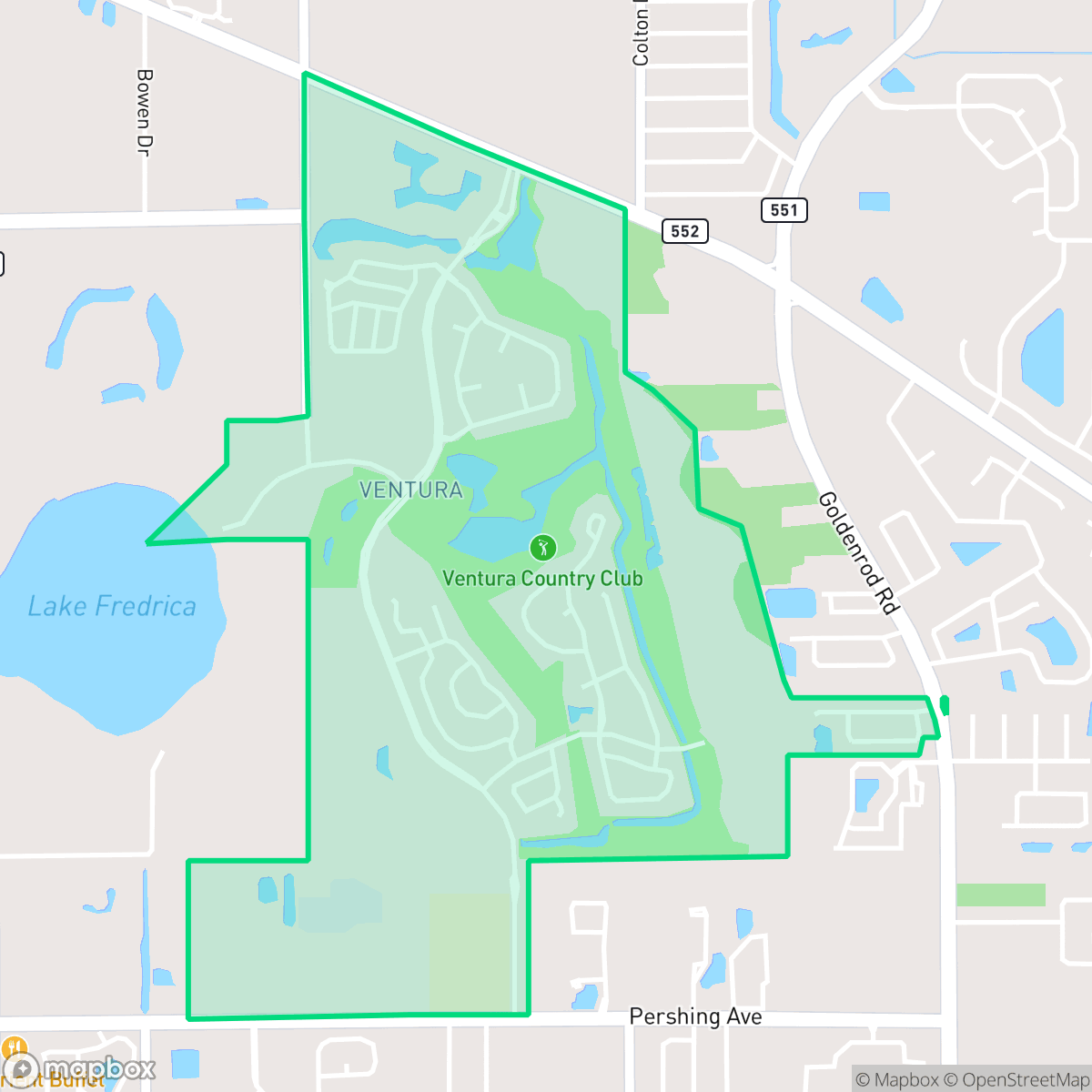
Ventura is a suburban neighborhood in Orlando, Florida, primarily defined by the development of the Ventura Country Club, which serves as a central hub for the community. The neighborhood's residential character was largely established during the late 20th century, with the majority of its housing stock constructed between 1970 and 1999. It features a mix of single-family homes, condominiums, and apartment complexes, often organized around local landmarks such as Lake Roper and Lake Fredrica. While the area experienced growth alongside the broader expansion of the Orlando region, it maintains a distinct identity as a residential enclave with a notable demographic diversity, particularly among residents of Puerto Rican and South American ancestry. The neighborhood remains characterized by its suburban layout, proximity to the Orlando International Airport, and its focus on recreational amenities like golf and community-based club facilities.
The area features a distinct suburban layout defined by its proximity to local lakes and recreational facilities. Residents benefit from a highly pedestrian-friendly environment, with well-connected sidewalk networks that make navigating the community easy for walkers and families with strollers. Unlike many dense urban sections of Orlando, the neighborhood offers a more spacious feel, characterized by significant green buffers and wooded corridors that provide a semi-rural aesthetic.
While the community offers a peaceful residential experience, prospective residents should note that the area experiences moderate traffic noise from nearby arterial roads. The housing landscape is varied, ranging from golf course frontage to more compact residential clusters, and the community maintains a notable liberal political lean. With good access to health insurance and a stable school district, the neighborhood is well-suited for families and individuals seeking a quiet, functional, and well-connected place to live.
Neighborhood Scores Across 15 Qualities
Housing density varies across the area, ranging from tightly packed mobile homes to detached single-family residences with moderate yard buffers. This level of privacy and spacing is higher than the Orlando average according to iHuus data.
Established sidewalk networks and safe crossings exist throughout most residential clusters, making this area significantly more pedestrian friendly than the Orlando average. While major arterial roads can act as barriers, internal loops and residential paths remain well-connected for walkers and strollers.
Residential views range from upscale golf course frontage with private pools to dense apartment blocks and mobile home parks. This visual diversity provides more landscape variety than the typical Orlando neighborhood, according to iHuus data.
Extensive green buffers, wooded corridors, and walking loops around retention ponds offer much more space for pet activities than the Orlando average. According to iHuus data, wide verges and proximity to golf course greenery provide safe, accessible areas for dog walking.
Frequent open land and significant green space preservation provide a more semi-rural atmosphere than the typical Orlando urban landscape. According to iHuus data, residents will find a mix of scattered homes and planned residential clusters amidst woodland or fields.
Daily activity levels are slightly higher than the Orlando average, though much of the area remains subdued with sparse commercial density. While some pockets near universities offer notable dining and business activity, many residential stretches are primarily functional and quiet.
Steady hum from nearby busy streets characterizes the area. This level of acoustic activity is notably higher than the average for Orlando.
Air quality remains consistently good with rare instances of elevated readings. This level of cleanliness is higher than the Orlando average according to iHuus data.
Industrial presence is notably lower than the Orlando average, with most areas consisting of residential and recreational spaces. A few northern sections contain warehouses and an electrical substation that may introduce some logistics-related traffic.
Health insurance coverage among residents is notably higher than the Orlando average, according to iHuus data.
Political leanings in this area skew more liberal than the Orlando average, though a moderate presence of opposing viewpoints exists. According to iHuus data, the community maintains a notable progressive majority.
A balanced mix of young adults, families, and older residents characterizes the area. According to iHuus data, this age distribution is more varied than the average found across Orlando.
Flood risk in this area is slightly higher than the Orlando average, though official FEMA studies for the neighborhood are currently incomplete. Residents should remain aware of potential drainage considerations according to iHuus data.
Address-Level Insights for Ventura


iHuus Neighborhood Intelligence Insights
Get address-level neighborhood insights for Ventura
- Street-level scores — see how individual blocks compare, not just neighborhood averages
- Micro-zone boundaries — identify quiet pockets, flood boundaries, and walkable clusters before you visit
- 15 dimensions in full — walkability, noise, air quality, school quality, insurance coverage, population age profile, urban/rural index, and more
- Boundary risk alerts — know if your address sits near a block boundary where scores drop, the kind of detail no listing will ever mention
- School insights — individual school ratings and insights, not just district-level data
- Compare before you commit — side-by-side data across neighborhoods, down to block precision
No credit card required
Compare with Any Neighborhood
| Dimension | Ventura | 33rd St. Industrial |
|---|---|---|
| 🚶 Walkabilityavg 5.62 | ||
| 🔊 Acoustic Comfortavg 3.33 | ||
| 🤫 Privacy Indexavg 4.6 | ||
| 🎨 Visual Appealavg 5.36 | ||
| 🐕 Dog Friendlinessavg 5.01 | ||
| 🗺️ Urban-Rural Indexavg 5.48 | ||
| ✨ Neighborhood Vibeavg 2.98 | ||
| 🏥 Health Insurance Coverageavg 5.11 | ||
| 🌿 Air Qualityavg 5.87 | ||
| 🏭 Industrial Proximityavg 5.75 | ||
| 🌊 Flood Safetyavg 4.98 | ||
| 🗳️ Ideological Leanavg 5.62 | ||
| 👥 Population Age Profileavg 3.78 | ||
| 🔥 Fire Safety | ||
| 🏫 School Quality |
Ventura Rankings
School Districts Serving Ventura
School Insights for Ventura
Below average outcomes; significant attendance and academic challenges.
School Insights
See what's really behind every school rating near Ventura
- Individual school ratings — each school's own score with outcome context, not just a district average
- Enrollment & class size data — student-to-teacher ratio and how it compares to the state average
- Full demographics breakdown — ethnicity and gender composition for every school in the enrollment zone
- Every school in the district — all schools within the enrollment boundary ranked by rating, not just the closest one
- Grade levels & benchmarks — elementary through high school, with below/above state-average flags
No credit card required