Ventura Country Club, Orlando
Updated · 3,738 residents
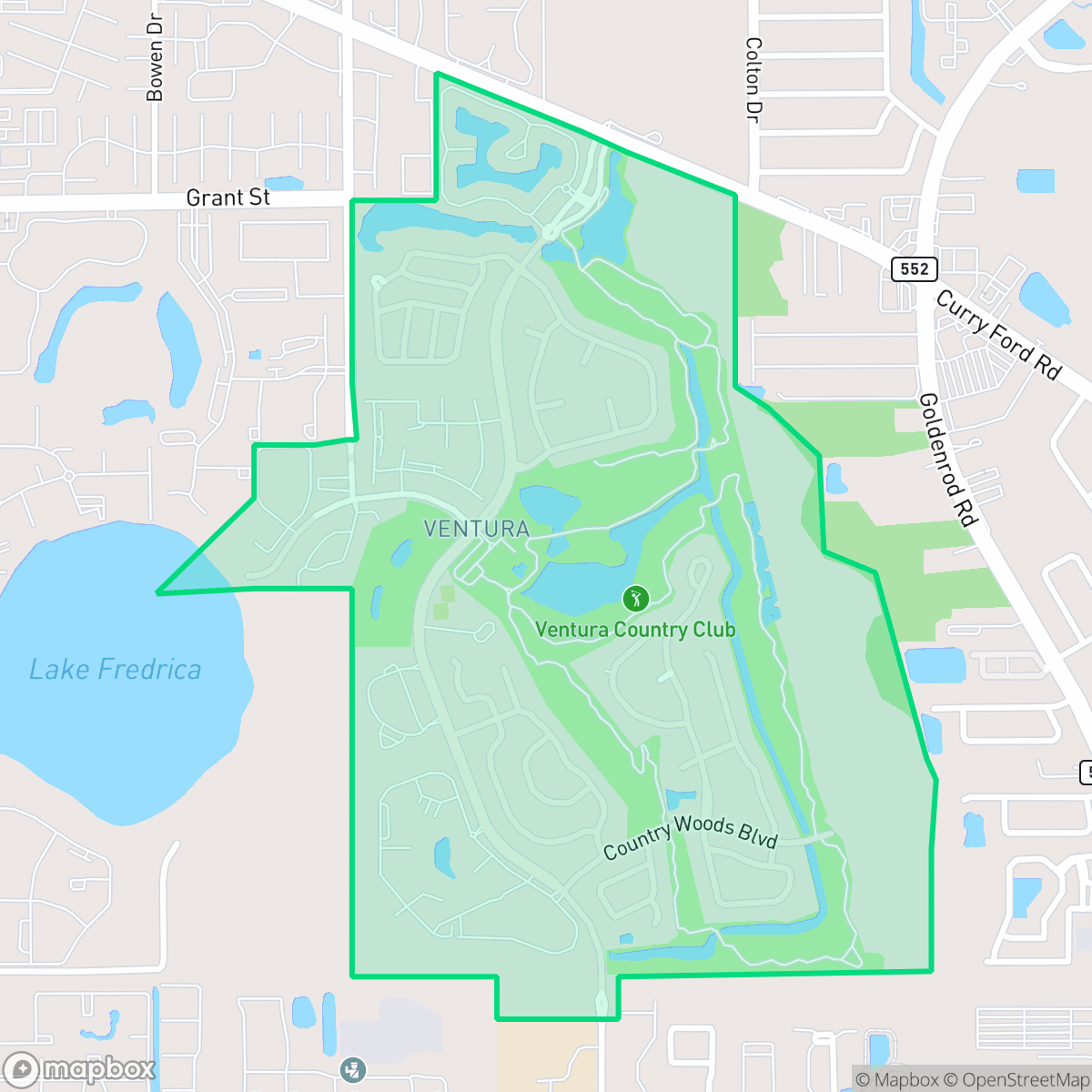
Ventura Country Club is a gated residential community in southeast Orlando known for its expansive golf course views and mature, tree-lined landscape. The area offers a highly walkable environment with extensive sidewalk networks, balanced by a quiet, functional atmosphere that appeals to a diverse mix of families and retirees.
Key Highlights
About Ventura Country Club
Ventura Country Club is a gated residential community in southeast Orlando established in 1981. The neighborhood was developed on the site of the former Raper Dairy Farm, a significant local agricultural operation that historically supplied the T.G. Lee Dairy. Designed by architect Mark Mahannah, the community’s 18-hole golf course was intentionally laid out to preserve Florida’s natural landscape, integrating existing pines, canals, and wetlands into the residential plan. Comprising over 1,700 homes and condominiums, the neighborhood is often referred to locally as 'Orlando's Best Kept Secret.' Its character is defined by this transition from mid-century agricultural land to a planned golf-centric residential environment that emphasizes the preservation of native habitats and wildlife, such as ospreys and bald eagles, within a suburban setting.
The neighborhood features a mix of multi-family units and single-family homes, creating a semi-rural feel despite its suburban location. Residents benefit from a polished, upscale aesthetic with abundant green space, which provides ample room for pet owners and outdoor enthusiasts. While the area is largely residential, it maintains a stable, quiet environment with minimal industrial activity, making it a functional choice for those seeking a reprieve from the density of central Orlando.
Living here involves a few trade-offs, particularly regarding traffic noise from nearby arterial roads and occasional air quality fluctuations. The community is served by the Orange County School District, which provides stable academic leadership despite ongoing enrollment shifts across the region. With its combination of high walkability and moderate privacy, the area is well-suited for individuals who value accessible outdoor amenities and a settled, community-focused lifestyle.
Neighborhood Scores Across 15 Qualities
Housing density is higher than the Orlando average, featuring a mix of shared walls in multi-family units and detached homes with moderate yard spacing. Residents will experience varying levels of separation depending on whether they live in apartment complexes or single-family lots near wooded buffers.
Established sidewalk networks and safe crossings make much of the area accessible to pedestrians, significantly surpassing the Orlando average. While internal residential loops are easy to navigate, certain high-speed arterial roads can act as barriers to movement.
Large homes and golf course frontage provide a more polished landscape than the typical Orlando surroundings. Many properties feature private backyard pools and expansive driveways, according to iHuus data.
Extensive green buffers, wooded corridors, and golf course perimeters offer ample walking space for pets. This level of access to open areas and shaded paths is significantly higher than the Orlando average, according to iHuus data.
Open landscapes and scattered greenery provide a more spacious feel than much of Orlando. According to iHuus data, the area features a transition from dense residential clusters to more open land and woodland.
Commercial activity remains sparse and centered around essential services, though the area offers more local engagement than the typical Orlando neighborhood. While much of the landscape is subdued, certain pockets provide walkable access to various dining and retail options.
Steady traffic sounds from a nearby busy street are present; however, acoustic comfort remains higher than the Orlando average according to iHuus data.
Air quality levels typically fluctuate between acceptable and unhealthy, presenting occasional concerns for sensitive groups. According to iHuus data, the air quality in this area is slightly better than the Orlando average.
Heavy industrial activity is notably absent, though some areas experience increased traffic and noise from nearby warehouses and large retail centers. Most of the area remains primarily residential with only occasional light commercial or utility-based infrastructure.
Health insurance access among residents is higher than the Orlando average, according to iHuus data. This indicates a relatively stable level of coverage for those living in the area.
Political leanings in this area trend more liberal than the Orlando average, with a noticeable majority supporting progressive viewpoints according to iHuus data.
Residents experience a varied demographic profile featuring a balanced blend of families, young adults, and seniors. This distribution represents a more diverse age range than what is typically found across Orlando.
Flood safety levels in this area are higher than the Orlando average, though a lack of detailed FEMA studies means the precise level of risk remains undetermined. Residents should remain aware of potential vulnerabilities during heavy rain events according to iHuus data.
Address-Level Insights for Ventura Country Club


iHuus Neighborhood Intelligence Insights
Get address-level neighborhood insights for Ventura Country Club
- Street-level scores — see how individual blocks compare, not just neighborhood averages
- Micro-zone boundaries — identify quiet pockets, flood boundaries, and walkable clusters before you visit
- 15 dimensions in full — walkability, noise, air quality, school quality, insurance coverage, population age profile, urban/rural index, and more
- Boundary risk alerts — know if your address sits near a block boundary where scores drop, the kind of detail no listing will ever mention
- School insights — individual school ratings and insights, not just district-level data
- Compare before you commit — side-by-side data across neighborhoods, down to block precision
No credit card required
Compare with Any Neighborhood
| Dimension | Ventura Country Club | 33rd St. Industrial |
|---|---|---|
| 🚶 Walkabilityavg 5.62 | ||
| 🔊 Acoustic Comfortavg 3.33 | ||
| 🤫 Privacy Indexavg 4.6 | ||
| 🎨 Visual Appealavg 5.36 | ||
| 🐕 Dog Friendlinessavg 5.01 | ||
| 🗺️ Urban-Rural Indexavg 5.48 | ||
| ✨ Neighborhood Vibeavg 2.98 | ||
| 🏥 Health Insurance Coverageavg 5.11 | ||
| 🌿 Air Qualityavg 5.87 | ||
| 🏭 Industrial Proximityavg 5.75 | ||
| 🌊 Flood Safetyavg 4.98 | ||
| 🗳️ Ideological Leanavg 5.62 | ||
| 👥 Population Age Profileavg 3.78 | ||
| 🔥 Fire Safety | ||
| 🏫 School Quality |
Ventura Country Club Rankings
School Districts Serving Ventura Country Club
School Insights for Ventura Country Club
Below average outcomes; significant attendance and academic challenges.
School Insights
See what's really behind every school rating near Ventura Country Club
- Individual school ratings — each school's own score with outcome context, not just a district average
- Enrollment & class size data — student-to-teacher ratio and how it compares to the state average
- Full demographics breakdown — ethnicity and gender composition for every school in the enrollment zone
- Every school in the district — all schools within the enrollment boundary ranked by rating, not just the closest one
- Grade levels & benchmarks — elementary through high school, with below/above state-average flags
No credit card required