Thornton Park, Orlando
Updated · 925 residents
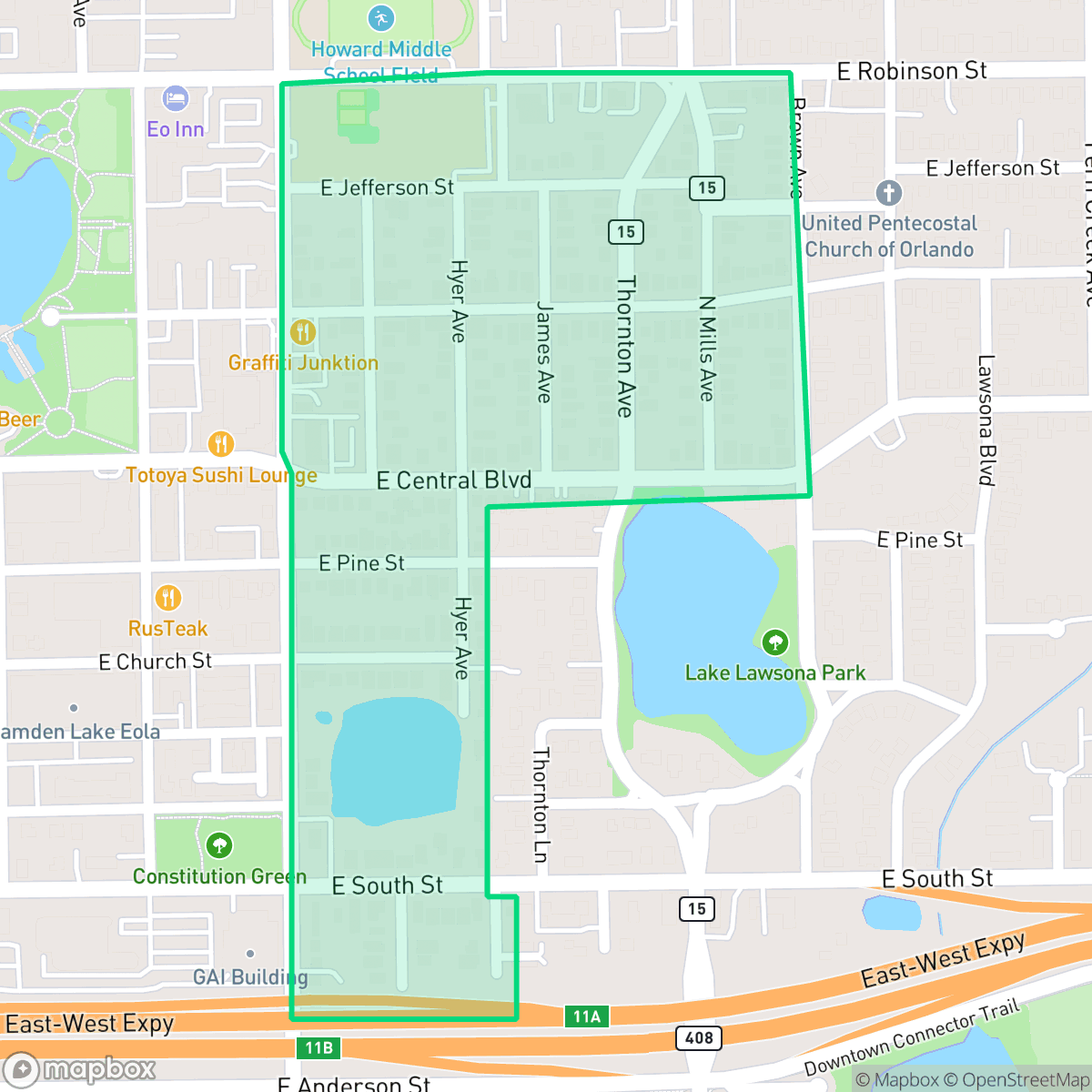
Thornton Park is a highly walkable urban enclave in Orlando known for its historic brick streets and vibrant social scene. Residents enjoy a manicured, upscale atmosphere with abundant green space for pets, though the area experiences notable noise from nearby transit and roadways.
Key Highlights
About Thornton Park
Thornton Park, established in 1915 by developer James Thornton, blossomed in the early 20th century as a residential enclave for cattle ranchers and citrus growers. The neighborhood is defined by its historic brick-lined streets and a diverse architectural stock ranging from 1920s Craftsman bungalows and Tudor Revivals to modern luxury condominiums. After experiencing a decline in the 1960s as development shifted westward, the area underwent a significant revitalization in the 1990s led by local developers and residents. Today, it is recognized as a vibrant, walkable district and is part of the Lake Lawsona Historic District. It is home to notable landmarks including the site of Orlando’s first Publix and the city's longest-operating bar, Burton’s, while maintaining a strong cultural identity centered on its boutique shopping, dining, and the monthly Art & Wine Walk.
The area functions as a bustling social hub, characterized by a diverse demographic that ranges from young professionals to retirees. Its exceptional pedestrian connectivity allows residents to easily access a variety of dining and entertainment options, while its semi-rural feel is preserved through scattered greenery and mature landscaping. According to iHuus data, the neighborhood maintains a strong liberal identity and benefits from an absence of heavy industrial activity, contributing to its clean and well-kept appearance.
Prospective residents should consider the trade-offs between the high-energy lifestyle and the local acoustic environment. While the streets are ideal for walking and pet owners, the proximity to major roadways and rail lines results in frequent noise. Families may also note the broader context of the Orange County School District, which offers stable leadership and significant facility investment despite ongoing challenges with enrollment and budget consolidation.
Neighborhood Scores Across 15 Qualities
Residential spacing provides a moderate level of separation between neighbors, notably higher than the typical density found across Orlando. While some apartment sectors are more concentrated, many homes benefit from mature tree canopies and consistent buffers between properties.
Pedestrian connectivity is exceptional due to a complete grid of sidewalks and clear crossings, significantly surpassing the Orlando average. According to iHuus data, the dense sidewalk network on both sides of most streets makes navigating the area on foot very efficient.
Lush landscaping, private pools, and large homes define this area, which offers significantly more visual appeal than the Orlando average according to iHuus data.
Abundant lakefront parks, wide green verges, and interconnected walking paths provide significantly more space for pet exercise than the Orlando average. According to iHuus data, these buffered sidewalks offer a safer environment for dog walking by separating pedestrians from vehicle traffic.
Frequent open land and scattered greenery provide a more semi-rural atmosphere than much of Orlando. This landscape features a mix of residential pockets nestled among fields and woodland areas, according to iHuus data.
High density and a diverse range of dining, bars, and entertainment venues create a significantly more active atmosphere than most of Orlando. This area serves as a bustling hub for social activity, according to iHuus data.
Frequent traffic and transit sounds from nearby rail lines and major roadways are common here. According to iHuus data, acoustic conditions are slightly more disruptive than the Orlando average.
Air quality levels remain mostly acceptable but feature occasional days of concern for sensitive groups; according to iHuus data, conditions in Thornton Park are roughly in line with the Orlando average.
Heavy industrial facilities and warehouses are entirely absent from this area, making it significantly cleaner of industrial activity than the Orlando average. Residents should note that while no manufacturing plants exist nearby, noise from a major highway remains a factor.
Health insurance access among residents is slightly lower than the Orlando average, according to iHuus data.
Voting patterns and census indicators show a significantly more liberal leaning than the Orlando average, according to iHuus data.
Residents live among a varied demographic of young professionals, families, and seniors. According to iHuus data, this age distribution is more balanced than the typical Orlando profile.
Flood risk in this area is slightly above the Orlando average, though it remains undetermined because a detailed FEMA study has not yet been completed for this specific location.
Address-Level Insights for Thornton Park


iHuus Neighborhood Intelligence Insights
Get address-level neighborhood insights for Thornton Park
- Street-level scores — see how individual blocks compare, not just neighborhood averages
- Micro-zone boundaries — identify quiet pockets, flood boundaries, and walkable clusters before you visit
- 15 dimensions in full — walkability, noise, air quality, school quality, insurance coverage, population age profile, urban/rural index, and more
- Boundary risk alerts — know if your address sits near a block boundary where scores drop, the kind of detail no listing will ever mention
- School insights — individual school ratings and insights, not just district-level data
- Compare before you commit — side-by-side data across neighborhoods, down to block precision
No credit card required
Compare with Any Neighborhood
| Dimension | Thornton Park | 33rd St. Industrial |
|---|---|---|
| 🚶 Walkabilityavg 5.62 | ||
| 🔊 Acoustic Comfortavg 3.33 | ||
| 🤫 Privacy Indexavg 4.6 | ||
| 🎨 Visual Appealavg 5.36 | ||
| 🐕 Dog Friendlinessavg 5.01 | ||
| 🗺️ Urban-Rural Indexavg 5.48 | ||
| ✨ Neighborhood Vibeavg 2.98 | ||
| 🏥 Health Insurance Coverageavg 5.11 | ||
| 🌿 Air Qualityavg 5.87 | ||
| 🏭 Industrial Proximityavg 5.75 | ||
| 🌊 Flood Safetyavg 4.98 | ||
| 🗳️ Ideological Leanavg 5.62 | ||
| 👥 Population Age Profileavg 3.78 | ||
| 🔥 Fire Safety | ||
| 🏫 School Quality |
Thornton Park Rankings
School Districts Serving Thornton Park
School Insights for Thornton Park
Below average outcomes; significant attendance and academic challenges.
School Insights
See what's really behind every school rating near Thornton Park
- Individual school ratings — each school's own score with outcome context, not just a district average
- Enrollment & class size data — student-to-teacher ratio and how it compares to the state average
- Full demographics breakdown — ethnicity and gender composition for every school in the enrollment zone
- Every school in the district — all schools within the enrollment boundary ranked by rating, not just the closest one
- Grade levels & benchmarks — elementary through high school, with below/above state-average flags
No credit card required