Spring Lake, Orlando
Updated · 1,222 residents
Spring Lake is a distinctive residential district defined by its historic architecture and spacious, tree-lined streets. Residents enjoy a highly walkable environment that balances a semi-rural, spread-out feel with convenient access to local dining and civic institutions.
Key Highlights
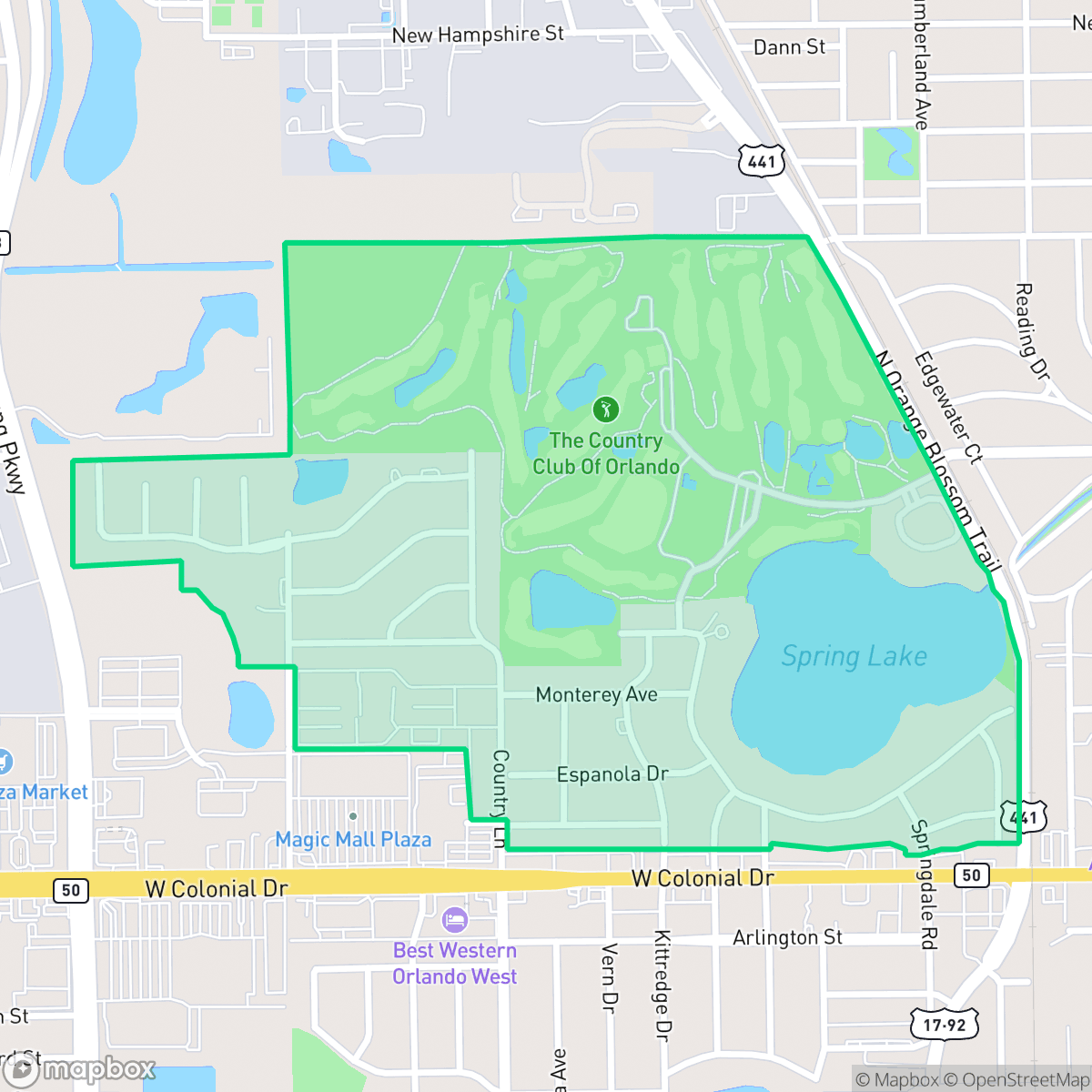
About Spring Lake
The Spring Lake neighborhood in Orlando, Florida, traces its residential origins to the 1920s, following the sale of the Gentile orange groves. The area was developed into one of the city's most distinctive residential districts, anchored by the Orlando Country Club, which was established in 1911. The neighborhood is noted for its diverse architectural heritage, featuring significant examples of Mediterranean Revival, Tudor Revival, Colonial Revival, and Monterey styles constructed between the 1920s and 1950s. Later development in the 1960s introduced Ranch and Neo-eclectic designs. Historically, the area transitioned from citrus groves to an exclusive residential enclave, with residents successfully preserving its character against commercial encroachment in the late 1950s. Today, it remains a well-established community defined by its historic brick-lined streets, lakefront estates, and a blend of mid-century and period-revival architecture.
The area maintains a unique aesthetic characterized by large, private residential properties and a diverse, multigenerational population. It serves as an active suburban hub where the prevalence of sidewalks and safe crossings encourages pedestrian activity, setting it apart from more car-dependent sections of the city. The community offers a tranquil, upscale atmosphere that feels removed from the typical density of Orlando, providing a stable environment for families and professionals alike.
Prospective residents should note that the neighborhood experiences higher levels of ambient noise due to its proximity to major thoroughfares. While the area offers significant visual appeal and high rates of health insurance coverage, it also sits partially within a floodplain and maintains proximity to light commercial and service-oriented businesses. Those seeking a walkable, pet-friendly community with a strong sense of architectural heritage will find the area well-suited to their needs, provided they are comfortable with the trade-offs of living near major transit corridors.
Neighborhood Scores Across 15 Qualities
Residential spacing provides some buffer between neighbors, offering more seclusion than the typical Orlando density. According to iHuus data, homes feature a mix of distances that are noticeably less crowded than the city average.
Pedestrian access is improved by the presence of sidewalks and safe crossings, making this area significantly more walkable than much of Orlando. Most local movements can be managed on foot according to iHuus data.
Large residential properties and premium amenities characterize this area, which offers significantly higher visual appeal than the Orlando average according to iHuus data.
Access to connected green spaces and wide, low-traffic paths makes this area much more suitable for pet owners than the Orlando average. According to iHuus data, the neighborhood provides a safe environment for walking dogs.
Open land and woodland are common throughout this area, providing a more spread out environment than the typical Orlando landscape. According to iHuus data, residents will find significantly more scattered homes and fields here compared to the city average.
Vibrant pockets of activity near universities and civic institutions provide a notably higher level of energy than the Orlando average. Residents can access a steady rhythm of dining, wellness services, and walkable parks within this mixed-use environment.
Frequent traffic and transit noise characterizes this area, which sits significantly below the Orlando average for acoustic comfort. According to iHuus data, proximity to major thoroughfares contributes to a much louder environment than most parts of the city.
Air quality in Spring Lake fluctuates between acceptable and unhealthy levels, according to iHuus data. These conditions are slightly worse than the average for the city of Orlando, which may cause occasional concern for sensitive groups.
Light commercial activity and service-oriented businesses are interspersed with residential areas, though the presence of a nearby Superfund site warrants awareness of potential soil or groundwater concerns. This level of industrial proximity is slightly higher than the Orlando average, primarily consisting of low-level operational noise from printing and retail services rather than heavy manufacturing.
Health insurance enrollment among residents is significantly higher than the Orlando average, according to iHuus data.
Political leanings in this area lean conservative, representing a notable departure from the more moderate political landscape found across Orlando. According to iHuus data, the neighborhood maintains a conservative majority with a modest opposing presence.
Residents experience a diverse age demographic that is more balanced than the typical Orlando profile. According to iHuus data, the area features a stable blend of young professionals, families, and seniors.
Residual flood risks exist within this area as it sits partially within a 500-year floodplain. According to iHuus data, the level of safety from flooding is notably higher than the average for Orlando.
Address-Level Insights for Spring Lake


iHuus Neighborhood Intelligence Insights
Get address-level neighborhood insights for Spring Lake
- Street-level scores — see how individual blocks compare, not just neighborhood averages
- Micro-zone boundaries — identify quiet pockets, flood boundaries, and walkable clusters before you visit
- 15 dimensions in full — walkability, noise, air quality, school quality, insurance coverage, population age profile, urban/rural index, and more
- Boundary risk alerts — know if your address sits near a block boundary where scores drop, the kind of detail no listing will ever mention
- School insights — individual school ratings and insights, not just district-level data
- Compare before you commit — side-by-side data across neighborhoods, down to block precision
No credit card required
Compare with Any Neighborhood
| Dimension | Spring Lake | 33rd St. Industrial |
|---|---|---|
| 🚶 Walkabilityavg 5.62 | ||
| 🔊 Acoustic Comfortavg 3.33 | ||
| 🤫 Privacy Indexavg 4.6 | ||
| 🎨 Visual Appealavg 5.36 | ||
| 🐕 Dog Friendlinessavg 5.01 | ||
| 🗺️ Urban-Rural Indexavg 5.48 | ||
| ✨ Neighborhood Vibeavg 2.98 | ||
| 🏥 Health Insurance Coverageavg 5.11 | ||
| 🌿 Air Qualityavg 5.87 | ||
| 🏭 Industrial Proximityavg 5.75 | ||
| 🌊 Flood Safetyavg 4.98 | ||
| 🗳️ Ideological Leanavg 5.62 | ||
| 👥 Population Age Profileavg 3.78 | ||
| 🔥 Fire Safety | ||
| 🏫 School Quality |
Spring Lake Rankings
School Districts Serving Spring Lake
School Insights for Spring Lake
Below average outcomes; significant attendance and academic challenges.
School Insights
See what's really behind every school rating near Spring Lake
- Individual school ratings — each school's own score with outcome context, not just a district average
- Enrollment & class size data — student-to-teacher ratio and how it compares to the state average
- Full demographics breakdown — ethnicity and gender composition for every school in the enrollment zone
- Every school in the district — all schools within the enrollment boundary ranked by rating, not just the closest one
- Grade levels & benchmarks — elementary through high school, with below/above state-average flags
No credit card required