Southport, Orlando
Updated · 1,663 residents
Southport is a quiet residential community characterized by its utilitarian suburban layout and proximity to the former naval base grounds. The area is primarily populated by young adults who value a peaceful environment, though residents often face challenges with limited walkability and tight housing density.
Key Highlights
About Southport
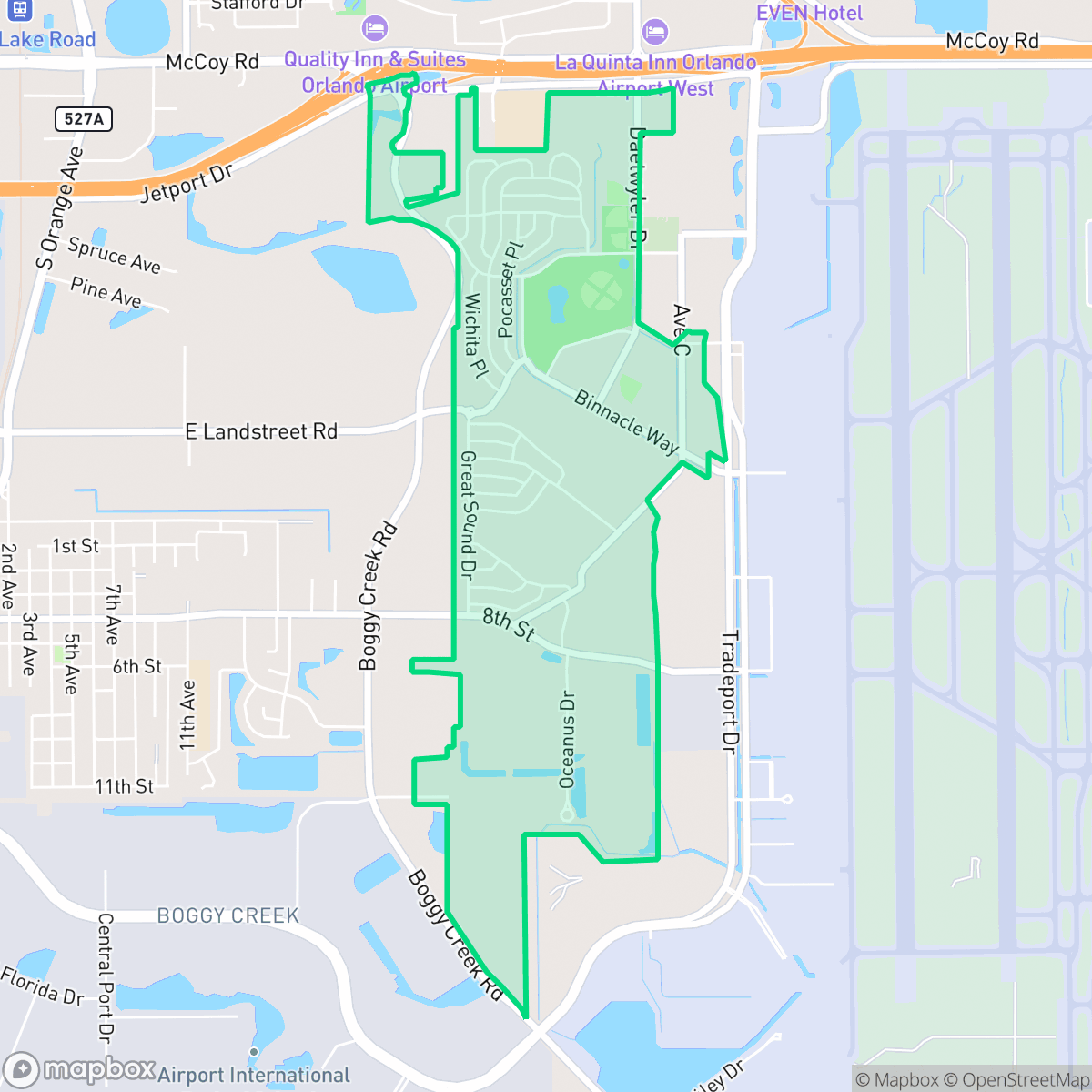
The Southport neighborhood in Orlando, Florida, is a residential community built on the site of the former Orlando Naval Training Center’s McCoy Annex. Following the base's closure in 1993, the area underwent a significant transformation, becoming the first major private-sector redevelopment project on the property. The neighborhood, known as the Villages of Southport, was established in the late 1990s, with renovations of former military housing beginning in 1998. The community is organized into five themed villages—Malibu, Portsmouth, Schooner, Island, and Bermuda—and features the 52-acre Southport Community Park, which repurposes land that previously served as a Navy recreation area. This transition from military use to a residential and recreational hub defines the neighborhood's modern character and historical development.
The neighborhood maintains a calm atmosphere with limited commercial activity, creating a distinctively suburban experience. The layout features closely spaced detached homes that prioritize density over expansive private yards, contributing to a utilitarian landscape. While the area lacks the social vibrancy or high-density amenities found in other parts of Orlando, it offers a consistent, low-key environment for those seeking a quiet residential setting.
Prospective residents should note that the area is best suited for those who prioritize a settled, suburban lifestyle over walkability or immediate access to urban nightlife. Pedestrian travel is often difficult due to limited sidewalk infrastructure, and the neighborhood experiences a steady level of background noise from nearby traffic. Additionally, while the local school district remains stable with robust institutional support, the community itself has a younger demographic profile and a conservative political lean, reflecting its unique position within the broader Orlando landscape.
Neighborhood Scores Across 15 Qualities
Residential lots feature close proximity between detached homes, with less than ten feet of separation in many areas. This density results in a lower privacy level compared to the Orlando average, according to iHuus data.
Limited sidewalk availability and high traffic volumes make pedestrian travel uncomfortable. This area is notably less walkable than the Orlando average, according to iHuus data.
Dense housing layouts and limited green space define the area's appearance. According to iHuus data, this lack of visual variety and greenery falls below the Orlando average.
Limited greenery and narrow verges make for few open areas for walking pets. According to iHuus data, this lack of accessible space is notably below the Orlando average.
Residential streets and green spaces are distributed in a balanced suburban pattern, though the area feels more developed than the Orlando average. According to iHuus data, the landscape lacks the dense urban density found in other parts of the city.
Suburban streets offer a peaceful environment with very little commercial activity or street-level energy. This neighborhood lacks the social vibrancy found in most parts of Orlando, as it contains few local destinations and points of interest.
Steady hums from nearby busy streets contribute to a level of acoustic activity that is slightly higher than the Orlando average. According to iHuus data, this creates a consistent background noise profile throughout much of the area.
Air quality in Southport fluctuates between acceptable and unhealthy levels, sitting below the Orlando average. Sensitive groups may experience occasional respiratory concerns according to iHuus data.
Heavy freight traffic and airport-related activity create concentrated pockets of industrial noise, though the overall level of nearby warehouses and heavy commercial operators remains significantly lower than the Orlando average.
Health insurance access among residents is lower than the Orlando average, according to iHuus data. This indicates a higher proportion of uninsured individuals living within the area.
Political leanings in this area are notably more conservative than the Orlando average, characterized by a solid conservative majority with a smaller presence of opposing viewpoints.
Young adults represent the primary demographic in this area, with a lower proportion of families and older residents compared to the Orlando average. According to iHuus data, the population age profile is notably younger than the city-wide norm.
Flood risks in this area remain undetermined due to a lack of detailed federal studies; however, the level of vulnerability appears slightly higher than the Orlando average according to iHuus data.
Address-Level Insights for Southport


iHuus Neighborhood Intelligence Insights
Get address-level neighborhood insights for Southport
- Street-level scores — see how individual blocks compare, not just neighborhood averages
- Micro-zone boundaries — identify quiet pockets, flood boundaries, and walkable clusters before you visit
- 15 dimensions in full — walkability, noise, air quality, school quality, insurance coverage, population age profile, urban/rural index, and more
- Boundary risk alerts — know if your address sits near a block boundary where scores drop, the kind of detail no listing will ever mention
- School insights — individual school ratings and insights, not just district-level data
- Compare before you commit — side-by-side data across neighborhoods, down to block precision
No credit card required
Compare with Any Neighborhood
| Dimension | Southport | 33rd St. Industrial |
|---|---|---|
| 🚶 Walkabilityavg 5.62 | ||
| 🔊 Acoustic Comfortavg 3.33 | ||
| 🤫 Privacy Indexavg 4.6 | ||
| 🎨 Visual Appealavg 5.36 | ||
| 🐕 Dog Friendlinessavg 5.01 | ||
| 🗺️ Urban-Rural Indexavg 5.48 | ||
| ✨ Neighborhood Vibeavg 2.98 | ||
| 🏥 Health Insurance Coverageavg 5.11 | ||
| 🌿 Air Qualityavg 5.87 | ||
| 🏭 Industrial Proximityavg 5.75 | ||
| 🌊 Flood Safetyavg 4.98 | ||
| 🗳️ Ideological Leanavg 5.62 | ||
| 👥 Population Age Profileavg 3.78 | ||
| 🔥 Fire Safety | ||
| 🏫 School Quality |
Southport Rankings
School Districts Serving Southport
School Insights for Southport
Below average outcomes; significant attendance and academic challenges.
School Insights
See what's really behind every school rating near Southport
- Individual school ratings — each school's own score with outcome context, not just a district average
- Enrollment & class size data — student-to-teacher ratio and how it compares to the state average
- Full demographics breakdown — ethnicity and gender composition for every school in the enrollment zone
- Every school in the district — all schools within the enrollment boundary ranked by rating, not just the closest one
- Grade levels & benchmarks — elementary through high school, with below/above state-average flags
No credit card required