South Eola, Orlando
Updated · 2,047 residents
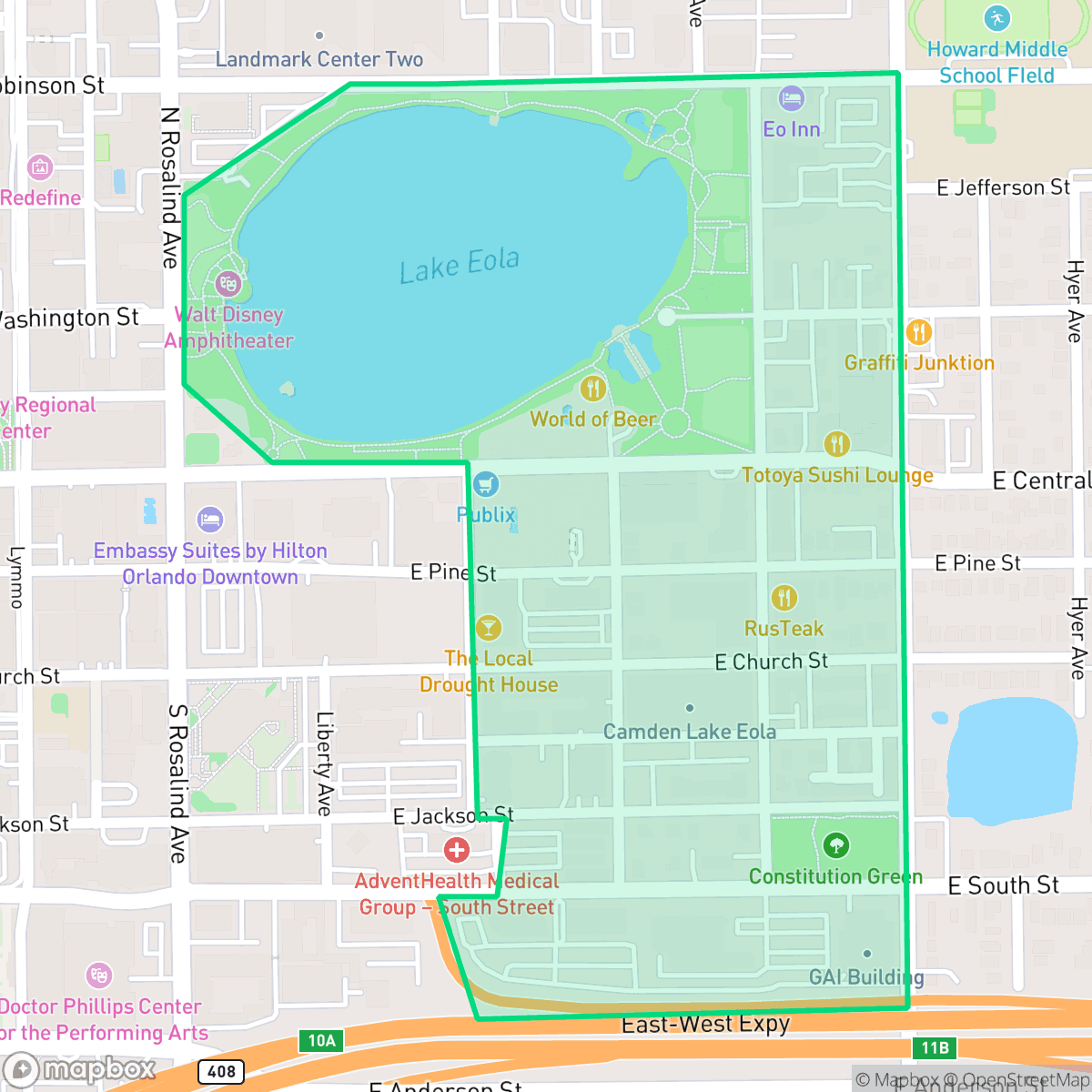
South Eola is a highly walkable urban hub anchored by the iconic Lake Eola Park. It offers a dense, high-energy environment with a polished aesthetic, though residents should expect a lively atmosphere with frequent noise from surrounding transit routes.
Key Highlights
About South Eola
South Eola, a central district in downtown Orlando, traces its origins to the late 19th century when cattle baron Jacob Summerlin purchased the land surrounding Lake Eola. Initially characterized by citrus groves and early vernacular structures, the area evolved significantly during the 1920s Florida land boom. The neighborhood retains historical architectural elements, most notably the 1926 Cherokee School, a Mediterranean Revival landmark. Over the decades, South Eola has transformed from a quiet residential enclave into a vibrant, walkable urban center. It is defined by its proximity to Lake Eola Park—the city’s historic focal point donated by Summerlin—and the presence of Constitution Green. Today, the district uniquely blends preserved historic character with modern high-rise development, serving as a key hub for downtown residential life and local commerce.
The area functions as a central hub for downtown residential life, characterized by a dense concentration of dining, nightlife, and retail options. Its exceptional pedestrian connectivity allows residents to reach most daily necessities on foot, while the visual landscape is defined by a combination of manicured landscaping and modern luxury high-rises. The district maintains a strong progressive demographic and a lively, high-energy atmosphere that sets it apart from more suburban sections of the city.
While the neighborhood offers an upscale and polished environment, potential residents should consider the trade-offs of urban living. The area experiences higher noise levels due to nearby railroad tracks and major roadways, and it carries a moderate risk of flooding during heavy rain events. It is well-suited for those who value proximity to city amenities and a diverse social environment, though individuals seeking complete acoustic privacy or rural stillness may find the urban density challenging. Families should note that the neighborhood falls within the Orange County School District, which is currently managing enrollment shifts and facility planning.
Neighborhood Scores Across 15 Qualities
Residential spacing varies throughout the area, with some apartment sectors offering less privacy than detached homes separated by mature tree canopies. This level of density is slightly higher than the Orlando average, according to iHuus data.
Pedestrian connectivity is exceptional due to a complete sidewalk grid and dedicated crossings around the central lake. Most daily activities can be accomplished on foot, offering much higher walkability than the Orlando average.
Lush landscaping, private pools, and modern luxury high-rises create a highly polished environment. According to iHuus data, the visual quality of this area is significantly higher than the Orlando city average.
Abundant lakefront parks and wide green verges around Lake Eola provide ample walking space for pets. According to iHuus data, the area offers significantly more accessible greenery and safe paths than the Orlando average.
Streets and green spaces exist in roughly equal measure, resulting in a setting that is less dense than the Orlando average. This balance of single-family homes and mid-sized commercial structures provides a transitional environment between urban and suburban living.
Constant movement and a dense concentration of dining, nightlife, and retail create an environment significantly more active than the Orlando average. According to iHuus data, this area functions as a high-activity hub characterized by continuous pedestrian traffic and strong commercial pull.
Frequent acoustic disturbances from nearby railroad tracks and major roadways characterize this area. According to iHuus data, noise levels are slightly higher than the average seen across Orlando.
Air quality in this area fluctuates between acceptable and unhealthy levels, presenting occasional concerns for sensitive groups. According to iHuus data, these conditions are roughly in line with the average seen throughout Orlando.
Minimal heavy industrial activity defines this area, which remains primarily residential and light commercial. According to iHuus data, the neighborhood lacks the industrial hazards found more frequently in other parts of Orlando.
Health insurance coverage among residents is notably lower than the Orlando city average. According to iHuus data, a small portion of the local population maintains active health coverage.
Voting patterns and census indicators show a significantly more liberal political leaning than the Orlando average. This area reflects a concentrated progressive demographic according to iHuus data.
Residents live alongside a balanced mix of young professionals, families, and seniors. This demographic variety is notably more diverse than the typical age distribution found across Orlando.
Flood risk levels in South Eola are higher than the Orlando average, though specific details remain undetermined because FEMA has not yet finished a detailed study for this area. According to iHuus data, residents should remain aware of potential vulnerabilities during heavy rain events.
Address-Level Insights for South Eola


iHuus Neighborhood Intelligence Insights
Get address-level neighborhood insights for South Eola
- Street-level scores — see how individual blocks compare, not just neighborhood averages
- Micro-zone boundaries — identify quiet pockets, flood boundaries, and walkable clusters before you visit
- 15 dimensions in full — walkability, noise, air quality, school quality, insurance coverage, population age profile, urban/rural index, and more
- Boundary risk alerts — know if your address sits near a block boundary where scores drop, the kind of detail no listing will ever mention
- School insights — individual school ratings and insights, not just district-level data
- Compare before you commit — side-by-side data across neighborhoods, down to block precision
No credit card required
Compare with Any Neighborhood
| Dimension | South Eola | 33rd St. Industrial |
|---|---|---|
| 🚶 Walkabilityavg 5.62 | ||
| 🔊 Acoustic Comfortavg 3.33 | ||
| 🤫 Privacy Indexavg 4.6 | ||
| 🎨 Visual Appealavg 5.36 | ||
| 🐕 Dog Friendlinessavg 5.01 | ||
| 🗺️ Urban-Rural Indexavg 5.48 | ||
| ✨ Neighborhood Vibeavg 2.98 | ||
| 🏥 Health Insurance Coverageavg 5.11 | ||
| 🌿 Air Qualityavg 5.87 | ||
| 🏭 Industrial Proximityavg 5.75 | ||
| 🌊 Flood Safetyavg 4.98 | ||
| 🗳️ Ideological Leanavg 5.62 | ||
| 👥 Population Age Profileavg 3.78 | ||
| 🔥 Fire Safety | ||
| 🏫 School Quality |
South Eola Rankings
School Districts Serving South Eola
School Insights for South Eola
Below average outcomes; significant attendance and academic challenges.
School Insights
See what's really behind every school rating near South Eola
- Individual school ratings — each school's own score with outcome context, not just a district average
- Enrollment & class size data — student-to-teacher ratio and how it compares to the state average
- Full demographics breakdown — ethnicity and gender composition for every school in the enrollment zone
- Every school in the district — all schools within the enrollment boundary ranked by rating, not just the closest one
- Grade levels & benchmarks — elementary through high school, with below/above state-average flags
No credit card required