Rose Isle, Orlando
Updated · 358 residents
Rose Isle is a tranquil, waterfront enclave defined by its semi-island geography and mature oak-lined streets. The neighborhood offers a quiet, residential atmosphere with generous privacy and a polished aesthetic, serving as a peaceful retreat from the surrounding city. Residents benefit from clean air quality and reliable access to local green spaces, providing a serene environment for those seeking a stable and well-maintained community.
Key Highlights
About Rose Isle
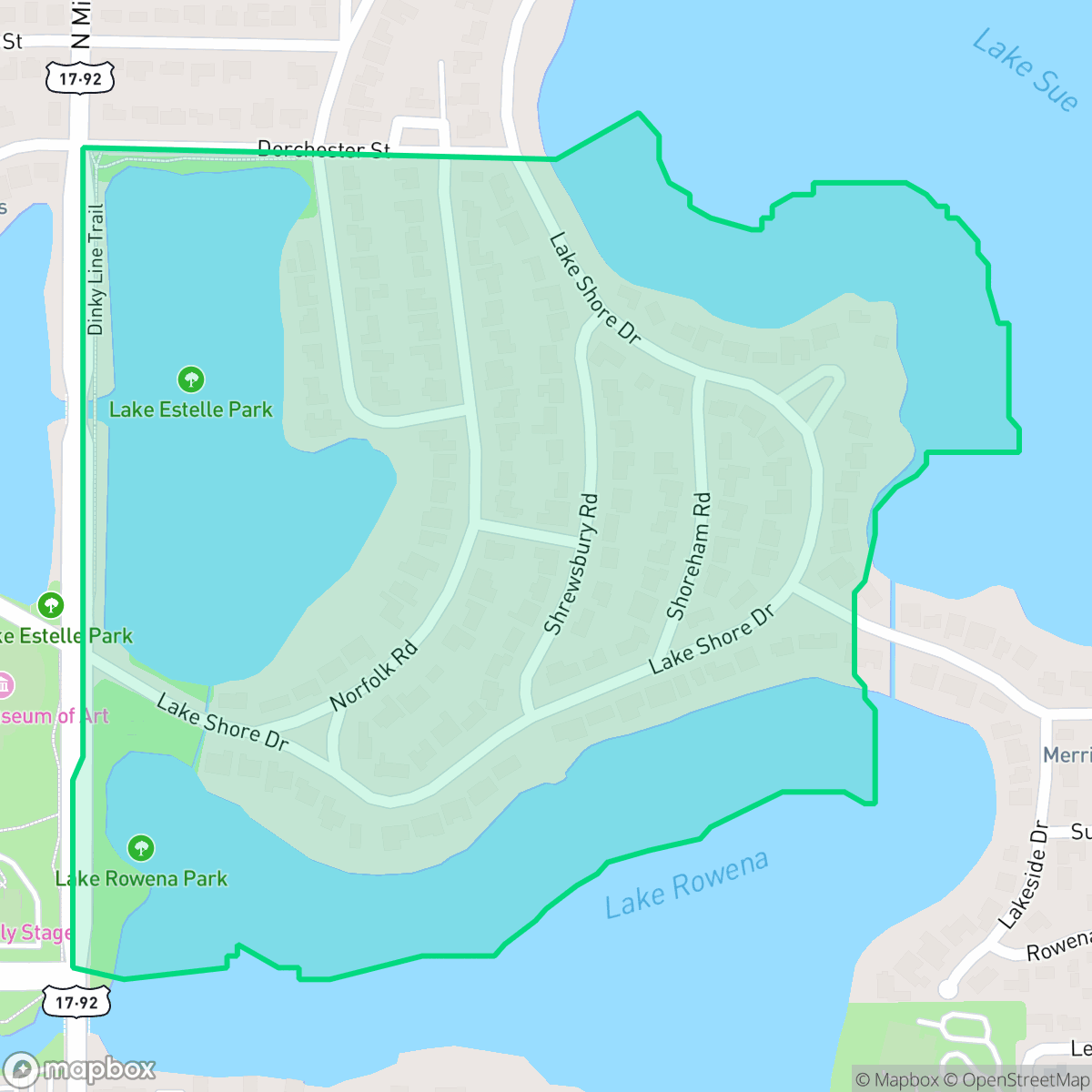
Rose Isle is an Orlando neighborhood developed by state senator and real estate visionary Walter W. Rose. Established between 1958 and 1964, it stands as one of the city’s earliest examples of a private residential development, predating the modern trend of gated communities with landscaped entranceways. Geographically defined by its semi-island character, the neighborhood is surrounded on three sides by Lakes Estelle, Rowena, and Sue, offering a tranquil, waterfront setting. Its development marked a significant shift in Orlando’s mid-century residential planning, focusing on private, cohesive community design. Today, Rose Isle remains known for its mature oak trees, scenic lakeside views, and its proximity to the cultural and educational institutions of the nearby Loch Haven Park area.
The area maintains a distinct semi-rural feel through its frequent open land and scattered homes nestled among woodlands. This residential environment is free from industrial activity, ensuring a tranquil acoustic landscape characterized by minimal ambient noise. The visual appeal is high, with spacious properties and well-tended landscapes that contribute to a polished, upscale aesthetic. Pedestrian infrastructure is reliable, featuring sidewalks and safe crossings that connect residents to the broader network of local parks and cultural institutions.
While the neighborhood offers a quiet, suburban rhythm, it is well-suited for a diverse demographic ranging from young adults to families and seniors. Residents enjoy high levels of health insurance coverage and a strong sense of community stability. While flood risk remains officially undetermined due to incomplete federal studies, the area provides a balanced density that prioritizes seclusion and privacy. It is an ideal location for those who value a serene, nature-adjacent lifestyle without sacrificing proximity to the educational and cultural resources of the greater Orlando region.
Neighborhood Scores Across 15 Qualities
Residential spacing provides a reasonable buffer between neighbors, offering more seclusion than the typical Orlando neighborhood. According to iHuus data, this area maintains a balanced density that avoids the overcrowding found in much of the city.
Sidewalks are available on one side of the street with safe crossings provided. This level of pedestrian infrastructure is higher than the average for Orlando.
Large residences and premium amenities characterize the area, providing a much more polished aesthetic than the Orlando average. According to iHuus data, the landscape features spacious driveways and well-maintained properties.
Connected green spaces and wide, traffic-safe paths make this area significantly more accommodating for dogs than the Orlando average. According to iHuus data, these features provide reliable opportunities for safe outdoor exercise.
Frequent open land and scattered homes among woodlands provide a more rural atmosphere than the typical Orlando landscape, according to iHuus data.
Local activity levels are higher than the Orlando average, providing a steady rhythm of life centered around parks and civic institutions. While some residential pockets remain low-key, certain areas offer a lively atmosphere near local gardens and seasonal entertainment.
Acoustic levels are notably lower than the Orlando average, consisting primarily of infrequent distant traffic or occasional trains. According to iHuus data, residents can expect a tranquil environment with very little ambient street noise.
Air quality remains consistently clean with infrequent instances of elevated pollutants, according to iHuus data. This level of air purity is notably higher than the average for Orlando.
This area is free from warehouses, heavy industry, or hazard sites, offering a much more residential environment than the Orlando average. According to iHuus data, the landscape consists primarily of quiet streets, open green spaces, and local amenities like parks and schools.
Health insurance enrollment among residents is exceptionally high, significantly surpassing the Orlando average according to iHuus data.
Political leanings in this area trend more liberal than the Orlando average, according to iHuus data.
Residents live alongside a broad demographic of young adults, families, and seniors. According to iHuus data, this age distribution is more varied than the typical profile found across Orlando.
Flood safety levels in Rose Isle are slightly above the Orlando average, though official FEMA studies for this specific area remain incomplete. Residents should note that the lack of a detailed federal flood study means risk levels are currently classified as undetermined.
Address-Level Insights for Rose Isle


iHuus Neighborhood Intelligence Insights
Get address-level neighborhood insights for Rose Isle
- Street-level scores — see how individual blocks compare, not just neighborhood averages
- Micro-zone boundaries — identify quiet pockets, flood boundaries, and walkable clusters before you visit
- 15 dimensions in full — walkability, noise, air quality, school quality, insurance coverage, population age profile, urban/rural index, and more
- Boundary risk alerts — know if your address sits near a block boundary where scores drop, the kind of detail no listing will ever mention
- School insights — individual school ratings and insights, not just district-level data
- Compare before you commit — side-by-side data across neighborhoods, down to block precision
No credit card required
Compare with Any Neighborhood
| Dimension | Rose Isle | 33rd St. Industrial |
|---|---|---|
| 🚶 Walkabilityavg 5.62 | ||
| 🔊 Acoustic Comfortavg 3.33 | ||
| 🤫 Privacy Indexavg 4.6 | ||
| 🎨 Visual Appealavg 5.36 | ||
| 🐕 Dog Friendlinessavg 5.01 | ||
| 🗺️ Urban-Rural Indexavg 5.48 | ||
| ✨ Neighborhood Vibeavg 2.98 | ||
| 🏥 Health Insurance Coverageavg 5.11 | ||
| 🌿 Air Qualityavg 5.87 | ||
| 🏭 Industrial Proximityavg 5.75 | ||
| 🌊 Flood Safetyavg 4.98 | ||
| 🗳️ Ideological Leanavg 5.62 | ||
| 👥 Population Age Profileavg 3.78 | ||
| 🔥 Fire Safety | ||
| 🏫 School Quality |
Rose Isle Rankings
School Districts Serving Rose Isle
School Insights for Rose Isle
Below average outcomes; significant attendance and academic challenges.
School Insights
See what's really behind every school rating near Rose Isle
- Individual school ratings — each school's own score with outcome context, not just a district average
- Enrollment & class size data — student-to-teacher ratio and how it compares to the state average
- Full demographics breakdown — ethnicity and gender composition for every school in the enrollment zone
- Every school in the district — all schools within the enrollment boundary ranked by rating, not just the closest one
- Grade levels & benchmarks — elementary through high school, with below/above state-average flags
No credit card required