Park Lake-Highland, Orlando
Updated · 1,452 residents
Park Lake-Highland is a historic neighborhood north of downtown Orlando known for its lush canopy trees and diverse architectural styles. The area offers exceptional walkability and a vibrant local atmosphere, though residents should expect noticeable noise from nearby transit corridors and flight paths.
Key Highlights
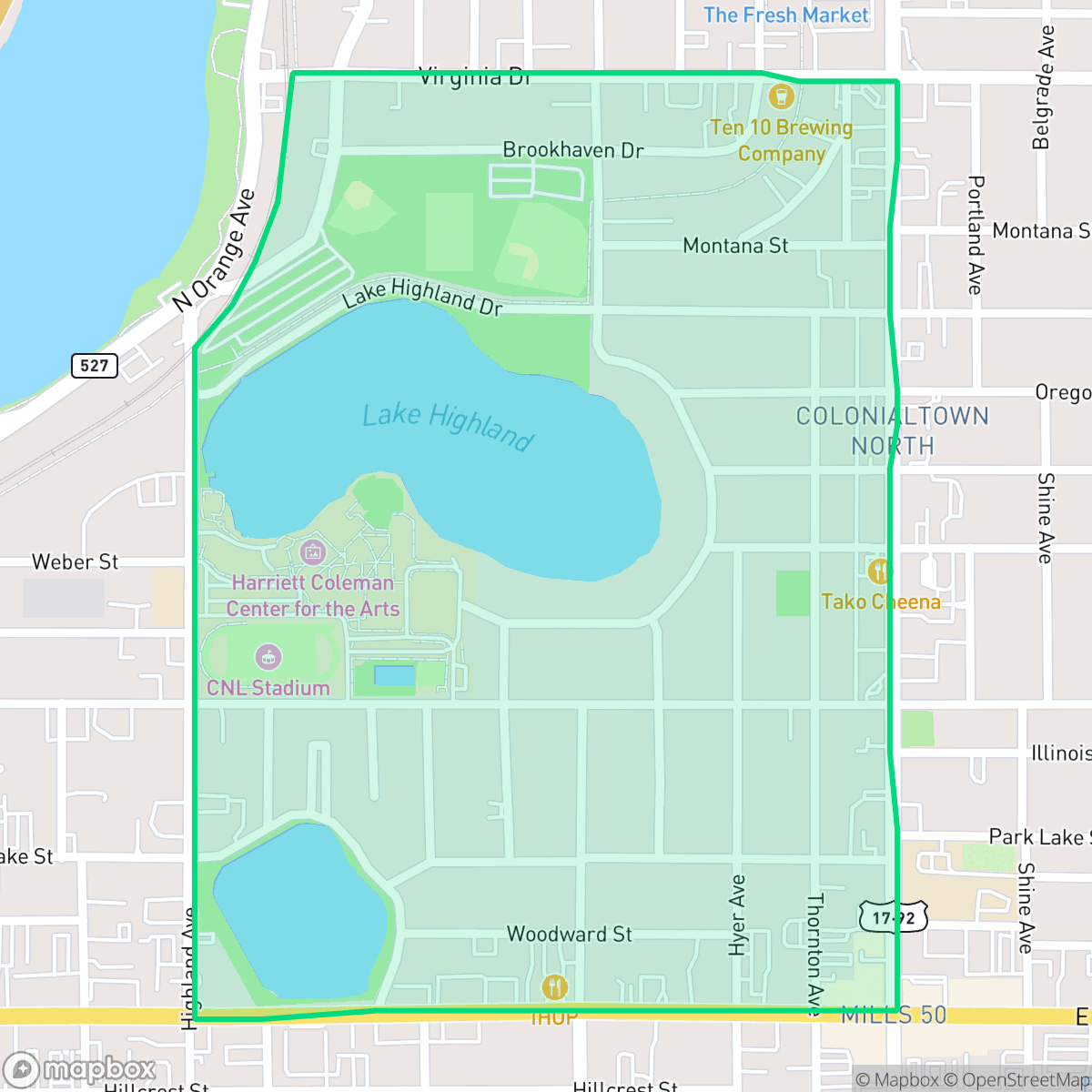
About Park Lake-Highland
Park Lake-Highland, located just north of downtown Orlando, is a historic residential neighborhood defined by its namesake lakes, Park Lake and Lake Highland. The area’s development began in the 1910s, with most plats filed by county surveyor and city engineer Samuel Robinson. Attracting early Orlando businessmen, the neighborhood features a diverse architectural stock, including Craftsman bungalows, Mediterranean Revival, and various Colonial Revival styles. Historically, the area was linked to local industry, notably the Atlantic Brewery, which operated near the lake in the late 1930s and famously touted the purity of the lake's water in its brewing process. Today, the neighborhood is recognized for its mature canopy trees, historic preservation, and proximity to the Orlando Urban Trail, maintaining a distinct, serene residential character amidst the city's surrounding urban expansion.
The neighborhood serves as a distinct residential enclave that blends historic charm with a vibrant social scene. Residents benefit from a semi-rural atmosphere characterized by frequent open land and woodland, which contrasts with the bustling dining and entertainment options found throughout the area. According to iHuus data, the community is defined by its visual polish and upscale landscaping, creating a serene environment that remains highly accessible to the urban core. The area maintains a strong liberal political lean and a diverse age demographic, fostering a community that values both historical preservation and modern connectivity.
While the neighborhood offers significant advantages, prospective residents should consider the trade-offs associated with its central location. The high level of pedestrian connectivity is paired with elevated traffic noise, as the area is situated near major transit routes and flight paths. Families with school-aged children are served by the Orange County School District, which is currently navigating enrollment shifts and facility consolidations while maintaining stable leadership. Despite these considerations, the abundance of green space and high health insurance coverage among residents contribute to a stable and desirable living environment for those seeking a balance of urban convenience and established neighborhood character.
Neighborhood Scores Across 15 Qualities
Residential spacing provides more separation between neighbors than the typical Orlando area. Mixed density creates a balance of open setbacks and some closely positioned structures, according to iHuus data.
Pedestrian connectivity is exceptional due to a well-defined street grid with consistent sidewalks and frequent crosswalks. This level of accessibility for walking errands is significantly higher than the Orlando average, according to iHuus data.
Large homes with private pools and manicured landscapes define the area, offering a level of visual polish that is significantly higher than the Orlando average.
Abundant tree-lined streets and proximity to lakefront parkland provide ample space for pet exercise. According to iHuus data, the area offers much more accessible green space for dogs than the Orlando average.
Frequent open land and scattered homes amid woodland create a more semi-rural atmosphere than most of Orlando. According to iHuus data, this area features a mix of single-family residences and larger commercial blocks that transition between suburban and open landscapes.
Dense clusters of diverse dining, bars, and local landmarks create a bustling atmosphere that is significantly more active than the Orlando average. Residents have access to high walkability and a rich variety of social destinations according to iHuus data.
Frequent noise from nearby transit corridors and flight paths creates a louder environment than the Orlando average. According to iHuus data, residents may experience consistent acoustic disturbances due to the proximity of major roadways.
Air quality levels typically fluctuate between acceptable and unhealthy for sensitive groups. According to iHuus data, these conditions are roughly in line with the average seen across Orlando.
Very little heavy industry exists within this area, which remains significantly cleaner than the Orlando average. Residents may encounter minor traffic noise or light operational hum from nearby small businesses and rail lines, but there are no hazardous industrial facilities present.
Health insurance access among residents is exceptionally high, significantly surpassing the Orlando city average according to iHuus data.
Political leanings in this area are notably more liberal than the Orlando average. Residents will find a community characterized by a significant liberal majority with some moderate opposition.
Residents live alongside a varied mix of young adults, families, and older populations. This demographic spread is more diverse than the average age profile found across Orlando.
Residual flood risks exist within certain areas of the neighborhood due to its location in a 500-year floodplain; however, overall flood safety is notably higher than the Orlando average according to iHuus data.
Address-Level Insights for Park Lake-Highland


iHuus Neighborhood Intelligence Insights
Get address-level neighborhood insights for Park Lake-Highland
- Street-level scores — see how individual blocks compare, not just neighborhood averages
- Micro-zone boundaries — identify quiet pockets, flood boundaries, and walkable clusters before you visit
- 15 dimensions in full — walkability, noise, air quality, school quality, insurance coverage, population age profile, urban/rural index, and more
- Boundary risk alerts — know if your address sits near a block boundary where scores drop, the kind of detail no listing will ever mention
- School insights — individual school ratings and insights, not just district-level data
- Compare before you commit — side-by-side data across neighborhoods, down to block precision
No credit card required
Compare with Any Neighborhood
| Dimension | Park Lake-Highland | 33rd St. Industrial |
|---|---|---|
| 🚶 Walkabilityavg 5.62 | ||
| 🔊 Acoustic Comfortavg 3.33 | ||
| 🤫 Privacy Indexavg 4.6 | ||
| 🎨 Visual Appealavg 5.36 | ||
| 🐕 Dog Friendlinessavg 5.01 | ||
| 🗺️ Urban-Rural Indexavg 5.48 | ||
| ✨ Neighborhood Vibeavg 2.98 | ||
| 🏥 Health Insurance Coverageavg 5.11 | ||
| 🌿 Air Qualityavg 5.87 | ||
| 🏭 Industrial Proximityavg 5.75 | ||
| 🌊 Flood Safetyavg 4.98 | ||
| 🗳️ Ideological Leanavg 5.62 | ||
| 👥 Population Age Profileavg 3.78 | ||
| 🔥 Fire Safety | ||
| 🏫 School Quality |
Park Lake-Highland Rankings
School Districts Serving Park Lake-Highland
School Insights for Park Lake-Highland
Below average outcomes; significant attendance and academic challenges.
School Insights
See what's really behind every school rating near Park Lake-Highland
- Individual school ratings — each school's own score with outcome context, not just a district average
- Enrollment & class size data — student-to-teacher ratio and how it compares to the state average
- Full demographics breakdown — ethnicity and gender composition for every school in the enrollment zone
- Every school in the district — all schools within the enrollment boundary ranked by rating, not just the closest one
- Grade levels & benchmarks — elementary through high school, with below/above state-average flags
No credit card required