Orlando International Airport, Orlando
Updated · 1,076 residents
The Orlando International Airport neighborhood serves as a primary logistics and industrial hub for Central Florida, defined by its massive aviation infrastructure and heavy freight activity. Residents experience a utilitarian environment with high noise levels and limited pedestrian accessibility.
Key Highlights
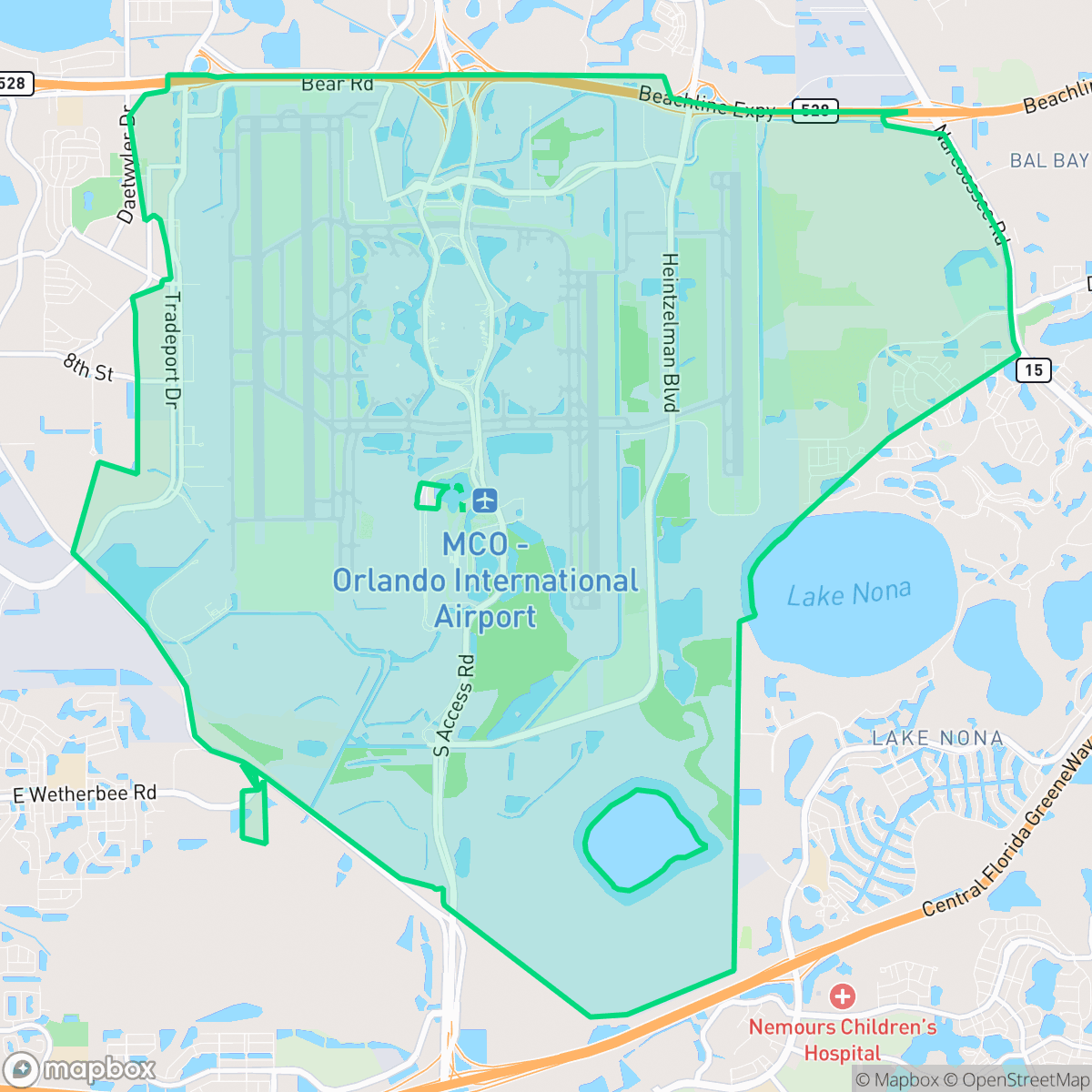
About Orlando International Airport
The Orlando International Airport area was originally established as the McCoy Air Force Base in 1942, named in honor of Colonel Michael N.W. McCoy. During the Cold War, the site served as a vital strategic installation, housing B-52 bombers and supporting significant military operations. Following the base's closure in 1975, the facility underwent a major transformation into a civilian aviation hub, which catalyzed the surrounding region's growth into a logistics and commercial center. While the neighborhood is now primarily defined by its expansive airport infrastructure and industrial parks, the historical transition from a military base to a premier international gateway remains the defining element of its local identity.
This area is dominated by large scale operational facilities and transportation corridors that reflect its role as a regional gateway. The landscape is largely paved and functional, lacking the greenery and recreational spaces found in typical residential communities. Its demographic is primarily composed of young adults, and the built environment features dense, tightly packed structures that offer minimal privacy.
The neighborhood presents significant livability trade-offs, including poor air quality and a high risk of flooding. Due to the prevalence of heavy vehicle traffic and a lack of sidewalks, the area is not conducive to walking or pet ownership. It is best suited for those working within the logistics and aviation sectors who prioritize proximity to transit infrastructure over traditional neighborhood amenities.
Neighborhood Scores Across 15 Qualities
Buildings and structures are positioned in very close quarters with minimal separation between adjacent properties. This level of density offers significantly less seclusion than the Orlando average, according to iHuus data.
Heavy traffic and a lack of sidewalks make navigating the area on foot difficult. Pedestrians are often forced onto road shoulders, making this area significantly less walkable than much of Orlando.
Limited greenery and minimal landscaping characterize the area, which presents a much more utilitarian landscape than the Orlando average. According to iHuus data, the environment consists primarily of dense infrastructure with very little aesthetic or recreational amenity.
Limited greenery and narrow sidewalks make this area poorly suited for pet owners. According to iHuus data, the lack of accessible park space is significantly lower than the Orlando average.
Large-scale infrastructure and transportation facilities dominate the landscape, creating a much more developed environment than the typical Orlando residential area. According to iHuus data, natural greenery is sparse throughout this highly paved region.
Minimal street-level energy and sparse commercial activity characterize this area, which remains significantly quieter than the Orlando average. While some pockets near transit hubs offer dining and hospitality options, much of the neighborhood consists of subdued or rural residential stretches with very few local amenities.
Frequent aircraft activity and proximity to major transit infrastructure result in significant acoustic disturbance. According to iHuus data, noise levels in this area are notably higher than the Orlando city average.
Frequent unhealthy air quality levels pose significant risks to sensitive groups; this area remains substantially worse than the Orlando average according to iHuus data.
Significant airport operations and freight corridors result in much higher levels of industrial activity and heavy vehicle traffic than the Orlando average. According to iHuus data, the area is characterized by constant loading dock activity and large scale operational facilities.
Health insurance access is significantly below the Orlando average, according to iHuus data. Residents in this area face much higher rates of being uninsured compared to most parts of the city.
Voting patterns and census indicators show a predominantly conservative lean, which is significantly more pronounced than the Orlando city average according to iHuus data.
The population consists mainly of young adults with very few children or seniors present. This demographic profile is significantly lower than the Orlando city average, according to iHuus data.
Significant flood risk exists due to the area's location within a designated floodplain, which is much higher than the Orlando average. According to iHuus data, properties in this zone typically require flood insurance.
Address-Level Insights for Orlando International Airport


iHuus Neighborhood Intelligence Insights
Get address-level neighborhood insights for Orlando International Airport
- Street-level scores — see how individual blocks compare, not just neighborhood averages
- Micro-zone boundaries — identify quiet pockets, flood boundaries, and walkable clusters before you visit
- 15 dimensions in full — walkability, noise, air quality, school quality, insurance coverage, population age profile, urban/rural index, and more
- Boundary risk alerts — know if your address sits near a block boundary where scores drop, the kind of detail no listing will ever mention
- School insights — individual school ratings and insights, not just district-level data
- Compare before you commit — side-by-side data across neighborhoods, down to block precision
No credit card required
Compare with Any Neighborhood
| Dimension | Orlando International Airport | 33rd St. Industrial |
|---|---|---|
| 🚶 Walkabilityavg 5.62 | ||
| 🔊 Acoustic Comfortavg 3.33 | ||
| 🤫 Privacy Indexavg 4.6 | ||
| 🎨 Visual Appealavg 5.36 | ||
| 🐕 Dog Friendlinessavg 5.01 | ||
| 🗺️ Urban-Rural Indexavg 5.48 | ||
| ✨ Neighborhood Vibeavg 2.98 | ||
| 🏥 Health Insurance Coverageavg 5.11 | ||
| 🌿 Air Qualityavg 5.87 | ||
| 🏭 Industrial Proximityavg 5.75 | ||
| 🌊 Flood Safetyavg 4.98 | ||
| 🗳️ Ideological Leanavg 5.62 | ||
| 👥 Population Age Profileavg 3.78 | ||
| 🔥 Fire Safety | ||
| 🏫 School Quality |
Orlando International Airport Rankings
School Districts Serving Orlando International Airport
School Insights for Orlando International Airport
Below average outcomes; significant attendance and academic challenges.
School Insights
See what's really behind every school rating near Orlando International Airport
- Individual school ratings — each school's own score with outcome context, not just a district average
- Enrollment & class size data — student-to-teacher ratio and how it compares to the state average
- Full demographics breakdown — ethnicity and gender composition for every school in the enrollment zone
- Every school in the district — all schools within the enrollment boundary ranked by rating, not just the closest one
- Grade levels & benchmarks — elementary through high school, with below/above state-average flags
No credit card required